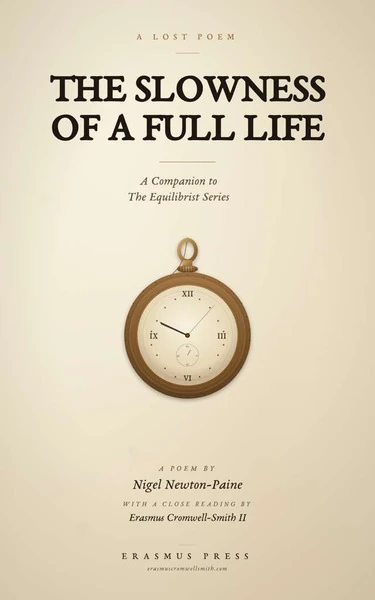
Free novella
The Slowness of a Full Life
This novella is the prelude to The Equilibrist Series.
The Slowness of a Full Life is an essential companion volume to The Equilibrist Series, centering on a long-lost poem recovered from the private papers of the late bookseller and World War II hero, Nigel Newton-Paine (Mr. N.). This volume contains the poem’s full text alongside a profound, multi-dimensional close reading across six lenses written by Erasmus Cromwell-Smith II.

The discovery of the envelope
A fifty-one-year-old secret
The story of the book begins with an extraordinary, almost magical archival discovery. In the late autumn of 2025, Erasmus Cromwell-Smith II returned to Hay-on-Wye, Wales, to finalize his late father’s remaining affairs. During his visit, the new owner of Mr. Nigel’s bookstore — Paine Arts Books and Collectables — requested his assistance in opening a small wooden cabinet that had remained locked and undisturbed in the back of the shop for decades.
Using a key from his father’s keychain, handwritten and labelled “NNP — Hay,” Erasmus II opened the cabinet. Inside, he discovered a flight log, a small framed photograph of a B-17 Flying Fortress crew, and a single sealed envelope postmarked the week before Mr. Nigel’s death. Addressed to his father (E. C.-S., Boston), the envelope had remained completely unopened for fifty-one years. Inside was the manuscript of the poem.
The poem
The metaphysics of time lived
Mr. Nigel’s poem is a profound ontological meditation on the nature of time, designed to fundamentally challenge the modern perception of the clock.
- The core premise
- The poem declares right away that “time is not what passes” but rather “what we fill.” An empty hour simply drains away, whereas an hour lived with passion can hold whole years inside of it.
- The secret of tempo
- It introduces tempo as the vital secret of existence — insisting on “never haste” and “never stagnation.” It posits that the correct pace of life is one where the soul is able to keep up with the body.
- Awareness as the doorway
- It describes awareness as a doorway that transforms time into an inward-opening chest, where memories are gently folded like fine silk and sealed with a name, a place, and a day.
- The eight temporal virtues
- The poem outlines how eight specific virtues perform geometric and gravitational operations to expand time into a new dimension: forgiveness widens it, gratitude lengthens it, coherence binds it, reciprocity returns it, curiosity quickens it, enthusiasm warms it, and Hope and Faith carry it completely beyond its edges until it becomes unending.
- Transformation of being
- Ultimately, if lived well — slowly, warmly, and awake inside the love of others — time ceases to be a resource we spend and instead becomes a thing we are.

The close reading
In six lenses
The Hand
What the poem does on the page
Analyzes the technical composition. It opens with a flat, direct statement — what Erasmus II’s father called the “bookseller’s hammer.” Rather than arguing, Stanza II slows down its line breaks as it lists quiet moments, physically slowing the reader’s eye and making the poem enact its own argument. It identifies “Walk in step with your own life” as the structural joist holding the entire poem together.
The Lineage
Where this poem sits among older voices
Situates Nigel’s work within three distinct traditions: the Welsh bardic line (time as local and ontological rather than psychological); the soldier-poet tradition of the World Wars, reflecting Nigel’s survival of an impossible landing in a bullet-riddled bomber; and the wisdom-literature tradition akin to Marcus Aurelius, using high, compressed aphorisms.
The Triangle
Mapping onto the Happiness Triangle
Maps the poem directly onto his father’s famous Happiness Triangle. Where the classic Triangle is spatial, this poem rotates it through time. It acts as the missing fourth coordinate, proving that living with tempo, awareness, and values dissolves the boundary between the liver and the lived.
The War
What the poem reveals about Nigel
Explores the famously private, guarded nature of Mr. Nigel, whom Erasmus’s father called a “one-way street.” Having nearly lost his life in combat, Nigel avoided looking at time directly, keeping a blood-marked note on his shop wall as a memento mori. This poem was the night he finally allowed himself to face time directly, at the end of his life.
The Reader
What the poem asks of you
Formulates four plain, unsoftened questions for the reader to sit with: What of your hour today is being filled, and what is draining away? At what tempo is your soul keeping up with your body? Which of the eight virtues is widening your time today? And what is currently stored in your inward chest?
The Inheritance
Its place in the canon
Explains how this work completes the entire canopy of the series. Where Hope opens Book I and Joy closes Book III, The Slowness of a Full Life is the third coordinate — the medium of time in which Hope matures into Joy. It closes the triangle of the three booksellers of Hay-on-Wye, giving each a foundational poem: Hope (Mrs. V.’s gift), Joy (the father’s arrival), and Time (Mr. Nigel’s unsent manuscript).
Send me this novella
Leave your name and email and the novella arrives in your inbox.