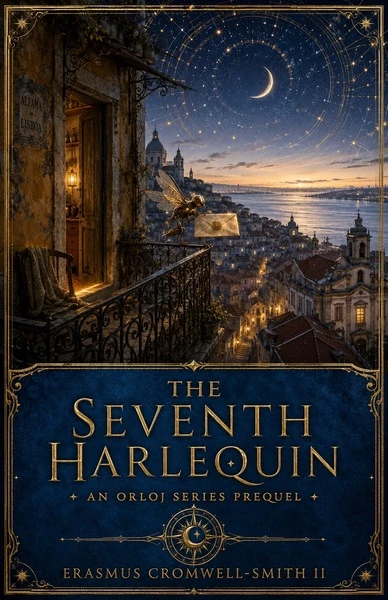
Free novella
The Seventh Harlequin
This novella is the prelude to The Orloj Series.
The prequel novella The Seventh Harlequin, penned by the series’ narrator Erasmus Cromwell-Smith II — known in his youth as “Blunt” — reveals a crucial, forty-year-old secret about the very beginning of the Orloj Saga.
While the master series chronicles the adventures of six chosen guardians across six cities, seven letters actually left the Prague Orloj on that fateful summer solstice night. Six were accepted. The seventh — which has remained unopened in Blunt’s canvas sack for four decades — holds the story of the night the search began, told from the Socratic perspective of the Orloj’s walnut-sized, brass-bodied youngest son, Buggie.
The midnight mandate
The blue country
The story opens on “the last ordinary night” in Prague. At sundown the ancient, six-hundred-year-old Orloj awakens and summons two of his personified clock-hand sons: the majestic, gold-matted Golden Rooster, the Central European Time hand, and the walnut-sized Buggie, the youngest, minute-hand messenger.
The Orloj hands Buggie seven sealed envelopes with no names and no addresses — only the cities written on their faces: Beirut, Mumbai, Shanghai, Pretoria, Barcelona, Boston and Lisboa. He instructs Buggie to read the astronomical dial not as a clock but as a map. Night is “the blue country”, a moving territory half the world wide that sweeps westward around the turning earth. Buggie’s mandate is to enter that moving dark and deliver the invitations.
The letters are penned in night-ink, legible and alive only while the night that made it is still running. If the dawn-border crosses a city before Buggie can slide the letter under its door, the invitation dies instantly and becomes a dead letter. The Orloj warns that these are invitations, not summonses: “The choosing happens on the far side of a door, in the only place a choosing is worth anything, which is inside the one who opens the letter.”
The Starling of Grit
What the gargoyles sent
High above on the cathedral tower, the stone-carved gargoyles plot to sabotage the errand. Bound to their fixed stone, they shed six hundred winters of fine dark dust and blend it with their own shadow to animate the Starling of Grit. The starling is sent as a proxy to hunt Buggie, to steal minutes through friction and contrived weather, and above all to capture the sixth letter — Boston — and carry it east into the morning sun, where its night-ink will be erased forever.

The seven deliveries
And the seven gifts
Equipped with a tiny, gold-needled compass called the aurora-glass, Buggie navigates the moving border of night.
Beirut — Carole
The target balcony is blocked by a massive, one-eared orange cat. Inside, an eleven-year-old girl pads barefoot onto the balcony, hears her parents locked in a bitter, hushed argument, and stops it instantly by naming their true, unvoiced fear with gentle clarity. Waking the house to peace, she glances up and spots Buggie in the dark with a curious, translating frown. Delivered — four minutes lost to a cat and a kitchen war.
Mumbai — Sanjiv
Buggie is caught in a violent monsoon gutter and swept helplessly toward a fatal drainage grate. He is saved by a twelve-year-old boy lying under a corrugated roof, correcting the railway’s monsoon timetables in a private ledger. The boy’s accurate prediction of an early goods train throws up a wave that flings Buggie clear. Delivered — eleven minutes lost drying his gears.
Shanghai — Sang-Chang
With only forty minutes of night left in the east, Buggie is pursued by a greedy harbour gull. On a narrow footbridge a nine-year-old boy — whose gift is the coming back, the understanding that home and away are a single road — throws a loose iron bolt into the river and scares the gull off. Delivered — nineteen minutes to spare.
Pretoria — Winnie
The starling has been seeding headwinds and turbulence, stealing minutes. In Pretoria the house is weather-sealed, with no way in. In desperation Buggie vibrates his wings against the glass, making a tiny rhythmic ringing. It wakes an eleven-year-old choir soprano who hears the finest details of the world. She slides the sash open, recognising that whatever this is, it is telling the truth. Delivered — eleven minutes.
Barcelona — Sofia
Over the Gothic quarter the starling attacks directly, clogging Buggie’s works with dust. He dives through wet laundry strung across the alleyways to wash the grit away, but the starling snatches the Boston letter and flees east toward the sunrise. Stranded on a windowsill with a seized wing-root, Buggie is rescued by a thirteen-year-old clockmaker mending a music box. Working to the rule that broken outranks strange, she cleans and oils his gears with a sable brush and deliberately leaves the scratch on his wing, because the mend that shows is the signature. Delivered.
The ocean chase
The wrong minutes
Holding to the belief that the world is short of the ones who write things down, Buggie chases the starling out over the open ocean at sunrise. The light begins to erase his memories. He dives onto the starling and drives them both into a rising wave; the salt water dissolves the creature of dust. Buggie recovers the Boston envelope and escapes back into the night.
Boston — Blunt
Exhausted and salt-rimmed, Buggie slides the sixth letter under the window of a twelve-year-old boy asleep beside the notebook in which he records the passing of the day. Delivered safely.
The Lisbon balcony
The girl who said no
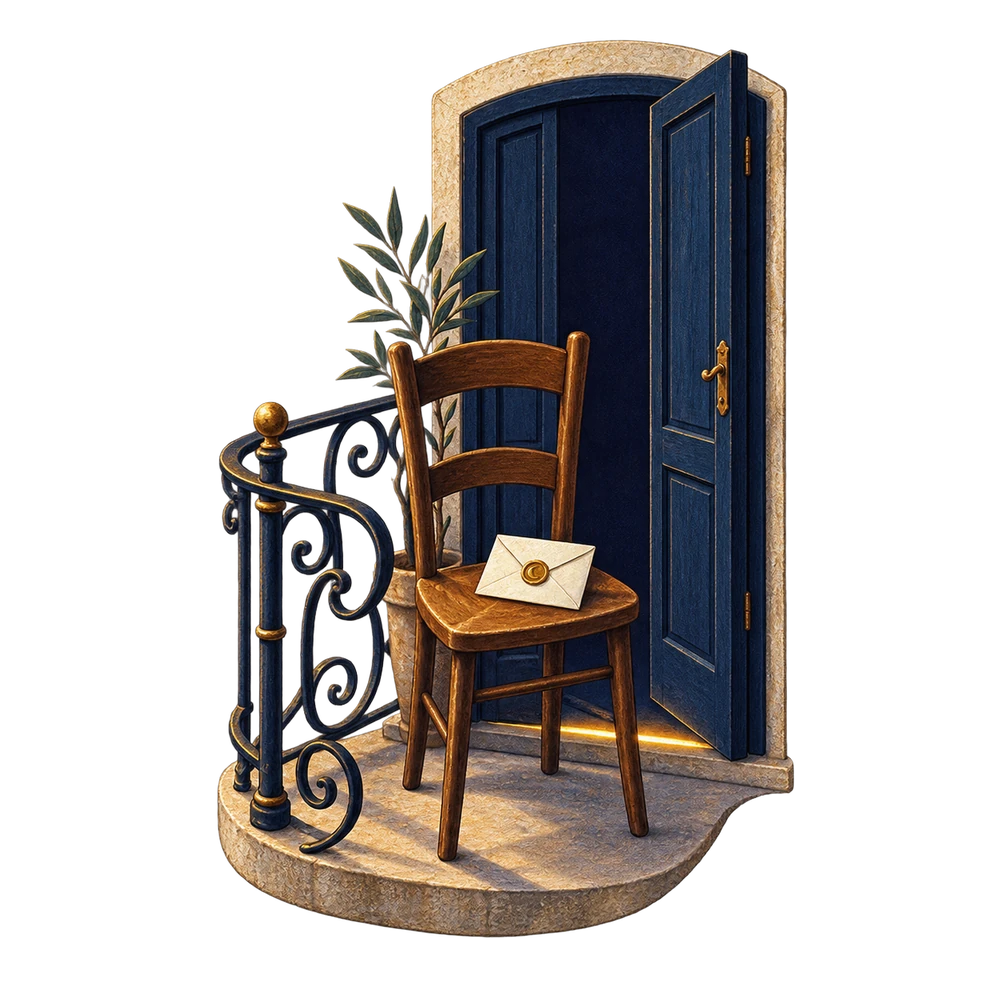
Buggie must fly back east into the rising dawn to deliver the final envelope to Lisboa. On an ochre balcony in the Alfama an eleven-year-old girl is awake, wrapped in a blanket, keeping vigil for a sick relative in the inner room. She reads the invitation twice, looks at the world, and then at the door where she is needed.
With serene certainty she hands the unopened letter back: “Tell it I am needed here. Tell it I said thank you.” Buggie whispers, “It would give you the world,” and she replies, “I know.”
Her refusal is not a tragedy but an honest arithmetic: she has weighed the universe against her duty in that quiet room and found the room heavier. As Buggie flies away, the Orloj runs a gold line of light along her inner doorway sill to salute the choice.
The Rooster’s silence
Four minutes of held morning
Buggie is four minutes late reaching Prague. If the dawn-border overtakes him he will be trapped in daylight and forget his way home. Perched on the tower, the Golden Rooster makes his sacrifice. Every dawn-announcer is minted with a single lawful refusal — a silence that holds back the morning tide at the cost of his own gold. The Rooster holds his throat and refuses to crow for four minutes, delaying the sunrise over Bohemia. Buggie slips inside the works just as the Rooster releases the morning.
The Orloj strikes the first bell four minutes late, and the Rooster’s throat stays permanently grey — a physical receipt of what he spent. In the dark, the Orloj marks the Lisbon envelope kept, not failed, and declares: “A door is not a summons. It is the first law.”
Send me this novella
Leave your name and email and the novella arrives in your inbox.