Current Events
The Choreography
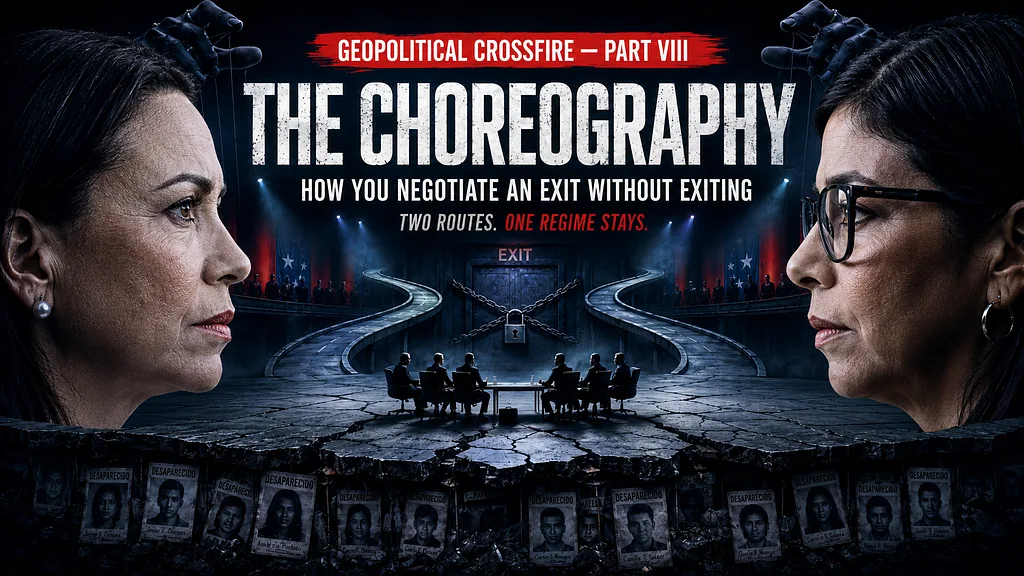
How to negotiate an exit without exiting
GEOPOLITICAL CROSSFIRE — PART VIII
THE COUNTRY UNDER THE RUBBLE — THIRTY-SEVEN DAYS ON
Estefany Landaez has been sitting on the same rubble since July 12. Her two children were in the building behind her when the doublet struck on June 24. The state has told her nothing, because the state has nothing to tell her: it stopped rescuing, in any operational sense, around July 8, and it has never once — not in thirty-seven days of daily televised updates — published a count of the missing. She is not waiting for the state. She is waiting for the WhatsApp group, the volunteer brigade, the citizen platform. She is waiting for her country, which is not the same thing as her government.
Around her, the arithmetic of the catastrophe has hardened into shape. The confirmed dead exceeded 5,600 by month’s end — quadruple the figure Time to Go published on June 27 — climbing at ninety to a hundred and ten per day as recovery teams work the collapsed structures of La Guaira, where roughly eighty percent of the building stock is damaged, and the five other afflicted states. Jorge Rodríguez repeats, at each update, that the count is not final. On this one point, he is telling the truth. The USGS PAGER model has never retracted its projection of a final toll between ten thousand and beyond one hundred thousand. An independent Swiss search-and-rescue expert, speaking anonymously to AFP, rendered the professional judgment that most of the 31,000 to 50,000 listed as missing at the two-week mark are already dead. Between the state’s certified figure and the rescuer’s operational assessment lies the truth the state will not certify: at least six of every ten people this earthquake killed have not been counted by the government that ruled them.
The refusal to count is not an oversight. It is the single most consequential documentary decision the interim government has made, and it is policy. The Foreign Ministry’s June 27 update quietly acknowledged 68,900 missing before the number vanished from official communications forever. The citizen platform Desaparecidos Terremoto Venezuela — built by volunteers in forty-eight hours — has processed 72,300 reports and located 9,800 of them, undercounting all the while, because it can only register the families who have phones, connectivity, and someone left alive to file. The U.N. Resident Coordinator warned publicly that the real figure is higher than anything communicated, and the U.N. quietly bought ten thousand body bags, a procurement whose implicit floor speaks louder than any communiqué. Certifying 72,300 missing would place the operational death floor near thirty thousand, rank June 24 among the deadliest disasters in Latin American history, and hang the largest peacetime civilian death toll in Venezuelan history around the neck of a government six months old. These are numbers the state will not certify because their certification collapses the choreography. The missing are the choreography’s first constituency: they cannot attend the August 1 dialogue, cannot ratify the December deliverable, cannot vote in whatever elections eventually get scheduled or don’t. They are the electorate the choreography was designed to survive.
The living toll carries its own subtexts. Of 39,567 injured — 16,740 severely — the tertiary hospitals of Caracas are still operating in triage mode, their waiting lists for reconstructive surgery extending into 2027, their emergency amputations now producing complications no ward can absorb, their Cuban staffing quietly drained away by a G2 recall that began in February and whose meaning this article will return to. Of 6,462 rescued alive, the state’s own share — documented by AFP and Reuters correspondents on the ground — was roughly one in five. The other four in five were pulled out by the citizen army: the Colombian, Mexican, Salvadoran, Spanish, Turkish, and American USAR teams, and above all the Venezuelan volunteers — the WhatsApp networks, the comanditos of Vente Venezuela, the Fuerza Vecinal municipal teams of Chacao, Baruta, and El Hatillo, the aviation community of Maiquetía — the same volunteers the state ordered to register at the Poliedro. Of 128,324 families receiving aid, roughly a third receive it through the CLAP system, which is to say through the carnet de la patria, which is to say through the political-control instrument the regime has operated since 2016; the rest are fed by Caritas, the World Food Programme, chef José Andrés’s kitchens — 3.2 million meals and counting — and the diaspora’s remittances flowing through Zelle and Binance into La Guaira. The state is not the country’s lifeline. It is one channel among nine.
And beneath the shelters’ official census of 23,122 lies the uncounted nation: a quarter million to four hundred thousand sleeping in plazas because they trust the open sky more than any structural certification the state might issue; eighty thousand families relocated inland to Barinas and Zulia; thirty-two to forty-five thousand already across the borders into Colombia and Brazil. The state does not know how many Venezuelans have moved. It has not attempted to count.
Then there is the number that converts grief into evidence. The state acknowledges 383 structural collapses. NASA satellite-imagery analysis, released in the last week of July, counts approximately 59,000 damaged buildings across the six states — a factor of 154 between what the satellites see and what the state admits. This is not methodological disagreement. It is intent, quantified. And within the 383 the state does admit, the forensic geography tells the story Part VII first named: roughly 54 percent of confirmed collapses are buildings of the Gran Misión Vivienda Venezuela cohort, 2011–2017 — the towers of Catia La Mar, the Urbanismo Hugo Chávez, the San Bernardino blocks — built in the very years when Venezuela’s seismic code was strictest on paper and least enforced in practice, because the materials budgeted for their construction were stolen. Transparencia Venezuela documented $76 billion in unaccounted GMVV expenditure through 2017. Alex Saab’s Fondo Global de Construcción was paid $159 million for materials and delivered $3 million. The 207 collapsed GMVV buildings are that theft, expressed in reinforced concrete and body bags. Saab’s federal cooperation file — unsealed in Miami on May 18 — is expected to yield the names of the inspectors, contractors, and ministers who signed each structural certification. Each name corresponds to specific bodies under specific slabs at specific addresses. The GMVV collapses will produce the second largest civil accountability case in the history of the U.S. federal courts, behind only the Boeing 737 MAX litigation. Hold that thought. It is not a digression. It is the hinge of this article.
The children carry the ledger’s cruelest lines. Yenderlin Cabarza — thirteen, both arms broken, orphaned, admitted to Hospital Domingo Luciani with adhesive tape on her arm because she could not speak her own name — was discharged on July 15 into the care of her father and an aunt in Petare, her surgical fixators still on, her school no longer existing, her father’s warehouse and inventory gone, his income zero. Of the twenty-two children admitted alone in the first seventy-two hours, three have been reunited with family and one has died: Isabela, six years old, of crush complications the overwhelmed hospital could not treat; her father arrived from Valencia on July 3 to identify her body. Across the hospital system, Cecodap and the Venezuelan Pediatric Society count roughly 1,850 minors orphaned or separated, 340 to 410 still unconnected to any relative, a state child-protection agency staffed at 22 percent of its 2010 level, 240 orphanage spaces against a waiting list of 700, and at least fourteen documented cases of children informally placed with adults who have no prior relationship to them — a practice that triggers protective intervention in every functioning country and triggers nothing here. And in a DGCIM cell that the earthquake never touched, Samantha Sofía Hernández Castillo, sixteen, reached day 249 of her detention. Her hearing has been deferred a seventh time. She is not in the rubble. She is not in the choreography. She is not on any list the choreography has produced.
The bill, meanwhile, has been quantified and will not be paid. The World Bank’s July 25 assessment: $19.6 billion in direct damages. The U.N.’s: $37 billion in aggregate reconstruction need. The working consensus: $52 to $88 billion. Against it, the world has mobilized approximately $953 million — Rodríguez’s $200 million fund, a fraction of the American pledge, an IMF reserve tranche, European and Gulf gestures. The gap runs from $18.6 billion to $86 billion, and no source in motion approaches it. The families of the 4,200 buildings that must be condemned will receive, on current trajectory, nothing. They will be absorbed by relatives, by remittances redirected from productive uses to survival, by the plaza settlements becoming the permanent architecture of the Caracas periphery. The choreography of August is being staged on the explicit understanding that the bill will not be paid — and, as Part VII’s protocol analysis predicted and thirty-seven days of outcome data now confirm, on a floor of 3,500 to 7,300 preventable deaths: the failed extractions of the first seventy-two hours, the post-rescue deaths in wards that hospitals in Turkey or Chile would have prevented, the shelter deaths from waterborne illness the state does not attribute to the earthquake at all. The clock of preventable death did not stop when the political clock started. Every day of the ceremony is a day of that count still accruing.
The earthquake has not ended. What has ended is the state’s capacity to convincingly claim it is responding.
THE PROTOCOL THAT STAYED
Time to Go diagnosed the seventy-two-hour architecture — the Havana protocol: suppress information, restrict movement, deploy the military against crowds rather than rubble, theatricalize the leader, eliminate opposition voices, recharacterize citizen organization as subversion. Thirty-seven days on, the protocol has not been retired. It has been institutionalized, and its institutionalization is the regime’s answer to every address Part VII delivered.
The information suppression has been formalized into doctrine. Asked directly by a French reporter whether a missing-persons figure would ever be released, Jorge Rodríguez answered that the missing are “an administrative category when search operations conclude — we are still rescuing.” The claim is operationally false — rescue became recovery weeks ago — and rhetorically perfect: a refusal recharacterized as patience. The X-platform blackout of the first hours, lifted under U.N. pressure, was replaced by something subtler — algorithmic throttling of #TerremotoVenezuela and #DesaparecidosVenezuela, documented by Access Now and NetBlocks at reach reductions of 60 to 85 percent, bearing the technical fingerprints of the Cuban G2’s long-documented management of Venezuelan digital discourse. The population’s capacity to organize around its missing was surgically reduced without a single announced act of censorship.
The movement restriction evolved the same way. The Poliedro registration requirement was formally lifted on July 4 and functionally replaced by a military checkpoint system on the Caracas-La Guaira highway — identity verification, cargo inspection, and, per EFE and AFP correspondents, political vetting against SEBIN databases. Volunteer flow fell by roughly forty percent. Not by law; by friction. Three comandito organizers were detained 72 to 96 hours for “political proselytism in a context of emergency,” released without charge, their vehicles held, their supplies confiscated. The message was operational, not judicial. The 14,000 uniformed personnel Cabello announced would help are now a standing containment perimeter around the plaza encampments: on July 12 — the day Estefany Landaez sat down on her rubble — Reuters photographed 1,200 Guardia Nacional troops in full riot formation at three plaza checkpoints in Catia La Mar, captioned as deployed “as families protest slow aid delivery.” The photograph reads as a policing operation because it is one.
The theater continued on schedule. Delcy Rodríguez has visited La Guaira three times in thirty-seven days, each visit identical — three-hour advance perimeter, six-vehicle motorcade, one hour on the ground, state cameras only, scripted unity — and the third, on July 15, synchronized to the hour with the announcement of the August 1 dialogue, so that the visit legitimated the choreography and the choreography legitimated the visit on the same evening’s cadena. Meanwhile the most operationally competent opposition officials in the country — the mayors of Chacao, Baruta, and El Hatillo, whose teams pulled survivors from the Petunia while the state cordoned streets — have been repaid with three SENIAT tax audits, a Contraloría investigation into Chacao’s post-earthquake procurement (no equivalent inquiry has been opened into Rodríguez’s reconstruction fund), and CORPOELEC’s refusal to restore power to three damaged sectors. And on July 20, Jorge Rodríguez asked citizens to channel their solidarity “through official state authorities, rather than through unregulated private initiatives that carry political motivations” — the Poliedro logic of Day 3, transposed to a permanent timeline. The choreography requires that the citizen response of June and July be retrospectively recharacterized as illegitimate political mobilization. The recharacterization has begun.
This is what any real transition would have to dismantle. It cannot be reformed; it can only be replaced — its architects removed, its files opened, its command structure prosecuted. Keep that standard in view. It is the measure against which everything that follows must be read.
READING THE CHOREOGRAPHERS
Now the ceremony itself — and the harder question beneath it.
The public sequence is quickly told. On June 18, Dinorah Figuera — physician and Primero Justicia lawmaker from Aragua, sixty-five, eight years in Spanish exile after fleeing through the French embassy, president of the 2015 National Assembly since January 2023 — returned to Caracas at the invitation of the U.S. State Department, coordinated by Assistant Secretary Michael Kozak, and met Jorge Rodríguez at Miraflores within hours of landing. They agreed to a joint technical and political working group on the reconstruction of the National Electoral Council, deliverable December 2026, “a dynamic objective that could be extended.” On June 26 and June 30, Machado’s two return attempts were blocked — the first turned around mid-air by U.S. officials, the second stranded by closed Venezuelan airspace and a Copa Airlines refusal. On July 14, Machado and Edmundo González convened the party leaders virtually and endorsed the AN 2015 roadmap while preserving her separate track. On July 15, the working agenda was announced. On July 20, in a compressed twenty-four hours: Rubio told reporters the parties had agreed on “a format and a forum not just for reconciliation talks but to begin the transition process”; Bernie Moreno floated Bolívar’s birthday 2027 on X; a Brooklyn federal court entered a $314 million default judgment against Maduro; and the Trump administration filed its letter arguing head-of-state immunity for Delcy Rodríguez. By July 27, Caracas Chronicles had described the coming delegations — twelve a side — as “like nothing we have ever seen, in terms of the US operating as an all-powerful actor wielding immense coercive capacity and veto power,” with the opposition delegates “expected to serve more as liaisons in constant communication with the Department of State… than as fully-empowered negotiators.” By July 30, the count was in: this is Venezuela’s ninth government-opposition dialogue in twelve years — after Santo Domingo, the Vatican, Oslo, Barbados twice, Mexico City twice, and the 2024–26 tracks — a process whose statistical record across twelve years is one hundred percent failure to deliver democracy and one hundred percent success at extending the chavista structure through the negotiation window. The word election does not appear in the August 1 agenda.
Read on the surface, this is a machine for going nowhere: Rubio controls the tempo through a three-phase plan whose first two phases have expandable durations; Figuera supplies the opposition-legitimacy signature; Rodríguez supplies operational continuity; the electoral horizon floats unanchored. That is the surface reading, and every fact in it stands.
But there is a second reading, and honesty requires laying it out with equal rigor — because the identity of the choreographers is not incidental to the choreography.
Marco Rubio is the first son of the Miami Cuban exile community to hold the second most powerful position in the United States government. That sentence carries more analytical weight than any State Department communiqué. His parents left Cuba in 1956; he was formed in West Miami, inside a community whose entire post-1961 political identity is organized around one unfinished piece of business. He was confirmed 99–0 — more bipartisan capital than any modern Secretary of State — and on the Venezuela file the intelligence community is not his rival but his instrument: the hemisphere’s covert and diplomatic tracks run through his office. No man of that biography, in that chair, at this moment, passes on his one chance at the account his community has kept open for sixty-five years. And the ledger of that account runs through Caracas. Cuba has survived since 1991 on a sequence of external lungs — Soviet subsidies, then Venezuelan oil, then Venezuelan remittances and services. Cut Venezuela out of the stack, and Havana faces the choice East Berlin faced in 1989. The quiet withdrawal of the Cuban G2 from the DGCIM since February — the least-covered and most consequential development of this entire year — is not atmosphere. It is the sound of the forward operating base being evacuated before the position falls.
And the President is not thinking about this file in barrels. He has called the January 3 operation historic in his own vocabulary of legacy; he positions himself, explicitly, as the president who ended communism in the Western Hemisphere. The commercial thread — the oil, the licenses — is real, and it is also the smaller thread. A man thinking about how history will carve him does not trade the fall of Havana for a production quota. Which means the two men who control the file — the President on money, through OFAC and every license PDVSA’s revenue passes through, and the Secretary on strategy, through every diplomatic and intelligence channel in the hemisphere — are aligned on the same terminal objective for different reasons: one for his community, one for his monument.
Under that reading, the choreography changes character without changing a single fact. The immunity brief is not permanent protection for Delcy Rodríguez; it is a stall — a tool to keep her cooperative and the courts at bay while the accountability architecture matures out of sight: the Saab cooperation file producing names, the Brooklyn discovery process compounding, the G2 evacuating. The open electoral calendar is not resignation; it is operational discipline — you do not let a regime fortify itself around a known deadline. Even the containment of Machado acquires a tactical logic: her return, now, would either trigger an uncontrolled confrontation before the legal predicate is ready, or hand the regime a visible enemy to consolidate against. Held in reserve, she is the piece you play when the board is set. The choreography, in this reading, is not the endgame. It is the anesthesia.
The domestic Republican noise fits the same frame. Rick Scott’s rupture — “Delcy Rodríguez is NOT the president of Venezuela, she’s the head of a cartel” — and Moreno’s floated Bolívar date are not evidence of a coalition at war with itself over the destination. Scott, Moreno, Machado, and the diaspora want the accountability outcome and the Cuban endgame; so, on this reading, do the two men running the file. What divides them is tempo, and tempo is a real dispute — the Florida, Texas, Arizona, and Nevada diaspora vote that anchors the Senate majority has been receiving the maternal feed since May, and its patience prices in daily — but a sequencing debate inside an aligned coalition is a fundamentally more stable political structure than the fracture the surface reading suggests.
The article does not adjudicate between the two readings, because the evidence as of July 31 genuinely supports both. What the article can do is name the test that will separate them — and the test is not rhetorical. If the choreography is the anesthesia, then the accountability chain must keep moving underneath it: the Cabello indictment must materialize, the Saab file must surface names, the Gayles ruling and the OFAC decision must be used as levers rather than surrendered as concessions. If the choreography is the endgame, those things will quietly not happen. The distinction will be visible, and datable, by October. Everything in the remainder of this article is organized around that test.
One more thing must be said before proceeding, and it belongs to the moral register that no strategic reading is permitted to dissolve. Whichever reading is true, the people paying for the anesthesia were not consulted about the operation. The five thousand six hundred dead did not agree to be the setup phase of anything. Samantha Hernández’s 249 days are not a holding pattern to her. If the strategic reading is right, its authors owe the country the endgame — soon, and in full. If it is wrong, they owe the country an apology history will not accept.
TWO ROUTES, TWO WOMEN
The choreography runs on two tracks, and each has a woman’s name on it.
Track One is Figuera. She was chosen with precision: not Guaidó — no youth, no populist vector, no international celebrity — but an older physician-lawyer carrying the constitutional legitimacy of the last democratically elected Venezuelan legislature, able to speak the vocabulary of institutional dialogue without the vocabulary of mass mobilization. Her June 18 return was executed in under twelve hours — State Department protection, Kozak invitation, Maiquetía arrival, Miraflores meeting, joint statement — a sequence whose message was unmistakable: this is what a managed opposition looks like. Her track’s substance, the CNE reconstruction, is genuine as a technical objective and deferred as a political timeline, and between the technical and the political is exactly where the choreography does its work. Her paradox is that she knows all of this. She accepted the role because refusing the State Department, in the country’s darkest month, would have read as intransigence — and she cannot name the role she is playing, because the moment she names it, the choreography ends and Cabello wins. What she can do — the one power the legitimating instrument always retains — is set the price of her signature. More on that in the Second Call.
Track Two is Machado. Nobel laureate, disqualified until 2036 by a regime she defeated at the ballot box, in Washington exile since December, mother of three, winner of the 2023 primary with 92 percent. Her Panama Agreement of May 23 assumed American support for a Q4 return and an early-2027 electoral horizon; the first has been revoked in practice, the second remains unanchored. She tried twice in June and was blocked twice — once by her ally, once by her enemy, a symmetry that tells its own story. And on July 28, the second anniversary of the mandate — the day 7.5 million Venezuelans voted for the candidate her movement carried — Vente Venezuela’s call for assemblies in all 335 municipalities produced approximately three hundred people at one shopping center in Chacao, addressed by their leader on a recorded video from Washington, while a chavista counter-protest formed a block away. Three hundred, against seven and a half million. That ratio is what the choreography has already cost, measured in the only currency that ultimately matters — the street — before the first dialogue session has even convened.
On the surface reading, she has been demoted from candidate to symbol, and her absence has become the regime’s principal rhetorical asset. On the strategic reading, she is the reserve — the piece held back until the accountability predicate is set, because deployed prematurely she triggers either an uncontrolled Model 6 or a regime consolidation, and deployed at the right moment she completes the constellation. Both readings agree on one thing, and it is the thing the July 28 plaza made undeniable: the reserve is a wasting asset. Movements are not batteries; they do not hold charge indefinitely. Every month of deferral converts mobilization capacity into memory. Whoever is holding her back — if anyone is holding her back for a reason — is spending something that cannot be reprinted.
Both women are being deployed. Neither is being empowered. The last independent actor on the opposition side, Edmundo González, watches from Madrid in a silence that is not his own: he has simply not been given anything to say.
THE EXIT MODELS, REWEIGHTED
The Case for Venezuela, on January 11, set the doctrine on Diosdado Cabello in four words: extracted or terminated. Six months later he sits in his office at Interior, a $25 million American bounty on his head, receiving American military officers for coffee. The exit is now being modeled by the regime itself, and the models have shifted weight over thirty-seven days.
The Delcy slow-walk remains the operating template — an unelected head of state with American recognition, a cabinet intact, cosmetic compliance calibrated, in former Ambassador James Story’s phrase, to be “just enough to make it look as if they’re complying,” betting that Washington’s attention dissolves into the midterms. The August 1 dialogue is this model’s formal expression, and an agenda in which the word election does not appear has reinforced it. The Cabello hold-out runs inside it as the fulcrum: a man with no incentive to leave and two doors — a negotiated exile in Havana or Moscow, or outlasting the administration — whose real deadlines are not in any communiqué but in two dockets: the OFAC waiver expiration of October 23 and the Gayles immunity ruling due in the same window. The Padrino template has already executed once — a hardliner quietly rotated out on March 18, replaced by another sanctioned figure Washington nominally opposes and functionally accepts — and will be offered to others; Cabello will not take it. The Pinochet exit, which the founding piece held open, is dead: that path belonged to a general who had won a plebiscite and could claim an economy, and no consequence-bearing ultimatum has been placed on the table to force a lesser man onto it. The Milošević/Noriega extraction remains the fallback, low probability, not zero, and rising as October approaches.
And underneath all of them runs the sleeper: the G2 withdrawal. The Cuban advisers leaving the DGCIM, the medical brigades flown home, the counterintelligence lattice that coup-proofed chavismo for twenty years being rolled up strand by strand since February. On the surface reading, it is Havana cutting losses. On the strategic reading, it is the load-bearing wall being removed before demolition — because a chavista structure without Cuban counterintelligence is, for the first time in a generation, a structure that can crack from inside. Whichever reading holds, the operational fact is identical: the thing that made the regime unbreakable is leaving the building.
None of these models, in itself, produces democratic legitimacy. The choreography’s continuity requires Cabello to stay; the transition’s legitimacy requires him to leave; and the resolution of that contradiction is not a matter of models. It is a matter of courtrooms — which is where this article now goes, because the courtroom is where the two readings of the choreography will be forced to declare themselves.
THE COURTROOM AS INSTRUMENT
While the choreography assembled itself in Miraflores and Foggy Bottom, the accountability chain was building in three jurisdictions, on calendars no diplomat controls.
On June 30, the Guernica 37 Centre filed a forty-four-page civil action in the Eastern District of New York on behalf of five families, under the Torture Victim Protection Act, alleging that Nicolás Maduro personally ordered the FAES extrajudicial-execution program — more than 1,300 killings documented between 2017 and 2020 by the U.N., Human Rights Watch, and the State Department. Maduro will claim head-of-state immunity; he will lose at trial court; he will appeal for years; and during those years, discovery will do what discovery does: produce documents, and documents name ministers. On July 20, a Brooklyn court entered a $314 million default judgment for three American citizens the regime had held — Kenemore, Saad, Marval — under the Anti-Terrorism Act and RICO. The same day, the administration filed its letter urging head-of-state immunity for Delcy Rodríguez in the pending civil litigation; Politifact subsequently confirmed the filing had been coordinated with a State Department intervention in June — two filings, one executive-branch policy, sustained across months. In Buenos Aires, federal judge Sebastián Ramos ordered the translation of an extradition request for Maduro under Argentina’s universal-jurisdiction statute — a third front, on a judiciary that answers to no American political calendar at all.
The immunity architecture is the most consequential legal development of the thirty-seven days, and it is the exact point where the two readings of the choreography diverge into testable predictions. On the surface reading, the brief is what it appears to be: the United States government placing its shield in front of the entire chavista structure, a policy statement that every future TVPA defendant will cite. On the strategic reading, it is a leash — protection extended precisely because it can be withdrawn, keeping Rodríguez compliant through the transition’s fragile phase while the Saab file matures and the Brooklyn discovery compounds beneath her. Judge Darrin P. Gayles of the Southern District of Florida will rule within roughly ninety days, which lands the ruling in the same news cycle as the October 23 OFAC expiration. If the brief is upheld and the waiver renewed with nothing demanded in return, the surface reading wins and the shield was a shield. If either lever is pulled — immunity denied, or renewal priced in accountability milestones — the strategic reading wins and the stall was a stall.
Meanwhile the criminal track grinds forward on its own gears: Maduro’s Manhattan narcotics trial in the first half of 2027, the Saab cooperation file yielding the GMVV certification chain — the inspectors, contractors, and ministers whose signatures sit above the 207 collapsed buildings and the bodies inside them. The reloj of the accountability chain is federal-court docketing, and federal judges are not on anyone’s three-phase plan. When the diplomatic clock and the docket collide, the docket governs. The only question the choreographers control is whether they are riding that collision or bracing against it.
THE PRICE OF FORGETTING — WHAT THE HISPANIC LEDGER SHOWS
Here the article must widen its lens, because the decision now forming in Washington and Caracas — how much accountability a “peaceful transition” can carry — has been run as an experiment thirteen times in the Ibero-American world in the last fifty years, and the results are not ambiguous.
Begin with the successes, because they destroy the false dichotomy first. Poland’s Round Table preserved the party through a transitional presidency — and then put General Kiszczak, the interior minister who signed the martial-law order, on trial; Jaruzelski himself was under indictment when he died. Czechoslovakia’s Velvet transition was followed by the formal declaration of the communist regime’s illegality, the imprisonment of the Prague party boss who ordered the November 17 police deployment, and lustration of the StB. Unified Germany prosecuted Honecker, imprisoned Mielke, and ran the Mauerschützen trials through the nineties — roughly a hundred thousand investigations, some 750 convictions concentrated at command level. And Venezuela’s own Punto Fijo — the country’s founding democratic pact — extradited Pérez Jiménez from the United States and put him in prison, while trying his secret-police chief in absentia. Every one of these transitions was peaceful. Every one prosecuted the security architects. The historical record does not contain a tension between negotiated handover and accountability at the top. It contains a package.
Now the failures, and their invoice. Spain bought its transition with the Pacto del Olvido — no trials, no truth commission, no lustration — and within five years the PSOE governed with an absolute majority; the Francoist security and economic personnel rotated intact into the new state; the GAL death squads operated under a socialist government; and the question Spain refused to adjudicate in 1977 is still tearing at it five decades later, with the ideological heirs of the amnestied now governing in coalition with a party whose founders cite Venezuelan chavismo as intellectual lineage. Brazil’s 1979 amnesty shielded every officer of the dictatorship; the Truth Commission that finally named 377 perpetrators in 2014 could prosecute none of them; and the political force that inherited the unpurged state machinery has governed for most of the last quarter century, its leader convicted of industrial-scale corruption and returned to office when the same unreformed judiciary annulled the conviction on procedure. Argentina’s pardons were followed by the Kirchnerist reconstruction of the extractive state. Chile’s transitional immunities were pierced only decades later, from abroad. El Salvador, Guatemala, Honduras — the whole Central American peace architecture of the nineties traded prosecution for signature, and every one of those states is today captured, oscillating, or authoritarian.
And then there is the anchor case, the one that should be printed and taped to the wall of the August 1 dialogue room. Nicaragua, 1990. Daniel Ortega lost an election and handed over power peacefully — the model transition, celebrated worldwide, a Nobel in its orbit. The price of the peace was total: no prosecution of anyone, the Sandinista piñata of state assets allowed to stand, the party’s grip on army and police left untouched. Ortega went into opposition with his machinery intact — and came back sixteen years later, with 38 percent of a fragmented vote, and never left: the electoral council captured by 2011, term limits abolished by 2014, 325 protesters dead in 2018, every credible candidate jailed by 2021, 316 dissidents stripped of citizenship and expelled stateless by 2023, and today a hereditary dictatorship — his wife co-president — that has outlasted and out-brutalized the Somoza dynasty it replaced. The 1990 transition without accountability did not merely fail. It manufactured, on a thirty-five-year fuse, something worse than what it removed.
The mechanism is not mysterious, and it is not culture. Impunity is a personnel-continuity device. The unprosecuted security service does not retire; it rotates. The unconfiscated clientelist machinery does not rust; it waits. Every subsequent populist inherits, ready-built, the extractive apparatus the transition declined to dismantle — the distribution lists, the surveillance files, the enterprise networks, the habits of a captured judiciary. The comparative development data says the rest: the post-communist states that prosecuted their architects — Poland, Czechia, the eastern German states — carry middle-class shares near or above seventy percent; the Ibero-American states that amnestied theirs cluster decades behind; and the single Hispanic country that reopened its amnesty and prosecuted its dictatorship’s officers — Uruguay — is, not coincidentally, the region’s quiet champion in middle-class share, institutional strength, and four decades of unbroken democracy. Uruguay is the Hispanic Poland. It proves the pattern is a choice, not a destiny.
Now apply the ledger to Venezuela, 2026. A transition that leaves the CLAP lists, the carnet de la patria, the FANB enterprise network, the SEBIN files, the DGCIM command structure, and the PDVSA revenue capture intact — that amnesties the architects and calls it reconciliation — is not a transition. It is a deferral, on the Nicaraguan schedule. Run the fuse: a chavista successor movement, under new branding, returning circa 2040–2045 to a country where the earthquake destroyed the savings, homes, and employment base of the very population the clientelist machinery was built to capture — a population more dependent, more desperate, and more captureable than the one Ortega found waiting for him in 2006. The revival case would find fertile ground faster in post-earthquake Venezuela than it found in Nicaragua. The window in which accountability can dismantle the machinery is not a generation wide. It may be two or three years wide. It may be exactly as wide as the choreography.
And this is where the strategic reading of Section III and the moral demand of the mothers converge into a single proposition, which is the thesis of this article: accountability is not the obstacle to the choreographers’ objective. It is the mechanism of it. Every Venezuelan prosecution — every DGCIM order entered into evidence, every GMVV certification traced, every Brooklyn discovery production — documents the Cuban G2’s command relationships inside the Venezuelan repression, and builds, case by case, the evidentiary predicate that reaches across the Straits of Florida. The trials that give the mothers their answer are the same trials that give the Secretary his endgame and the President his monument. There is no fork in this road. There is one road, and it runs through the courtroom — or it runs, sixteen years from now, back through Miraflores.
THE CASE FOR VENEZUELA, MEASURED HONESTLY
Thirteen days after the January 3 operation, the founding piece of this series laid out a vision: a country of creators, not caudillos; a second republic, deliberate, inclusive, export-minded, resilient; Poland and Spain and the Marshall Plan as templates; Mandelstam and Seneca as spine — cease to hope, and you will cease to fear. Six months and twenty days later, the honest audit is neither a celebration nor a uniform indictment. It is a ledger with three columns.
On path, if the strategic reading holds: The accountability predicate is materially further along than any public commentary acknowledges — the Saab cooperation file unsealed and producing, the Brooklyn discovery engine running, a $314 million judgment entered, three legal fronts converging, the Manhattan trial docketed for 2027. The G2 withdrawal — the founding piece’s precondition for any real transition, since no Venezuelan settlement survives with Cuban counterintelligence embedded in it — is actually happening, quietly, monthly. The oil leverage over the interim government is total and held in one hand. And the two most powerful men in American foreign policy are, for reasons of biography and legacy respectively, personally invested in the terminal objective in a way no prior administration has been.
Deferred, at compounding cost: The Marshall Plan — the founding piece’s $20 to $50 billion conditioned on judicial independence — stands at $953 million, unconditioned; the reconstruction bill will not be paid, and the population is absorbing the difference in plazas and border crossings. The diaspora bonds, the sovereign fund, the “Venezuela Return” — none built; the diaspora’s capital is flowing, but as survival remittance, consumed rather than invested. Machado’s return — the founding piece’s first freely elected president of the new era — deferred twice by force and once by discretion, while the mobilization it would anchor decays measurably: three hundred in the plaza where seven and a half million once voted.
Abandoned, or never attempted: The timeline. The founding piece imagined a transition measured in months; the choreography is measured in deliverables that are not elections. The amnesty balance — limited prosecutions paired with genuine defector amnesty — inverted into its Spanish opposite: 454-plus political prisoners still held, Samantha Hernández at day 249 and a seventh deferral, while the architects negotiate their own comfort. The petro-discipline — no more petrodollars for patronage — surrendered: the machine runs on export revenue through licensed intermediaries, exactly the arrangement the founding piece said must end.
The vision has not been betrayed wholesale. It has been split — its hard instruments advancing in the dark while its human commitments are deferred in the light — and the October window will reveal whether the split was sequencing or abandonment. What the audit forbids, either way, is the one conclusion the choreographers’ communiqués keep implying: that the deferrals are costless. They are not. They are being paid daily, in the plazas, in the wards, in cell 249.
THE CLOCKS OF OCTOBER
El reloj maternal taught this series to count in clocks. There are now five, and they converge on a single window.
The maternal clock — Carmen Navas’s clock, still running for Samantha Hernández, for the Chirinos Parra brothers, for Ámbar Castillo, for Yenderlin Cabarza and Estefany Landaez and the forty thousand mothers of La Guaira. It does not pause for dialogues.
The clock of the intermedias — Washington’s political calendar to November 2026, and with it the patience of the diaspora vote in Florida, Texas, Arizona, and Nevada that anchors the Senate majority and has been receiving the maternal feed since May. Every choreography assumption prices in its tolerance.
The clock of paciencia — the Venezuelan people’s endurance, which registered its July 28 reading in a single number: three hundred.
The clock of October 23 — the OFAC waiver expiration: the interim government’s entire operational budget, renewable or revocable by one signature, and — if the strategic reading holds — the single most powerful accountability lever any American administration has ever held over Caracas, provided it is priced rather than given away.
The clock of the immunity ruling — Judge Gayles’s decision on the July 20 brief, due by court convention within ninety days, landing in the same news cycle as the waiver.
The permutations are stark. Waiver renewed unconditionally and immunity upheld: the choreography extends indefinitely, and the surface reading is vindicated — the anesthesia was the operation. Waiver priced in milestones — a Cabello indictment date, DGCIM prosecutions, publication of the Saab certification chain — or immunity denied: the discovery engine accelerates, names surface, and the strategic reading is vindicated in the only currency that counts. Both levers failing the regime at once: the choreography collapses in a single week, and Model 6 arrives on the docket’s schedule, not the diplomats’.
The choreography has ninety-one days from its first session to become a transition. Whether it does will not be decided at the dialogue table. It will be decided in a Miami courtroom and on a Treasury signature line, in the same week, under five clocks striking together.
THE SECOND CALL — WHAT THIS MOMENT DEMANDS
To the United States Government — You hold both levers, and October will reveal what you built. Do not squander the immunity brief by making it permanent, and do not squander the waiver by renewing it for free. Price them. Tie the OFAC renewal to a public accountability calendar: a Cabello indictment date, the DGCIM prosecutions, the publication of the Saab certification chain that names the men whose signatures sit above 207 collapsed buildings. Reaffirm González. Set a Q1 2027 electoral date and bind sanctions relief to it. The historical ledger of Section VII is your own case file: every transition that amnestied its architects manufactured its own sequel, and a chavista restoration circa 2042 would erase — retroactively and completely — the legacy the January operation was meant to write. If the strategy is what its authors’ biographies suggest, prove it in October. The endgame you want and the accountability the mothers demand are the same deliverable. Deliver it.
To the Venezuelan People — You have not yielded, and the ledger shows what you built while the state cordoned streets: four of every five rescues, nine channels of aid of which the state is one, a missing-persons registry the government fears more than any opposition party. The choreography is designed to survive you; your task is to remain undeniable. Keep the registries. Keep the names — Yenderlin, Isabela, Estefany, Samantha. And understand what July 28 measured: not your defeat, but the cost of waiting for permission. The choreographers cannot dance if the audience will not sit down. Three hundred sat down in July. By the week the clocks strike in October, let it be thirty thousand — not because a leader called you, but because the count is yours to keep.
To María Corina Machado — Whether you are being blocked or being held in reserve, the operational truth is the same: the reserve is wasting. Movements do not hold charge. Every deferred week converts mobilization into memory, and July 28 was the meter reading. If the strategic logic is real, then your moment is the October window — the ruling, the waiver, the week the regime’s protections are repriced — and you must be on Venezuelan soil when it opens, permission or no permission. Fly to Panama, to Curaçao, to Santo Domingo; if Copa refuses, charter; if the airspace closes, land in Aruba and cross at Táchira. The people who ran the citizen army did not ask permission to dig. Do not ask permission to arrive. Time your arrival to the clocks — and arrive.
To Dinorah Figuera — You are the legitimating signature, you know it, and you cannot say it. But the legitimating instrument holds the one power the choreographers cannot take: the price of the signature. The historical record you now personify is specific — Poland’s Round Table worked because Kiszczak later stood in a dock; Spain’s pact failed because Fraga died a senator. Demand, publicly, on the record, from inside the working group, that the December deliverable contain three things: a Q1 2027 electoral date, a prosecutorial-independence guarantee, and the release of the 454 — Samantha Hernández’s name read aloud into the minutes. If the group refuses, resign, and let the refusal be the headline. If it accepts, you will have done what no negotiator in nine dialogues across twelve years accomplished: made the ninth one different.
To the Chavistas — Six months ago the founding piece offered you Pinochet’s door. You chose the slow-walk instead, and you believe the choreography protects you. Read Section VII again. The men who wrote your protection are the son of the community you helped Havana besiege for sixty-five years and a president composing his monument; the shield over Delcy is a leash; and the two clocks that govern your future are held by a federal judge and a Treasury pen, neither of which attends dialogues. Delcy Rodríguez — when Gayles rules, the window between the ruling and October 23 is the narrowest exit you will ever be offered; negotiate inside it. Diosdado Cabello — the Saab file is producing your name; Havana is evacuating its own officers and will not die for you; Moscow winters are long. Choose. Tarek William Saab — the Quero Navas file has your signature on it, and the ICC reads signatures. Every minister on any GMVV certification, any DGCIM order, any judicial file since 2014 — the discovery engine does not negotiate, does not defer, and does not forget. The dialogue table has twelve chairs on your side. The docket has none. Time to go — while going is still a choice.
CODA — RACHEL DOES NOT CONSENT TO DANCE
El reloj maternal closed with an invocation: “Este es el territorio que la arquitectura del estancamiento no puede cruzar. Porque Raquel no consiente que la consuelen.”
Part VIII completes it.
The choreography of August has been staged. The music arranged in Foggy Bottom, the steps rehearsed at Miraflores, the floor cleared by careful men with careful invitations. Figuera has taken her position under the lights. Machado waits in the wings — or is held there; the audience cannot yet tell, and the distinction is the whole drama. Cabello stands in the shadows where the spotlight is forbidden to reach, and everyone on stage knows he is there. Perhaps the performance is what it appears — a ceremony designed to substitute for an ending. Perhaps it is the overture to an ending its composers cannot announce. October will lower the house lights either way.
But the people who paid the choreographer’s fee were not invited to the performance, and no reading of it — strategic or cynical — changes who they are. They are the five thousand six hundred dead and the tens of thousands beneath them whom no ministry will count. They are Yenderlin Cabarza in Petare, fixators still on her arms, whose school no longer exists. They are Isabela, six years old, identified by her father on the third of July. They are Estefany Landaez, still on her rubble — July 12, July 24, July 31. They are Samantha Hernández at day 249, whose seventh deferral the dialogue’s agenda does not mention. They are the forty thousand mothers, and Cardinal Porras’s Rachels, weeping and refusing to be consoled. And they are also — this must be said in the same breath — the country of creators the founding piece promised: the headlamp volunteers of the Petunia, the platform administrators updating 72,300 names by hand, the mayors under audit, the fishermen of Macuto rebuilding a third time, the four-in-five. The country exists. It rescued itself while the state cordoned streets. It is not waiting to be invented. It is waiting to be counted.
Rachel does not consent to dance. She does not consent to the December deliverable. She does not consent to the immunity brief. She does not consent to Cabello at Interior, to Machado in the wings, to Figuera’s signature purchased below cost. And her refusal now carries the precision this article has assembled: she consents to Poland, not to Spain. To Germany, not to Nicaragua. She consents to Kiszczak in the dock and Mielke in the cell — not to Fraga dying a senator, not to Ortega waiting sixteen years in the tall grass with his machinery intact while the world congratulated itself on a peaceful transition. She has read the ledger, because she is written in it. She knows what forgetting costs, because her children are the currency it is paid in.
Rachel consents to exactly one thing: that her children come home. And where they cannot come home, that the men responsible be named, indicted, and removed — not as vengeance, but as the only vaccine the historical record has ever certified against the disease returning.
If the choreographers are building what their biographies suggest, then October is where they prove it, and this series will record it honestly. If they are not — if the anesthesia is the operation, if the shield is only a shield, if the ninth dialogue is the ninth dialogue — then the case for Venezuela returns to where it has lived since June 24 at 6:51 in the evening: under the rubble, in the plazas, in the registries kept by hand, in the courtroom dockets that no diplomat can adjourn.
From under the rubble. Where the choreographer cannot dance.
Time to go — still.
Llegó la hora — todavía.
Erasmus Cromwell-Smith II
July 31, 2026
SOURCES AND FURTHER READING
Earthquake toll and humanitarian. Jorge Rodríguez official Telegram updates (daily since June 24); Al Jazeera, HNGN, Techtimes, IndexBox on the toll trajectory (June 27: 1,430 → July 25: 5,546 → July 29: 5,600+); SwissInfo (July 25); U.N. Resident Coordinator Gianluca Rampolla del Tindaro (July 1); U.N. OCHA on caseload and body-bag procurement; IMF reserve-tranche disbursement (July 17); USGS PAGER projections; independent Swiss USAR expert assessment (AFP, July 15); World Bank $19.6B assessment (July 25); U.N. $37B reconstruction estimate (July 24–25); NASA satellite-imagery analysis, ~59,000 buildings damaged (late July).
Citizen documentation. Desaparecidos Terremoto Venezuela platform (72,300 reports; 9,800 located); Access Now / NetBlocks throttling documentation (July 5–25); Cecodap and the Venezuelan Pediatric Society on the unaccompanied-minors caseload.
Structural forensics. Colegio de Ingenieros de Venezuela; UCV Faculty of Architecture and Urbanism; Funvisis; Transparencia Venezuela GMVV expenditure tracking; U.S. DOJ / SDFL, USA v. Alex Naim Saab Morán, unsealed May 18, 2026.
Political and diplomatic sequence. State Department releases (July 15, July 20); Trump July 24 Oval Office remarks (Local10, PBS NewsHour, AFP, Reuters/AOL et al.); UPI, Venezuelanalysis, MercoPress on the Figuera-Rodríguez working agreement; Atlantic Council on delegation structure; Bloomberg (July 8 Air Force One remarks); Reuters, Reason, MercoPress, Wall Street Journal on Machado’s blocked returns; NYT on White House frustration; Bernie Moreno on X (July 20); Manila Times, Latin America Reports, TN (Grupo Clarín) on the July 28 anniversary; Cuba Headlines on Machado’s July 28 video; Caracas Chronicles (G. Hernández Acevedo, July 27); LatinAmericanPost (July 30) on the nine-dialogues history; Americas Quarterly (July 29).
Legal fronts. Fox News, Voz, Euronews on the June 30 EDNY civil action (Guernica 37); Venezuelanalysis on the July 20 $314M default judgment; AP/Yahoo on Argentina’s Judge Sebastián Ramos extradition request; Trump administration July 20 immunity letter; Politifact (July 24) on the coordinated June-July immunity filings; Just Security (Chimène Keitner) on head-of-state immunity doctrine.
Chavista landscape and Cuba nexus. InsightCrime on the March 18 Padrino replacement; Havana Times on the Cuban G2 withdrawal from DGCIM since February; Washington Examiner on Cabello; International Crisis Group, Venezuela’s Bonfire of Dogma (May 22, 2026); CSIS, The Geopolitics of Maduro’s Capture (March 11, 2026); Recorded Future (April 8, 2026); Time, Trump, Rubio and a Zombie State in Venezuela (July 20, 2026); OFAC General License 60 (June 25, 2026); General License 5X (June 18, 2026).
Comparative transitions and accountability. On Poland: the Kiszczak prosecutions and the Wujek trial record; on Czechoslovakia: the 1993 Act on the Illegality of the Communist Regime, the Štěpán and Lorenc convictions; on Germany: the Honecker and Mielke proceedings and the Mauerschützenprozesse; on Spain: the 1977 Amnesty Law, the Historical Memory Law (2007), and the Garzón proceedings; on Nicaragua: the 1990 Chamorro transition, the piñata, IACHR documentation of the 2018 repression (325 dead), the 2023 denationalizations; on Brazil: the 1979 Amnesty Law, the 2014 National Truth Commission report, the Lava Jato record; on Argentina: the Trial of the Juntas, the Menem pardons, the 2005 nullifications; on Chile: the Pinochet immunity litigation; on Uruguay: the Comisión para la Paz and subsequent prosecutions; comparative middle-class data per World Bank (2023, $10–50/day 2011 PPP) and the Bertelsmann Transformation Index; Venezuela’s Punto Fijo precedent: the Pérez Jiménez extradition and trial.
Erasmus Cromwell-Smith II, previous installments (Erasmus Newsletter and Medium): The Case for Venezuela (January 11, 2026); Más allá del interinato; Venezuela pos-Maduro: la prueba de los 45 días; El ajuste de cuentas de Venezuela en marzo de 2026; El estancamiento de Caracas; El veredicto de abril; El reloj maternal (May 17, 2026); La Fractura (June 8, 2026); Time to Go / Llegó la hora de que se vayan (June 28, 2026); (Fuego cruzado geopolítico, Partes I-VII), 2026.