Current Events
THE CASE FOR THE U.S. LABOR PARADOX
Introduction: Closing One Valve, Opening Another
There is widespread support across the nation for President Trump’s policyof stopping illegal immigration and securing America’s borders. Ensuring that those who enter the country do so lawfully is a central goal for most voters and policymakers. But as we close one valve to address illegal entries, we must also open another to address critical labor shortages. The U.S. economy faces a demographic crunch, an aging workforce, and a growing need for both low-wage and highly skilled labor. Without a well-structured system to bring in the workers we urgently need, the country risks slowing growth, rising costs, and even long-term stagnation.
Labor Market Dynamics: The Growing Need for Workers
The U.S. economy employs 163 million people, with a total payroll of $11.5 trillion annually. Despite high interest rates (7–8% at the retail level), unemployment remains around 4% (full employment), indicating a tight labor market where nearly every available worker is being absorbed.
- Annual Growth Needs: With GDP projected to grow at 3% per year, the economy needs roughly 4 million additional workers annually just to maintain its current pace.
- Replacement Needs: Another 1.5 to 2 million workers retire or leave the workforce each year due to age, illness, or other factors, pushing the total requirement closer to 6 million new entrants annually.
- New Workforce Entrants: In contrast, demographic trends suggest the U.S. is generating around 2 to 2.5 million new entrants to the labor force each year (e.g., high school or college graduates, plus some legal immigrants). That falls well short of the ~6 million needed to sustain growth and replace retirees; that leaves an annual gap of up to 3.5 million workers. If that gap isn’t filled by foreign-born workers entering legally, American companies will continue to hire abroad and leverage remote work to meet their labor needs — shifting even more jobs and economic opportunities overseas.
- Undocumented Workforce: Approximately 7 million undocumented workers are embedded in the U.S. labor market. If 163 million workers collectively earn $11.5 trillion — an average of $70,000 per worker — then at 50% of this wage level (reflecting their undocumented status), 7 million workers still command an annual payroll of roughly $245 billion. This is an aggravating factor, because in simple terms, the country does not have the native workforce to replace those 7 million workers. If they were removed, entire industries relying on their labor — such as agriculture, construction, and hospitality — would risk grinding to a halt, exacerbating existing shortages and undermining economic stability.
Wage Differentials for Undocumented vs. Legal Workers
Undocumented workers are often paid below-market wages. Even in labor-intensive sectors like agriculture or meat processing, they might earn 50–60% of the average rate for comparable roles. This difference not only impacts the workers themselves but also shapes the labor market: employers accustomed to lower labor costs may be reluctant to raise wages. Meanwhile, undocumented workers lack bargaining power and legal protections, perpetuating a cycle of low pay and limited mobility. A comprehensive solution that legalizes or replaces this workforce could significantly alter wage structures across these industries.
These gaps underscore the three great labor workforce challenges facing America: Where will we find enough workers to power economic expansion? Who will replace the wave of retiring baby boomers? And what are we going to do about the illegal immigrant workforce?.
Breaking Down the 3.5 Million Worker Gap
To estimate the 3.5 million worker gap, we rely on a combination of economic forecasts and demographic data. The 4 million annual growth need assumes a 3% GDP growth rate, which aligns with Congressional Budget Office (CBO) projections for a healthy U.S. economy, requiring roughly 2.5% labor force expansion (approximately 4 million workers, given the current 163 million employed). The 1.5–2 million retirement figure draws from U.S. Census Bureau data on the aging workforce, with 10,000 baby boomers reaching retirement age daily — a trend expected to persist through 2030. Meanwhile, the 2–2.5 million new entrants reflect Bureau of Labor Statistics (BLS) estimates of high school and college graduates entering the workforce, adjusted for legal immigration flows (around 500,000–700,000 annually). These estimates are not fixed; a sensitivity analysis suggests that if GDP growth slows to 2%, the gap could shrink to 2.5 million, while a 4% growth scenario could push it to 4.5 million. To refine these projections, further study — incorporating industry-specific demand and regional variations — would strengthen our understanding. For now, these numbers represent a conservative midpoint, grounded in widely accepted economic models, but they underscore an urgent reality: the U.S. labor supply is not keeping pace with demand.
While these estimates provide a useful starting point, they rely on a uniform 2.5% labor force expansion tied to 3% GDP growth — an assumption that may oversimplify sectoral differences. For instance, BLS data suggests manufacturing might need only 1% annual workforce growth due to automation, while healthcare, driven by an aging population, could require 4–5% (adding 600,000–800,000 workers yearly). Economic cycles also matter: a recession could shrink demand, while a tech boom might spike it beyond 4 million. To address this, sector-specific forecasts — e.g., 1 million for healthcare, 800,000 for construction, 500,000 for hospitality — could refine the 3.5 million figure. Though such granularity exceeds this article’s scope, it highlights the need for tailored workforce planning to complement the broader estimate, ensuring precision matches urgency. Point being that at least on paper there is a material deficit between the number of workers the U.S. generates per year and the number of workers the economy needs.
The Conundrum of High Interest Rates and Simultaneous Full Employment
High Interest Rates and the Labor Market
Historically, when the Federal Reserve rapidly or significantly raises interest rates to combat inflation, unemployment rises 3 to 4 percentage points. This phenomenon occurs because higher borrowing costs tend to slow economic activity and reduce hiring. Yet, despite nearly two years of high interest rates hovering around 7–8% at the retail level, the unemployment rate has remained at or near 4% — signifying full employment — and the economy has consistently added 150,000 to 200,000 jobs per month.
Why has this defied historical precedent and contradicted macro-economic and econometric principles? Two major factors offer an explanation:
- Persistent Labor Shortages
Employers recognize that it is far more expensive and time-consumingto find and train new workers than to keep the ones they have — especially in industries experiencing critical shortages. Faced with a shallow talent pool and strong competition for qualified labor, businesses are reluctant to lay off employees even in the face of higher interest rates or economic uncertainty. - The High Cost of Turnover Part of the reluctance to lay off staff in a tight labor market stems from the mounting cost of turnover. Studies estimate that replacing a mid-level employee can cost employers up to 20–30% of that worker’s annual salary in lost productivity, recruitment fees, and training. In industries like construction or specialized manufacturing — where skill sets are in short supply — the cost of replacing a single highly trained worker can rise even higher. This financial penalty incentivizes companies to hold onto their existing workforce, defying the usual layoffs associated with rising interest rates.
- Excess Demand for Labor
In many sectors, demand for workers far exceeds supply, creating a tight labor market. This imbalance provides employees with bargaining power and job security, as vacancies go unfilled and employers continue to hire aggressively to meet market needs. Even with higher rates and increased borrowing costs, companies cannot afford to reduce their workforce if they want to maintain production levels, fulfill orders, and stay competitive.
Hence, these unusual market conditions — labor shortages coupled with strong demand — have defied traditional economic patterns, allowing job growth and low unemployment to persist despite elevated interest rates.
Labor Shortages in Key Sectors: Who’s Filling the Gaps?
Several industries in the U.S. already show severe worker shortages, both in low-wage and high-skill roles. Complicating matters is the fact that many jobs simply don’t attract American workers, resulting in chronic deficitsthat demographics alone cannot fix.
- Agriculture and Meat Processing
- Employs around 2 million workers.
- Physically demanding, seasonal jobs like fruit picking or slaughterhouse labor rely heavily on immigrant workers.
- Net Deficit: Native-born workers generally avoid these strenuous, low-paying roles.
Real-World Impact: A Family-Owned Farm
In the heart of California’s Salinas Valley, a small family-owned strawberry farm struggled to fill over half its 200 seasonal picking positions last year. The owner spent months advertising locally and offering slightly higher wages, yet fewer than a dozen U.S. applicants showed interest — and fewer still stayed through the harvest. “We lost nearly 20% of our crop,” the farmer lamented, “because we simply couldn’t get enough hands to pick it in time.” The shortfall led to lower profits, higher prices for local consumers, and a desperate search for more immigrant labor to save next season’s yield.
- Construction
- Employs 7.5 million workers.
- Many positions — especially labor-intensive tasks such as roofing, concrete work, and drywall — are filled by immigrants because U.S. citizens often view them as too risky or physically taxing.
- Net Deficit: Chronic difficulty in staffing, especially for entry-level labor.
Real-World Impact: Homebuilding Delays
A mid-sized homebuilding company in Austin, Texas, saw its average project timelines extend from nine months to over a year. “We used to finish a single-family home in about 36 weeks,” explained the project manager, “but now we wait weeks just for enough roofers and drywall specialists.” Many of the specialized crews, historically comprised of immigrants, have shrunk due to stricter immigration enforcement and fewer visa opportunities. Delays have driven up housing prices, stretched the company’s finances, and frustrated clients waiting to move in. “I’ve got buyers wanting to close,” the manager said, “but I don’t have the workers to finish.”
- Hospitality and Other Low-Wage Services
- Hotels, restaurants, and food services collectively employ 15 millionworkers.
- Roles like dishwashing, housekeeping, and fast-food prep often see high turnover and low native participation, leading to reliance on immigrants.
- Net Deficit: These roles are widely considered “undesirable,” creating perpetual vacancies.
Real-World Impact: Reduced Hours and Higher Prices
In a popular tourist town in Florida, a local restaurant that once served three meals a day has cut breakfast service entirely. “We just couldn’t find a consistent dishwasher or line cook,” said the owner, who had to consolidate shifts and pay overtime to remaining staff. Despite raising wages by nearly 15%, applicants were scarce, leading to increased menu prices and reduced hours for loyal customers. Vacationers, too, have taken notice — longer wait times and understaffed dining rooms dampen the area’s reputation as a getaway spot. “It’s not that we don’t want to hire Americans,” the owner insisted, “it’s that we can’t find enough who’ll stick with the tough hours and physically demanding roles.”
- Skilled Labor and STEM
- The U.S. academic system graduates 63,000 engineers per year, a staggering number in absolute terms.
- The problem is that the economy needs at least twice that to sustain technology, infrastructure, and innovation — some estimates put the annual engineer shortage at 60,000+.
- High-demand areas include software development, civil engineering, electrical engineering, and robotics.
Real-World Impact: Offshoring Software Engineers
A promising medtech startup in Boston recently faced a critical skills shortage when attempting to hire AI and data engineering talent. “We posted positions for six months,” said the CEO, “but we just weren’t getting enough qualified applicants.” The company considered sponsoring H-1B visas, only to discover the annual cap had been reached in days. Left with few options, it turned to hiring remote engineers in Eastern Europe. “They’re skilled, and we pay competitive wages for that region,” the CEO explained, “but it’s frustrating. We originally wanted a local team we could collaborate with in real time.” The move to offshore some roles saved immediate costs but created new hurdles: time zone mismatches, cultural differences, and a lack of on-site synergy crucial for rapid product development. While the startup remains operational, the CEO worries about America’s ability to stay on the cutting edge of innovation if companies must increasingly look abroad for high-level STEM talent.
Impact on Consumer Prices
These shortages affect more than just employers — they also impact everyday expenses for American families. According to various economic studies, a 10% increase in agricultural labor costs can drive up produce prices by 2–3%. In hospitality, labor shortages can lead to higher menu prices or reduced services as restaurants and hotels struggle to staff key roles. Over time, these higher operating costs trickle down to consumers, affecting the overall cost of living.
Average Wage Comparisons by Industry
To illustrate the scope of these shortages, consider the median wages in some of these sectors:
• Agriculture and Meat Processing: Laborers typically earn $30,000–$35,000 per year on average, yet these positions often remain unfilled due to physically demanding conditions.
• Construction: General construction laborers earn around $37,000, with specialized workers (e.g., roofers, concrete specialists) potentially earning much more — yet companies routinely cite difficulty attracting native-born workers.
• Hospitality: Roles like dishwashing and housekeeping hover around $25,000–$28,000 annually, leading to high turnover in an industry notorious for low pay and irregular shifts.
• STEM Fields (e.g., engineering): The annual starting salary can exceed $60,000–$70,000, but the supply of qualified graduates lags behind industry demand.
By highlighting these wage differentials, we see not only the varying compensation levels but also the reasons these industries face chronic labor gaps. Even when wages rise, native-born workers do not necessarily flock to the most physically demanding or skill-intensive positions.
Thus, while demographic change might replace some retiring workers, there is no indication it will fill these persistent, specialized, or labor-intensive jobs. This shortfall of both low-wage and high-skill workers is one of the most urgent problems facing the U.S. economy.
Regional Wage and Labor Disparities
It’s also important to note that labor shortages vary by region. For example:
• Urban Areas: A construction laborer in New York City or San Francisco might earn 25–40% more than one in rural areas, yet these cities still face acute shortages due to high living costs.
• Rural Communities: Many agricultural regions rely heavily on seasonal immigrant labor. Without sufficient visa options, farmers in states like California, Florida, and Texas grapple with harvest labor deficits, risking crop losses and higher consumer prices.
Such regional inequalities mean even pay raises aren’t always enough to attract domestic workers, especially when housing costs in certain high-demand areas make local employment less economically viable.
The Irony of Restrictive Immigration Policies
Paradoxically, restrictive immigration policies — often enacted to protect American jobs — can have the opposite effect. When U.S. companies cannot hire the engineers, developers, or construction workers they need within the country, they turn to remote work arrangements or offshoring. In other words:
- Jobs Move Abroad: When U.S. companies cannot find the workers they need in the U.S. market, U.S. businesses hire foreign-based teams to perform the same functions remotely, creating job growth overseasrather than domestically.
- Innovation Slows: Skilled labor gaps hinder innovation and competitiveness, pushing companies to invest in global hubs where talented workers are easier to access.
Moreover, many professions have become increasingly virtual or offshorable. As companies struggle to find domestic talent or navigate visa restrictions, they turn to remote work or offshoring for the tasks that can be done anywhere in the world. Here’s how:
Advanced Professional Services
- Engineering and Architectural Plans: Detailed schematics, blueprints, and 3D models can be shared online, enabling engineers and architects abroad to contribute design work, safety checks, and project reviewswithout ever setting foot in the U.S.
- High-Resolution Imaging in Healthcare: Secure telemedicine platforms allow X-rays, MRI scans, and body scans to be interpreted by medical professionals located overseas. Likewise, medical records can be analyzed remotely by foreign physicians or technicians.
- Legal and Paralegal Work: Attorneys can outsource document review, research, and drafting of briefs and contracts to remote professionals with legal training — often at lower cost.
AI-Enhanced Knowledge Work
- Translation and Localization Services: AI-driven tools, combined with human editors, can operate fully online from any location.
- Document and Presentation Drafting: Overseas professionals can create marketing materials, technical documentation, and more using collaborative software in real time.
- Training and e-Learning: Virtual instructors develop and deliver online training and educational contentwithout needing in-person interaction.
Customer-Facing Roles
- Customer Service and Technical Support: Many call centers have moved overseas, using internet-based phone systems, chat tools, and AI chatbots.
- Telemarketing and Sales: Outbound and inbound sales calls, lead generation, and appointment setting can be handled by remote teams using CRM platforms.
- Virtual Administrative Support: Tasks like scheduling, data entry, bookkeeping, and invoice processing are handled entirely online.
Specialized Digital Services
- Data Analysis and Machine Learning: With cloud computing, data sets can be stored online for data scientists and ML engineers abroad to work on remotely.
- Graphic Design and Multimedia: Designers, video editors, and animators collaborate globally, accessing shared drives and high-speed rendering services.
In short, technology and global connectivity have made it easier than ever to offshore or outsource any work not requiring a physical on-site presence— whether it’s reading an MRI, drafting engineering plans, or fielding customer service calls. Restrictive immigration policies that block skilled or semi-skilled workers from entering the U.S. don’t necessarily create or protect jobs for Americans; rather, they can drive these roles to remote, international teams. Over time, this not only transfers employment opportunities abroad but also weakens the domestic talent pool and undermines U.S. competitiveness in critical industries.
Beyond Immigration: Other Forces at Play: Automation and Cultural Shifts
- Automation’s Dual Impact:
- Could reduce the 3.5M gap by 500K–700K (McKinsey).
- Demands technicians and programmers — roles Americans can fill if properly trained.
- Cultural Shifts:
- Younger workers often prioritize flexibility over physically demanding or low-wage jobs.
- Interest in construction down 8% among 18–25-year-olds since 2010 (BLS).
- Wage stagnation in some sectors further discourages native participation.
For Implementation Feasibility
- Housing Constraints: 3.5M new dwellings needed (HUD, 2024) to accommodate an influx of workers.
- Educational Overhaul: Doubling vocational programs to produce 200K more graduates annually.
- Timing: A phased approach (1.5–2M legal entrants initially) helps infrastructure adapt before scaling to 3.5M.
Productivity and Immigration: The Two Pillars of Economic Growth
Productivity in developed nations rests on two key pillars:
- Rising Real Wages
- Drives consumer spending, stimulates investment, and encourages workers to enhance their skills.
- Without enough labor supply, wage increases can spark inflation and push companies to raise prices or relocate.
- Mass Legal Immigration
- Expands the labor force, filling roles that native-born workers will not or cannot fill — whether that’s fruit picking or software engineering.
- Broadens the tax base, funds public services, and injects new ideas and innovation into the economy.
- Mass Immigration because the gap is 3.5 million workers — which breaks down to about 300,000 per month, or 10,000 legal immigrants per day.
The Macroeconomic Cost of Inaction
Failing to address these labor shortages poses broader risks to the U.S. economy. Some economists estimate that an unfilled position in manufacturing, healthcare, or tech can reduce potential GDP growth by 0.1–0.2% annually if chronic shortages persist. On a large scale, the cumulative effect of hundreds of thousands — or even millions — of unfilled jobs translates to billions of dollars in lost production, weaker tax revenue, and slower innovation cycles. In essence, the cost of doing nothing extends far beyond individual businesses; it permeates every layer of economic activity.
Failing to embrace these pillars leaves the U.S. economy vulnerable. One need only look to Japan, where a rapidly aging population and restrictive immigration policies have led to decades of economic stagnation.
Conclusion: A Call for Leadership, Vision, and Comprehensive Reform
President Trump has a broad and very strong political mandate to secure borders and prevent illegal immigration.Thus, timing is perfect to pivot and expand the goals and vision since: it is equally urgent for the nation to acknowledgeand address the severe labor supply crunch the U.S. economy faces. The President is in a perfect position to expand the public discourse on immigration by laying out the numbers — demonstrating how badly the country needs both low-wage and skilled workers, in massive numbers, entering legally every day.
Securing the Border and Securing Our Future
- The Administration’s first priority remains to secure the border and deport illegal immigrants where necessary. It can now embrace the equally grave challenge of filling millions of vacant positions across all sectors of the economy.
- Without a legal pathway for hire the much-needed workers, American companies will continue to hire remoteemployees abroad, effectively exporting jobs and innovation away from the U.S.
Practical Solutions for Growth
- Immigration Reform
- Implement broad, dynamic guest worker programs and expanded visa categories to ensure that both low-wage and high-skill immigrants can fill long-standing workforce gaps.
- This not only protects American jobs by keeping key roles on U.S. soil but also spurs innovation and boosts economic competitiveness.
2. Domestic Workforce Development
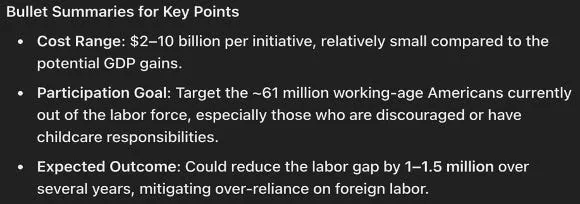
- Invest in STEM education, trade schools, and apprenticeship programsto train more American workers for industries with urgent needs.
- Over the long term, this reduces dependence on foreign labor for certain specialized roles.
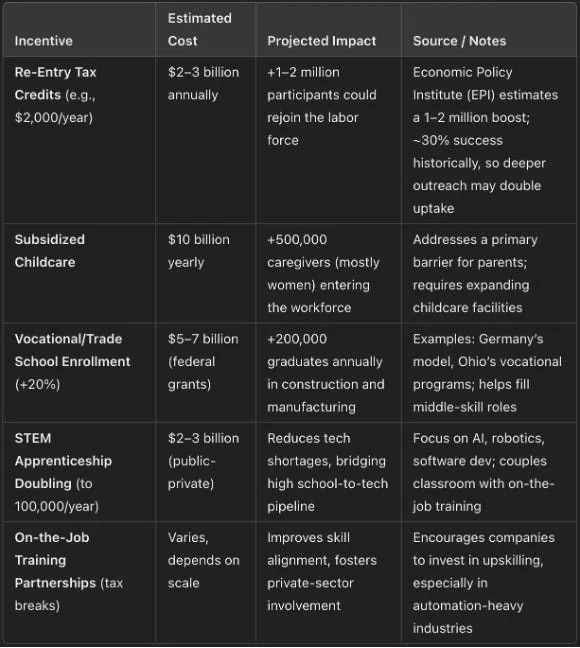
Incentives for American Workers
3. Flexible Visa Programs
- Update H-1B or similar visas to ensure companies can hire essential talent directly, without resorting to offshoring.
- Streamline guest-worker and seasonal-worker visas to fill critical shortages in agriculture, hospitality, and other sectors.
4. A Roadmap for the 7 Million Undocumented Work
- The President, backed by a strong mandate from the American people, could seize the opportunity by using his leadership position proposing a workable plan for the 7 million undocumented workers already in the U.S.
- This could range from Reagan-style amnesty — where they begin paying taxes and eventually earn legal status — to a return-and-reenter model, assuming it is feasible, fair, and in line with domestic workforce needs.
5. Shift away from government bureaucracy as much as possible the processing of worker’s permits applications and vetting. To streamline the foreign worker market dynamics, shift the burden on compliance to the private employers.
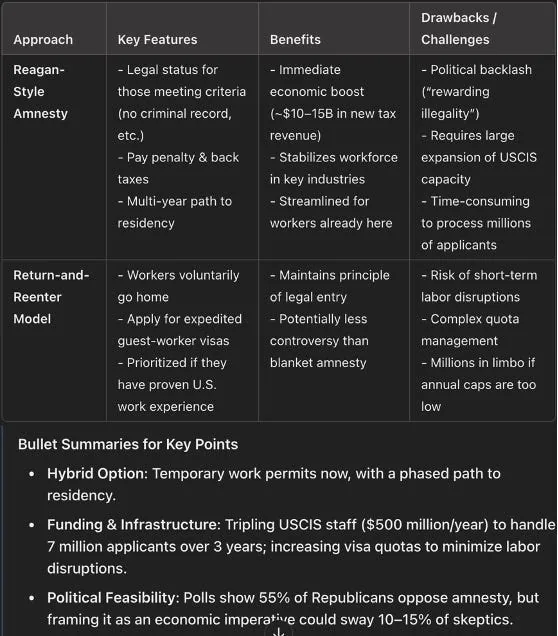
Alternative Policies Chart
A Line of Thought on Scale and Readiness
The case for 3.5 million legal workers annually — 10,000 daily — is rooted in urgent need: Americans shun low-wage roles like fruit picking ($30,000–$35,000/year), graduating only half the engineers required (63,000 vs. 120,000+), and the 7 million undocumented workers prop up industries at 50–60% of market wages. Yet, a pragmatic question emerges: Can the U.S. absorb this scale immediately, or might a phased approach better balance growth with readiness? Automation, already trimming manufacturing’s labor needs (1% growth, per BLS), could offset 500,000–700,000 jobs (McKinsey), buying time to scale infrastructure — HUD’s 3.5 million housing shortage (2024) warns of strain. Starting with 1.5–2 million legal entrants yearly, ramping up as housing, schools, and automation align, could ease the transition without sacrificing urgency. This doesn’t diminish the crisis of 7 million undocumented workers — a can we cannot kick down the road. Their $245 billion payroll underscores their indispensability; legalizing them (raising wages sharply, not lowering them) or replacing them legally is non-negotiable to stabilize agriculture, construction, and hospitality. The slack of 61 million non-participants (BLS, 2024) offers some relief, but U.S. productivity already outpaces Europe — squeezing this “lazy horse” further yields diminishing returns, especially for low-wage or high-skill roles Americans avoid or can’t fill. A lower initial target refines, not rejects, the vision — ensuring leadership acts decisively while the nation adapts.
A Moment for Bold Leadership
In the end, there is no way around this subject. President Trump has the courage and the public support to surpass what Reagan did in redefiningAmerica’s immigration approach. By linking border security with the critical labor demands of the economy, the Administration can resolve labor shortages, preserve American jobs, and safeguard the nation’s global competitive edge.
As we tighten one valve to stop illegal immigration, we must open anotherto legally recruit the workers essential for the country’s economic might. The stakes — measured in millions of jobs, trillions of dollars, and countless innovations — could not be higher.
Erasmus Cromwell-Smith
March 17th. 2025