Current Events
THE CASE FOR ROBOTICS
Research Brief
Introduction
As of May 2025, robotics has experienced unprecedented advancement and widespread adoption, profoundly transforming industries and daily life globally. With approximately 4.3 million operational industrial robots deployed, automation has reached record highs, driven by significant breakthroughs in artificial intelligence (AI), sensor technology, and ease of integration. This robust growth trajectory underscores robotics’ critical role in contemporary economies and its potential for future innovation.
Industrially, robotics continues to dominate manufacturing, particularly in automotive and electronics sectors. Collaborative robots (“cobots”) and autonomous mobile manipulators now perform intricate tasks alongside human workers, significantly improving productivity, safety, and operational flexibility. “Lights-out” manufacturing facilities, which operate autonomously, have become increasingly prevalent in high-tech sectors, exemplifying robotics’ potential to optimize production efficiencies and reduce human labor in hazardous or repetitive tasks.
Logistics and warehousing sectors have notably embraced robotics, driven by the escalating demands of e-commerce and global supply chain complexities. Autonomous mobile robots (AMRs) and guided vehicles streamline operations by autonomously sorting, transporting, and managing inventory. Such automation has critically addressed labor shortages and enhanced operational speed, efficiency, and accuracy.
Agriculture has rapidly incorporated robotics through autonomous machinery, drones, and AI-powered robots that optimize crop management, harvest fruits delicately, and efficiently manage weeds and pesticides. Forecasted to surpass $56 billion by 2030, agricultural robotics signify a strategic response to global food production challenges and labor scarcities.
Healthcare has extensively benefited from robotic innovation, notably through the proliferation of surgical robots like the da Vinci system, which enhance surgical precision, reduce invasiveness, and improve patient outcomes. Robotics is also instrumental in healthcare logistics, patient care automation, rehabilitation robotics, and eldercare assistance, particularly amid rising demand due to an aging population.
Consumer robotics has become ubiquitous, especially through robotic vacuum cleaners and home assistance devices, reflecting strong market acceptance and continual technological advancements in AI-driven interaction and domestic automation.
The global landscape reveals distinct leadership in robotics, with China, Japan, South Korea, Europe, and the United States at the forefront, each leveraging robotics to address unique demographic, economic, and industrial challenges. Strategic governmental initiatives and substantial investments continue to drive robust regional growth and technological innovation, establishing these countries as pivotal hubs for robotics leadership.
The convergence of AI and robotics has significantly propelled capabilities across autonomy, vision systems, machine learning, and natural language processing, greatly enhancing robots’ adaptability and efficiency. AI-driven predictive maintenance, advanced simulation training, and human-robot interaction innovations are foundational advancements shaping future robotic integration.
Visionary future horizons explore transformative possibilities such as robotic body augmentation, digital consciousness, enhanced human capabilities through sensory augmentation, and interplanetary exploration robotics. These concepts, while speculative, highlight the profound potential and extensive implications robotics and AI may hold for human evolution and societal development.
Overall, robotics stands as a pivotal driver of global productivity and innovation, posing essential considerations for workforce adaptation, ethical standards, and policy frameworks to harness its full potential responsibly and effectively.
Figure 1. Major reinforcement learning (RL) milestones in robotics from 2019 to 2023, highlighting breakthroughs such as OpenAI’s Dactyl robot, ETH Zurich’s ANYmal robot, and Brown University’s MotionGlot model, underscoring significant advancements in robotic dexterity, locomotion, and human-robot interaction.

Current Achievements in Robotics
Robotics has seen remarkable progress in recent years, with record levels of adoption and technical breakthroughs. The global stock of operational industrial robots reached about 3.9 million units by 20231 (and climbed further to ~4.3 million by the end of 20232 ), indicating an all-time high in automation.
Annual installations have exceeded 500,000 units for three years running2 , driven by advances in
sensors, artificial intelligence, and ease of integration. Below are some recent technological breakthroughs and major application areas in robotics:
• Manufacturing and Industrial Automation: Industrial robots continue to become faster, more precise, and safer. Collaborative robots (“cobots”) now work alongside humans on factory floors, thanks to improved vision and sensor technology that lets them adapt in real-time 3 . These robots are widely used for assembly, welding, painting, and packaging. Notably, mobile manipulators (robot arms mounted on autonomous mobile platforms) have emerged, enabling robots to navigate factories and perform material handling or machine tending tasks that were previously hard to automate 4 5 . Industrial automation remains a pillar of robotics achievements – for example, fully “lights-out” manufacturing lines (operating with minimal human intervention) are becoming reality in electronics and automotive industries.
• Logistics and Warehousing: The logistics sector has aggressively adopted robotics to meet the demands of e-commerce and supply chain efficiency. Autonomous guided vehicles and mobile robots swarm warehouses to move goods, sort packages, and load trucks. In 2023, over 113,000 professional service robots were sold for transportation and logistics applications (over half of all service robots sold), a 35% increase driven by labor shortages in warehouses 6 . Companies like Amazon have deployed tens of thousands of warehouse robots, and robots now commonly handle tedious tasks like lifting pallets or fetching items from storage. The technology has matured to the point that robots can work 24/7 in warehouses, using AI to navigate and avoid obstacles while coordinating with human workers.
• Agriculture: Robotics is transforming agriculture through autonomous farm equipment and crop management robots. Self-driving tractors and robotic harvesters can till soil, plant seeds, and harvest crops with minimal human oversight. Drones and rover robots are used for crop monitoring, precise pesticide spraying, and weed removal. The agricultural robot industry is growing rapidly – one projection estimates it will expand from about $13.3 billion in 2023 to $56.9 billion by 2030, illustrating the high demand for farm automation 7 . Recent breakthroughs include fruit-picking robots capable of gentle harvesting using computer vision, and robots like Agrobot or Naio Technologies’ weeding robots that use AI to identify and eliminate weeds, reducing chemical usage.
• Healthcare and Medical Robotics: Robotics in medicine has advanced from the operating room to hospital hallways. Surgical robots (like the da Vinci system) are now common for minimally invasive surgery, providing surgeons enhanced precision and control via robotic instruments. By early 2025, over 10,000 surgical robots have been installed in hospitals worldwide 8 , and they have been used in millions of procedures ranging from urological to cardiac surgeries. Beyond surgery, hospitals employ service robots for disinfection (e.g., UV-light robots that autonomously sterilize rooms) and telepresence robots that allow doctors to remotely consult with patients. During the COVID-19 pandemic, adoption of hospital robots accelerated to reduce infection risks – robots delivered supplies, took vital signs, and disinfected facilities. This momentum continues as healthcare faces staff shortages and looks to automation for support.
• Consumer and Home Robotics: In the consumer sphere, robots have entered our homes primarily as appliances and assistants. Robot vacuum cleaners and mops are now mainstream – more than 2 million robotic floor cleaners were sold in 2023 alone 9 , accounting for 57% of domestic robot sales that year. Over 50 million home robots (mostly vacuuming Roombas and similar devices) have been sold to date by leading companies 10 11 . Other home robots include lawn-mowing robots, pool-cleaning robots, and emerging social robots. While the dream of a general household humanoid is still in progress, simpler consumer robots like Amazon’s Astro home robot and personal assistant robots are being piloted. Advances in voice recognition and AI enable these devices to understand commands and even recognize faces. The consumer robotics market has matured significantly – growth surged during the pandemic and remains strong as robots become more affordable and user-friendly.
In summary, by May 2025 robotics has achieved widespread adoption across industries and made technical strides in autonomy, dexterity, and human-robot collaboration. Robots are not confined to high- tech factories anymore; they are plowing fields, stocking shelves, assisting surgeries, and cleaning living rooms. These achievements set the stage for even deeper integration of robotics into the economy and daily life.
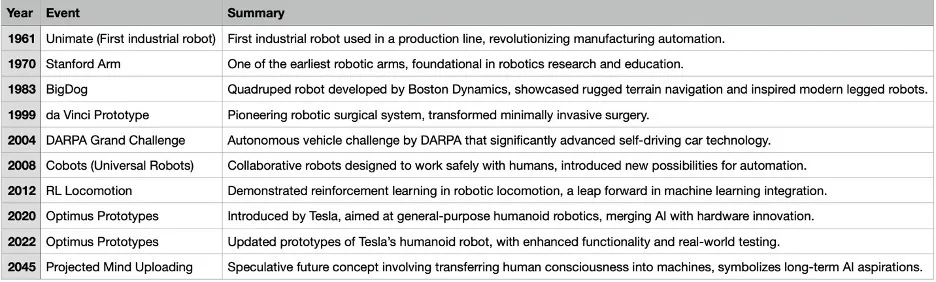
Figure 2. Key historical milestones in robotics, from the introduction of the first industrial robot (Unimate, 1961) to speculative future advancements, such as projected human mind uploading by 2045, marking significant moments in robotic evolution and their technological implications.
Impact by Industry
Robotics is Robotics is transforming a wide range of industries, boosting productivity, altering job roles, and raising new economic considerations. Below is an overview of how key sectors are being impacted, along with global economic and labor implications:
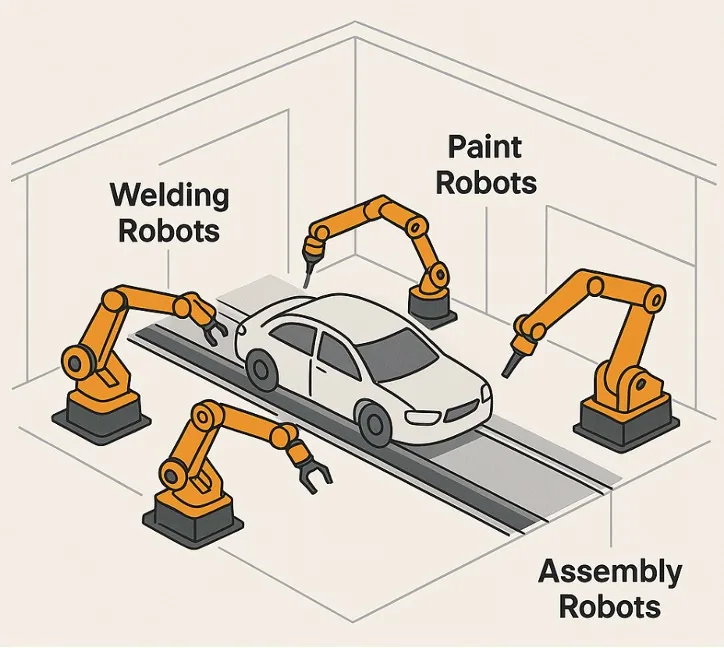
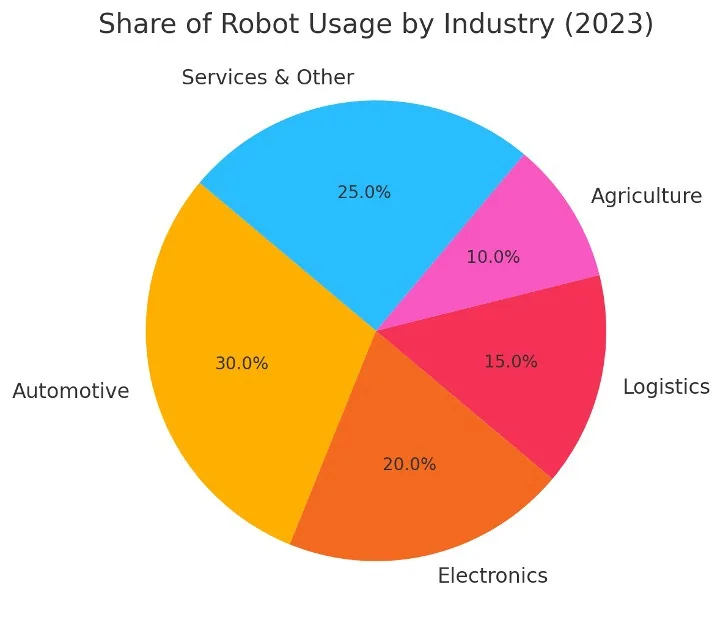
• Automotive Industry: The automotive sector has been a pioneer in industrial robotics since the 1960s and remains a top adopter. Auto manufacturing plants use robotic arms extensively for assembly, welding, and painting – modern car factories deploy thousands of robots for precision and efficiency. In 2023, the automotive industry accounted for about 30% of new industrial robot installations worldwide 12 , making it the single largest sector for robotics use. Beyond manufacturing, the rise of autonomous vehicles brings robotics to the product itself: self-driving car development essentially treats the car as a robot that perceives its environment and navigates using AI. Companies like Tesla, Waymo, and others are investing heavily in robotics and AI to achieve reliable self-driving cars. The impact on labor is twofold: on one hand, robots have largely taken over dangerous or repetitive tasks on assembly lines (e.g., welding car frames), improving worker safety; on the other hand, this automation reduces the number of assembly jobs per vehicle produced. However, the industry’s overall employment has shifted toward more high-skilled roles (robot maintenance, programming) and completely new domains (fleet management for autonomous taxis, etc.). Automotive robotics have also improved quality and consistency in production, contributing to economic gains for manufacturers and lower costs per vehicle.
Figure 3. Illustration of robotic automation in automotive manufacturing, including welding, painting, and assembly robots, highlighting robots’ critical role in precision, safety, and efficiency within modern car production.
• Electronics and Semiconductor Manufacturing: This sector has seen rapid automation due to the precision required in assembling tiny components. Robots and automated systems build smartphones, computers, and semiconductor chips in cleanrooms where human hands would be too large or introduce contamination. The electronics industry is now one of the largest consumers of robots – for example, in 2023 nearly two-thirds of all industrial robots in the electronics industry were installed in China alone 13 , reflecting a huge automation drive in electronics factories. Pick-and-place robots, PCB assembly robots, and wafer-handling robots in chip fabs work at speeds and accuracy beyond human capability, enabling mass production of complex gadgets. This increases output and helps meet global demand for electronics, but it also shifts the labor force towards supervisory and technical maintenance roles. The global shortage of skilled electronics workers has, in part, been mitigated by deploying robots to keep production lines running 24/7. As a result, the cost of consumer electronics has been kept in check and the sector’s economic output has grown, though countries with less automation risk losing manufacturing competitiveness.
• Logistics, Retail, and Warehousing: Warehouses and distribution centers have been revolutionized by robotics in response to the e-commerce boom. Autonomous mobile robots (AMRs) ferry goods across warehouse floors, retrieve items from shelves, and sort packages for shipping. Companies in retail logistics (Amazon, DHL, Alibaba, etc.) operate some facilities where human workers and robots collaborate closely – humans handle delicate or complex picking tasks, while robots do the heavy lifting and long-distance transport. The 35% surge in logistics robot sales in 2023 6 underscores how this industry is turning to robots to address labor shortages and speed requirements. In retail stores, inventory-scanning robots roam aisles to monitor stock levels, and some stores and malls experiment with customer-facing robots for information or cleaning. The labor implications are significant: warehousing jobs are being augmented (and in some cases replaced) by robots. While robots take over routine, injury-prone tasks (like lifting heavy goods), there is rising demand for technicians to manage robot fleets. Global logistics efficiency has improved, enabling faster delivery times and supporting the growth of online retail – a clear economic benefit. However, there’s an ongoing need to retrain workers whose jobs are affected, shifting them to higher-value roles that robots cannot easily fill (like complex order packing or equipment oversight).
• Agriculture: The agricultural sector faces the dual challenges of feeding a growing population and dealing with labor scarcity for farm work. Robotics is increasingly seen as a solution – autonomous tractors, robotic harvesters, and drones are making farms more efficient. For example, robotic harvesters equipped with machine vision can pick fruits like strawberries or apples without crushing them, working day and night. Milking robots have been widely adopted in dairy farming to automate milking cows on schedule with minimal stress to the animals. These technologies help address seasonal labor shortages and reduce the drudgery of farm work. Economically, agricultural robots can increase yields and reduce waste (through precise application of fertilizers or pesticides), which can improve farm profitability and possibly stabilize food prices. A potential $57 billion market by 2030 dependent on migrant labor and more resilient, but careful transition strategies are needed to support farm workers in adopting these new tools.
• Construction and Infrastructure: Construction has traditionally lagged in automation, but that is changing with advances in robotics. We now see bricklaying robots that can lay thousands of bricks per day, rebar-tying robots for reinforcing concrete, and large-scale 3D printing robots that can print entire building structures in concrete. Autonomous construction machinery (bulldozers, excavators) guided by GPS and sensors can do earthmoving with minimal human operation. Drones and robot dogs (like Spot from Boston Dynamics) patrol construction sites for progress monitoring and safety inspections. The impact on the industry could be transformative: productivity in construction may rise (addressing the sector’s historic inefficiency issues) and dangerous jobs (like working at great heights or handling heavy materials) can be made safer by delegating to robots. Some construction projects have experimented with fully robotic teams building simple structures, indicating a future where housing could be built faster and cheaper with automation. For workers, this means a shift – fewer laborers doing repetitive tasks like bricklaying, but more demand for skilled operators who supervise robotic systems or handle the complex tasks robots can’t. If widely adopted, construction robotics could alleviate labor shortages and accelerate infrastructure development, impacting economic growth by reducing building costs and timescales.
• Healthcare Services: Outside of surgery (covered separately), service robots are impacting healthcare through roles such as hospital transport robots, rehabilitation bots, and eldercare companions. Hospitals use robots to carry linens, medications, or meals through hallways – freeing up staff for patient care. Pharmacy robots automatically dispense medications. In rehabilitation, robotic therapy devices help patients regain movement (for instance, robotic exoskeletons assist patients in re-learning to walk after spinal cord injuries). The healthcare industry, under pressure from aging populations, looks to robots to improve care efficiency. In eldercare, social robots and assistive robots (like SoftBank’s Pepper or the therapeutic robot seal PARO) are used in some nursing homes to provide cognitive stimulation or comfort to residents. While these are not widespread yet, they show promise in augmenting a strained caregiving workforce. Economically, medical service robots can reduce routine workload on highly paid clinicians and nurses, potentially lowering healthcare costs or improving patient throughput. They also represent a growth market themselves. The labor implication is mostly positive in that robots handle support tasks (delivery, monitoring) allowing healthcare professionals to focus on direct patient interaction – critical in a field where human touch is irreplaceable. However, training is needed to integrate robots smoothly into clinical workflows, and ethical standards are being developed to govern robot-patient interactions.
Figure 4. Illustration of a da Vinci-style robotic surgical system showing the surgeon’s console, patient-side cart, robotic arms, and surgical instruments. This technology allows enhanced precision, minimal invasiveness, and greater surgeon comfort and control during complex surgeries.
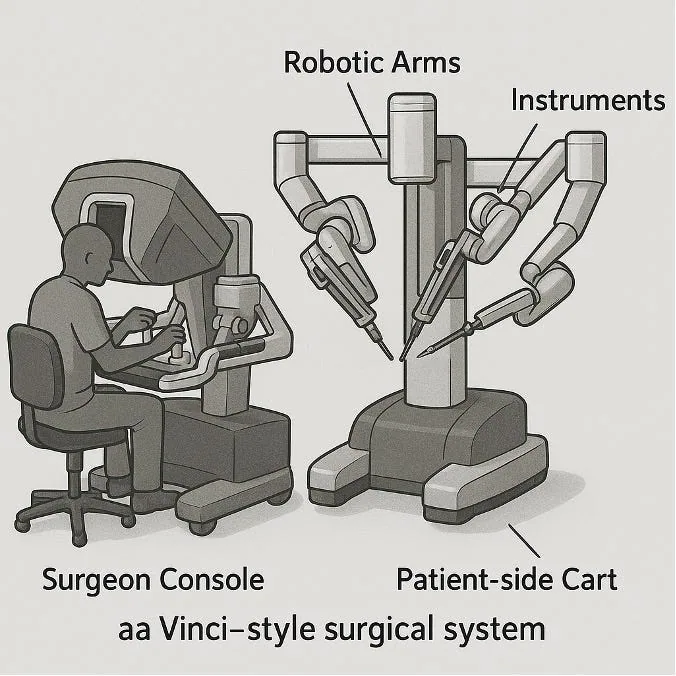
Figure 5. Pie chart depicting robot usage distribution by industry (2023) with automotive and electronics sectors dominating. The accompanying table compares characteristics of notable exoskeleton prosthetic systems, highlighting their practical application, costs, and technological capabilities.
• Defense and Security: Defense has long invested in robotics for unmanned systems. Today, military forces use unmanned aerial vehicles (drones) for reconnaissance and airstrikes, bomb-disposal robots to neutralize explosives, and are testing legged or tracked robots for scouting and carrying gear for soldiers. Automated sentry robots and surveillance drones are employed for base security and border patrol in some regions. The impact is a mixed bag: robotics can save lives by taking soldiers out of immediate harm (e.g., a robot investigating a potential IED instead of a human), but also introduces new warfare capabilities and ethical questions (like autonomous weapon systems). Economically, military robotics is a driver of high-tech R&D – government defense spending on robotics and autonomy was about $10.3 billion in 2023 in the U.S. Department of Defense alone 14 , which spurs innovation that often spins off into civilian tech. In law enforcement and security, robots (like Knightscope security patrol robots or drone surveillance) are used to monitor premises and inspect hazardous situations (like chemical spills), improving safety. The labor impact in defense is more about changing skill requirements: soldiers now need training to operate and coordinate with robotic systems, and there is growing demand for drone pilots, robotics engineers, and maintenance crews in the armed forces.
Overall, global economic implications of these industry transformations are significant. Robotics and automation are boosting productivity and could add trillions of dollars to the global economy over the next decade. A more automated industry can produce goods at lower cost and higher volume, contributing to economic growth and potentially lowering prices for consumers. For example, robotics is one factor enabling reshoring of manufacturing to high-wage countries by offsetting labor costs with automation efficiency. The labor implications are complex: while robots displace some jobs (especially routine, physical jobs), they also create new jobs in robotics engineering, programming, maintenance, and in scaling new robotic-enabled services. There is evidence that automation can initially reduce employment in certain regions or sectors, but historically it also leads to job growth in complementary roles and entirely new industries. A recent analysis noted that in the U.S., each additional robot per 1,000 workers can have a modest negative impact on employment and wages in the short term , highlighting the need for workforce retraining and transition plans. On the positive side, robots taking over dangerous and repetitive tasks can lead to safer workplaces and allow humans to focus on more creative or interpersonal work. Policymakers worldwide are thus balancing the productivity gains from robotics with strategies to support workers, such as investing in robotics education, upskilling programs, and social safety nets for those affected.
In summary, every major industry – from manufacturing and agriculture to healthcare and logistics – is being reshaped by robotics. This cross-sector penetration of robotics is driving efficiency and economic growth, even as it requires adaptation in the workforce and raises important discussions about the future of work.
Impact by Country/Region
The adoption and development of robotics vary significantly by country and region. A few nations stand out as global leaders in robotics usage and innovation, often supported by targeted government policies and investments. Here we examine the leading countries/regions in robotics and their national strategies:
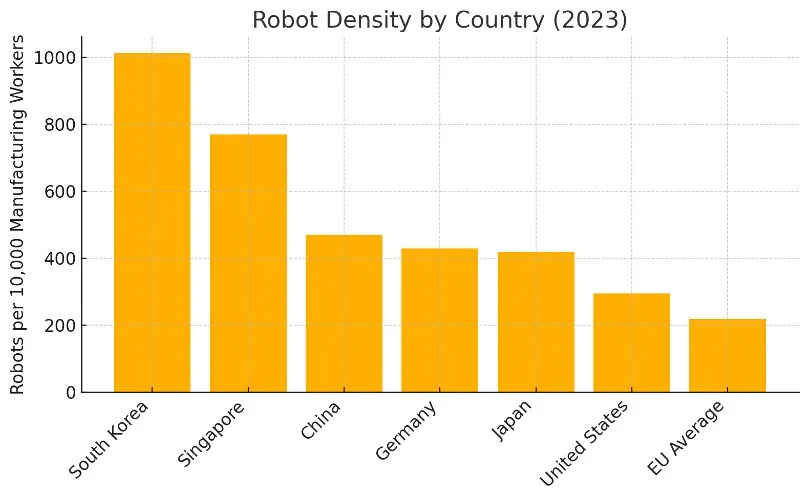
• China: China has become the world’s largest and fastest-growing robotics market. In the past decade, China’s share of global industrial robot installations rose from around 20% to over 50% of the world’s total demand 17 – meaning one out of every two new industrial robots is installed in China 17 . By 2023, China achieved a robot density of 470 robots per 10,000 manufacturing workers, ranking third in the world (up from only 25th a decade ago) 18 . This rapid rise is no accident: the Chinese government has made robotics a national priority. Under the 14th Five-Year Plan for Robot Industry Development (2021–2025), China aims to become a global leader in robot technology and manufacturing innovation 19 . The Ministry of Industry and IT (MIIT) set detailed goals, including mass-production of humanoid robots by 2025 20 . In March 2025, China announced a state-backed venture capital fund expected to attract ¥1 trillion (~$138 billion) over 20 years for robotics, AI, and high-tech industries 21 17 – a massive investment to sustain its robotics growth. Chinese domestic robot makers are also on the rise: local suppliers increased their market share of China’s robot installations from 30% in 2020 to 47% in 2023 13 , partly due to the government’s push for self-reliance. The result is that China now leads in total robots deployed (especially in electronics and automotive plants) and is aggressively using automation to counter rising labor costs and demographic challenges. Government support includes R&D programs, subsidies for robot adoption in small enterprises, and the “Made in China 2025” initiative which identified robotics as a key strategic sector. China’s rapid adoption is transforming its economy – factories are becoming highly automated, and while this may displace some manufacturing jobs, it’s also creating demand for skilled technicians and driving growth in high-tech industries.
• Japan: Japan has a long legacy in robotics and remains a powerhouse in both robot manufacturing and usage. Japan is the world’s No.1 producer of industrial robots – Japanese companies (Fanuc, Yaskawa, Kawasaki, etc.) supply a significant portion of the global market 22 . In terms of usage, Japan has about 419 robots per 10,000 workers in manufacturing 23 , placing it 5th globally in robot density. The Japanese government’s New Robot Strategy aims to make Japan the world’s top innovation hub for robotics, with focus areas including advanced manufacturing, nursing/medical robots, and agricultural robots . Given Japan’s aging population and shrinking workforce, the government sees robotics as crucial to sustaining economic productivity and supporting the elderly. There are national programs like the Moonshot R&D Program (2020–2050) with a budget of JPY 25 billion (~$440 million) to develop AI-enabled robots that autonomously learn and work alongside humans. Robots are increasingly visible in Japan’s service sector – from robot assistants in stores to caretaking robots in nursing homes – often supported by government trials and subsidies. For example, Japanese companies have pioneered therapeutic robots (the seal-like robot PARO for dementia patients) and human-like robots (Toyota’s and Honda’s assistant robots). Culturally, Japan has a high acceptance of robots, which smooths adoption. Government and industry collaborate to standardize robotics and train workers; for instance, Japan has initiatives to put more robots in small-medium enterprises and in construction sites. Economically, Japan leverages robotics to maintain its industrial output despite having one of the world’s oldest populations. While some traditional jobs are being automated, Japan’s approach emphasizes robots as helpers to fill labor gaps rather than simply replace workers, reflecting a vision of human-robot coexistence to address societal needs.
• South Korea: South Korea leads the world in robot density and is a global champion of industrial automation. As of 2023, South Korea has 1,012 industrial robots per 10,000 employees in manufacturing 25 – the highest robot density in the world (about 5× the U.S. level) 25 18 . This means roughly 1 robot for every 10 workers in factories. The country’s dominant electronics (e.g., semiconductor) and automotive industries heavily drive robot use, and giants like Samsung, Hyundai, and LG rely on automation for their competitiveness. The Korean government actively supports robotics as a growth engine. In January 2024, South Korea announced its 4th Basic Plan on Intelligent Robots (2024–2028), investing KRW 180 billion (~$128 million) to further develop the robotics industry as a core of the Fourth Industrial Revolution 26 . Key targets include advancing core robot technologies, developing robotics talent, and fostering collaboration between companies and regions in robotics 26 . South Korea is also home to leading robot companies and initiatives: for example, Hyundai Motor Group acquired Boston Dynamics in 2020 and is investing in humanoid robots and “Factory of the Future” concepts (Hyundai announced a $6B investment to purchase tens of thousands of robots for its new facilities 27 ). In daily life, Koreans are increasingly encountering robots in places like hospitals (for disinfection or meal delivery) and restaurants (robot baristas and servers), often as pilot programs backed by government innovation grants. The economic impact for Korea is significant – robotics boosts productivity in manufacturing (keeping Korean exports strong) and is spawning new industries (e.g., service robot startups). With government support in R&D and a tech-savvy workforce, South Korea aims to maintain its lead and even export more of its home- grown robotic technologies globally. However, like others, it faces the need to retrain workers whose jobs on production lines are automated; Korea’s approach includes funding for robotics education and an emphasis on SME automation to ensure even smaller manufacturers can benefit.
• United States: The U.S. is a world leader in advanced robotics R&D and high-tech applications, though its industrial robot adoption rate, while growing, is behind some Asian nations. The U.S. had about 295 industrial robots per 10,000 workers in 2023, ranking 10th globally in robot density 28 . American industries such as automotive and electronics do use many robots (the U.S. auto sector saw a double-digit increase in robot installations recently), but overall adoption in general manufacturing is moderate compared to Korea or Germany. However, the U.S. excels in innovation and software – home to companies pioneering AI for robotics, autonomous vehicles, drones, and logistics robots (e.g., Waymo and Tesla in self-driving, Boston Dynamics (now part of Hyundai) in legged robots, Amazon in warehouse automation). The U.S. government has funded robotics primarily through agencies like DARPA, NSF, NASA, and DoD. DARPA’s Robotics Challenge (2015) spurred humanoid robot development; NASA invests in space robotics (the Mars rovers, robotic arms on the ISS, and upcoming lunar robots for Artemis). In fact, NASA’s Artemis program (2021–2025) allocated $53 billion, part of which goes to developing robotic capabilities for moon missions 30 31 and more, with about $70 million requested for 2024 14 . While the U.S. does not have a single unified “robotics strategy” document at the federal level, it released periodic Robotics Roadmaps through academic-industry collaboration (most recently in 2020 and 2024) that guide priorities. A key trend is the integration of AI – many U.S. robotics efforts are at the intersection of AI and physical systems (for instance, warehouse robots that use cutting-edge AI vision, or surgical robots with AI driven decision support). Economically, the U.S. benefits from robotics in maintaining manufacturing in certain sectors and leading the development of new markets like self-driving cars and delivery drones. American tech companies have massive deployments of service robots (e.g., tens of thousands of Amazon’s Kiva robots operate in fulfillment centers). The U.S. labor market is tight, and automation is seen as a tool to address shortages in industries like logistics and trucking (hence interest in autonomous trucks and warehouse bots). There is also a focus on retraining – community colleges and universities offer more robotics and automation programs to supply skilled workers. The U.S. approach relies heavily on the private sector and academia to push robotics forward, with government facilitating via research grants and policy (for example, NIST developing standards for safe human-robot collaboration, or the FAA crafting rules for delivery drones). Despite not being #1 in density, the U.S. remains one of the innovation leaders, producing many of the world’s cutting edge robots and AI algorithms that power them.
• Europe (European Union & key countries): Europe collectively is a robotics leader, with certain countries at the forefront. The EU’s average robot density is 219 per 10,000 workers 32 33 , higher than the U.S., and Europe hosts several of the top 10 most automated nations (Germany, Sweden, Denmark, Slovenia) 32 34 . Germany is Europe’s largest robotics user and manufacturer – it has 429 robots/10k workers (4th globally) 23 and is known for its automotive industry robots (Volkswagen, BMW, etc. are heavily automated) and for companies like KUKA (a major robot producer). Germany’s government supports robotics through programs like High-Tech Strategy 2025 with €350 million earmarked for robotics research and networking of innovation hubs 35 36. Northern Europe has surprisingly high robot densities in smaller countries; for example, Sweden and Denmark have a strong robotics presence due to high-tech manufacturing and food/pharma industries that automated early. Denmark is home to Universal Robots, a pioneer in collaborative robots. Italy and France also use many robots in industries like automotive, fashion (textile robots), and aerospace, though their densities are lower than Germany. The European Union as a whole pushes robotics via its Horizon Europe research funding – roughly €174 million was dedicated to robotics-related R&D in the 2023–2025 work programme 37 38 , focusing on AI, data, and robotics innovations and applications in energy and health. The EU also emphasizes ethical AI and robotics, looking to create frameworks for safe and trustworthy robotic systems (e.g., ISO standards for robot safety, and discussions on robot “civil laws” like the AI Act). Eastern Europe (e.g., Czech Republic, Poland) is rapidly adopting robots as they integrate into global manufacturing networks, often with foreign investment building automated factories there. In terms of economic impact, robotics helps high-wage European countries keep manufacturing competitive – for instance, German car makers remain efficient partly due to heavy automation. It also is seen as key to future growth in areas like service robots for elderly care (particularly in aging Europe). Labor impacts in Europe have led to strong emphasis on worker retraining and apprenticeship programs so that automation augments rather than displaces workers. Social partnerships (unions, industry) in countries like Germany negotiate the deployment of robots in ways that manage the transition for workers. Europe also invests in education and robotics clusters (e.g., the European Robotics Forum and local innovation hubs) to ensure a pipeline of talent and startups in robotics. Leading universities like ETH Zurich (Switzerland) – though Switzerland is outside the EU, it’s a European leader in robotics – and others collaborate closely with industry. Notably, Switzerland (with robot makers like ABB) and Italy (strong in packaging and food industry robots) contribute significantly to Europe’s robotics landscape. The European approach combines competitiveness (using robots to boost industry output) with responsibility (policies for AI ethics, safety, and workforce inclusion).
• Other Regions: Southeast Asia is an emerging robotics adopter – countries like Singapore (770 robots/10k, 2nd highest globally due to its small manufacturing workforce and high-tech focus) 25 and Taiwan (significant in electronics manufacturing) use many robots. Singapore in particular, with government grants, has test-beds for service robots in public areas (like robot cleaners and delivery robots in hospitals). Taiwan and Malaysia integrate robots in semiconductor fabs and electronics plants. India, while far behind in automation density, has started a push for robotics in manufacturing as part of its “Make in India” initiative and to modernize sectors like automotive and textiles – Indian startups are also developing affordable robots for tasks like warehouse sorting and agriculture (such as tea harvesting robots). Middle Eastern countries (like the Gulf states) are investing in robotics and AI as part of diversification – for instance, the UAE has introduced robots in police and customer service roles and funds research labs. Finally, Latin America (led by Mexico and Brazil) is adopting industrial robots in automotive factories (Mexico, as a major car producer, has a rising robot count) and exploring robots in mining and agriculture. While these regions are not yet global leaders, they recognize robotics as crucial for future competitiveness and are crafting their own strategies.
Governmental support and national strategies play a pivotal role in these trends. We see massive investments: China’s billions in funds, South Korea’s targeted plans, EU’s research funding, Japan’s long- term vision, and U.S. defense and NSF grants. Many countries have national robotics roadmaps or AI strategies that encompass robotics – often highlighting goals like developing domestic robot industries, setting ethical guidelines, and preparing the workforce. A common theme is that governments view robotics as central to economic growth, national security, and social challenges (aging, labor shortages), and they are increasingly coordinating efforts to harness the technology. For example, Singapore’s Smart Nation initiative includes deploying service robots in public services, and Germany’s Robotics Innovation Centers aim to bring breakthroughs from lab to market. International collaboration is also evident: countries share best practices through organizations like the International Federation of Robotics and partnerships in research (e.g., EU-Japan and US-Japan collaborations on AI & robotics standards).
In summary, the leading regions in robotics – East Asia (China, Japan, Korea, Singapore), Europe (Germany, Northern Europe), and North America (USA) – each have distinct strengths but all strongly back robotics. The result is a global race and collaboration in robotics innovation. This regional dynamic means that robotics knowledge and investments are spreading worldwide, with each country hoping to capitalize on the productivity gains and strategic advantages that advanced robotics can provide.
Figure 6. Annual global industrial robot shipments from 2015 to 2024, demonstrating consistent growth in industrial robot adoption driven by advancements in automation technologies and market demand.
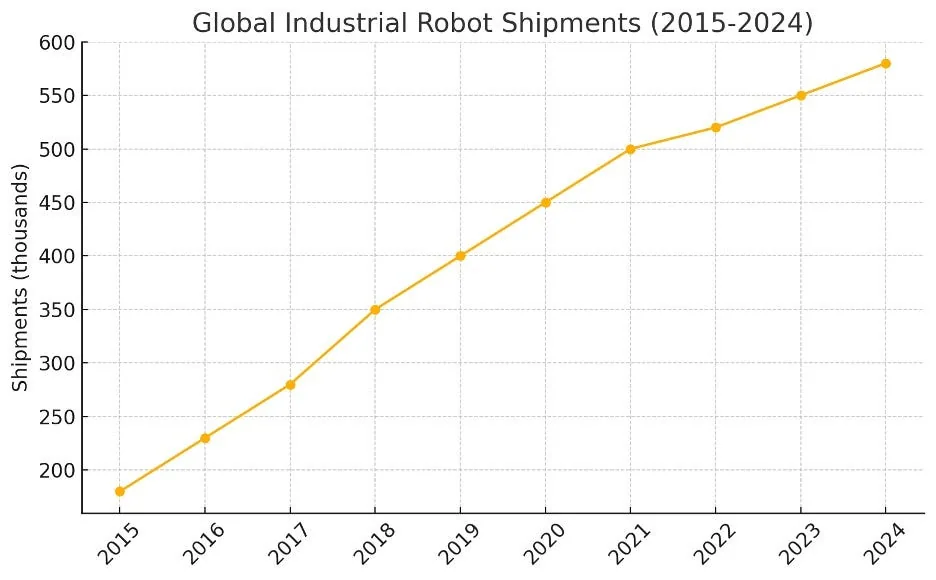
Figure 7. Robot density per 10,000 manufacturing workers by country (2023), showcasing South Korea and Singapore as global leaders, illustrating varying national strategies and investments influencing automation levels worldwide.
AI and Robotics Synergy
Artificial intelligence and robotics have developed a deeply intertwined relationship: advances in AI (especially machine learning) are dramatically expanding what robots can do, while the challenges of robotics are driving new AI research. In 2025, the synergy between AI and robotics is evident in areas like autonomy, perception, decision-making, and human-robot interaction. Key aspects of this synergy include:
• AI-Powered Autonomy: Modern robots increasingly leverage AI algorithms to perceive their environment and make decisions on their own. For instance, computer vision powered by deep learning allows robots to recognize and track objects or people with high accuracy – a crucial ability for tasks like self-driving cars, delivery drones, or warehouse picking robots. High-profile examples include autonomous vehicles using neural networks to interpret camera and lidar data in real-time, and robotic vacuum cleaners using AI-based SLAM (simultaneous localization and mapping) to intelligently navigate homes. The emergence of powerful generative AI and large language models is also influencing robotics: robot manufacturers are developing generative AI-driven interfaces that let users program and command robots using natural language 39 40 . This means instead of writing complex code, an operator might simply tell the robot what to do in plain English, and an AI system translates that into robotic actions. Early versions of this can be seen in systems like OpenAI’s APIs combined with robot frameworks or startup products that allow voice instructions for drones. Overall, AI is moving robots from scripted, pre-programmed behavior toward adaptive, autonomous behavior, enabling operation in unstructured, dynamic settings like homes, streets, or chaotic factory floors where hard-coding every contingency is impossible.
• Machine Learning for Skills and Optimization: Robots are benefiting from machine learning both in acquiring new skills and in optimizing performance. Through techniques like reinforcement learning, robots can learn complex behaviors via trial and error in simulations and then transfer those skills to the real world. A recent achievement by researchers at Brown University demonstrated an AI model that generates robot motion from text commands, essentially “translating” natural language into sequences of movements across different robot types 41 42 . This kind of work, treating robot motions as a language to be learned, was unheard of a few years ago and showcases the power of AI to generalize skills (a robot could be taught “walk forward and turn right” and apply it whether it has legs or wheels). Similarly, deep reinforcement learning has been used to teach legged robots how to navigate challenging terrains or perform acrobatics – for example, ETH Zurich’s ANYmal robot learned via machine learning to perform parkour-like maneuvers and traverse obstacles autonomously 43 . In industrial settings, predictive AI is analyzing data from robot sensors to predict maintenance needs 44 , thus avoiding downtime; an AI model can detect subtle changes in a robot’s motor currents or vibrations that indicate a part is wearing out. This predictive maintenance, guided by AI analytics, is extremely valuable – in automotive parts manufacturing, an hour of downtime can cost $1.3 million, so preventing failures with AI brings massive savings 45 . Machine learning also optimizes multi-robot operations: for instance, AI can coordinate fleets of robots so they don’t interfere with each other and share tasks efficiently, or analyze production data across many robots to suggest process improvements. The more data robots collect, the smarter these AI systems become, creating a virtuous cycle of improvement – a concept often referred to as “data network effects” in robotics.
• Computer Vision and Sensor Fusion: Vision is the richest sensor modality for robots, and AI (specifically deep convolutional neural networks) has revolutionized computer vision in the last decade. Robots now “see” far better than before – they can recognize a vast array of objects, even in cluttered scenes, and determine their 3D position and orientation. This is crucial for tasks like robotic picking and manipulation (e.g., a robot arm picking varied grocery items off a conveyor needs to identify each item and grasp it without crushing it). AI-driven vision also enables facial and gesture recognition for social robots or security robots to interpret human expressions and actions. Beyond normal cameras, AI helps fuse data from LIDAR, depth sensors, and even sound, giving robots a multimodal understanding of their environment. For example, autonomous drones use AI to interpret both visual and infrared camera feeds to navigate and avoid obstacles in varied lighting. The synergy here is that better sensors produce massive data, and only AI techniques can effectively process that in real-time to guide robots. Recently, edge AI – running neural networks on small, embedded processors on the robot – has matured, so robots don’t always have to rely on cloud computing; they can perform AI inference on-board to react quickly (important for tasks like a self- driving car identifying a pedestrian and braking immediately). In manufacturing, vision-guided robots can adjust on the fly: an AI vision system can detect that a part is slightly misaligned on a conveyor and instruct the robot arm to adjust its path to grab it – something classical machine vision struggled with. AI has essentially given robots eyes and a brain sophisticated enough to work in unpredictable real-world environments rather than only in structured, pre-programmed settings.
• Natural Language and Human-Robot Interaction: One of the most tangible ways AI benefits robotics is by making interaction with robots more natural. Natural Language Processing (NLP) lets robots understand spoken or written commands and respond intelligibly. For instance, modern service robots or digital assistants on wheels (like concierge robots in airports or hotels) use AI language models to understand customer inquiries (“Where is gate 20?”) and respond with useful answers or actions (guiding the person to the location). Large Language Models (LLMs) like GPT-4 are being explored to control robots through high-level reasoning: researchers have shown that an LLM can serve as a “planner” that converts a command like “make me a cup of coffee” into a sequence of actions for a household robot (find coffee, find cup, use coffee machine, etc.), tapping into its vast semantic knowledge behavior or tone of voice accordingly. This synergy between AI and human psychology in robotics is key to building trust and usability for robots that operate in homes and public spaces.
• Robotic Learning and Simulation: AI has enabled a paradigm called “learning in simulation, deployment in reality.” Companies and labs use physics simulation environments to train robot AIs on millions of scenarios (which would be impractical or unsafe in the real world) – for example, training a robot hand to solve a Rubik’s cube using reinforcement learning (as OpenAI did), or training a bipedal robot to walk under many conditions. Once the AI policy is learned, it can be transferred to the real robot, sometimes with techniques to bridge the “reality gap.” This dramatically accelerates the development of robust robotic behaviors. Cloud-based simulation platforms and digital twins (virtual copies of physical robots/factories) are increasingly used to refine AI algorithms before live deployment 48 49 . As an illustration, a company might maintain a digital twin of its robotic assembly line and use AI to simulate thousands of hours of production to find optimizations or to test how adding a new robot would impact flow. AI-driven simulation can also predict how robots will wear and tear over time or how changes in software will affect performance, reducing trial-and-error on the actual hardware.
• “Physical AI” and Embodied Intelligence: There is a growing concept of embodied AI, which posits that intelligence arises from interaction with the physical world. Robotics provides the embodiment for AI – unlike a disembodied software agent, a robot feels gravity, friction, and other physical constraints. This synergy is leading to research on AI algorithms that learn like a human or animal would, by physical trial, sensory feedback, and exploration. We see this in projects where AI-driven robots learn to self-model – e.g., a robot might initially not know its own kinematics, but through moving and seeing the results, it learns an internal model of its body. In 2023, some robots demonstrated the ability to adjust their behavior after damage: using AI, a legged robot could detect it has a malfunctioning leg and adapt its gait to compensate, rather than failing outright – akin to an animal learning to limp effectively. This blend of resilience and learning is squarely due to AI techniques like Bayesian optimization and meta-learning being applied to robotic control. Another area is AI in grasping and manipulation: human hands are incredibly dexterous; teaching robots to manipulate varied objects (from tools to delicate items) is hard with conventional programming. AI algorithms now allow robotic hands to learn how to grasp new objects by training on huge datasets of objects or through trial (some approaches even involve AI vision systems guessing the best grasp points on an object that the robot has never seen before – a task requiring generalization, which AI is well-suited for).
In summary, AI acts as the “brains” of modern robotic systems. The synergy means robots have become smarter, more adaptable, and more capable of working in human environments. For example, where an older robot might freeze if an unexpected obstacle appeared, an AI-enabled robot could recognize the obstacle and dynamically re-plan its path. Or where programming a robot for a new task used to take days of coding, now an AI interface might do it in an hour by learning from just a few demonstrations (so-called imitation learning). This convergence of AI and robotics is accelerating – as noted by the International Federation of Robotics, the five major trends in robotics for 2024 are all underpinned by AI, from cobots with smart vision to autonomous humanoids with decision-making capabilities 50 49 . The ultimate vision is robots with a form of common sense: machines that can understand goals, learn on the job, and safely work with humans. We’re not fully there yet, but the rapid progress in AI (especially with the breakthroughs in deep learning and now large-scale generative models) is continually breaking down barriers. We are already seeing practical outcomes like easier robot programming via natural language 39, and multi-modal AI systems that integrate vision, language, and action for robotics 51. As both fields advance, their union promises robots that are not only physically competent but also cognitively capable, bringing us closer to science-fiction-like autonomous helpers and coworkers.
Leading Players in Robotics
The robotics landscape in 2025 is shaped by a mix of established companies, innovative startups, and academic institutions. These
• Boston Dynamics: Boston Dynamics is often regarded as a leader in advanced robotics and locomotion. Founded out of MIT, it became famous for its legged robots that can walk, run, and perform acrobatics. Its humanoid robot Atlas has demonstrated stunning agility – jumping between platforms, doing backflips, and recently showcasing the ability to pick up and throw objects in a mock construction task. Its quadruped robot Spot, a dog-like robot, is commercially available and used in industrial inspections, mapping, and public safety. Boston Dynamics was acquired by Hyundai Motor Group in 2020, and under Hyundai’s backing it’s expanding from R&D demos to real- world applications. In April 2025, Hyundai announced a plan to purchase “tens of thousands” of Boston Dynamics robots over the next few years for use in its factories 27 . Hyundai is already deploying Spot for maintenance inspections and plans to eventually use Atlas in factories as well 52. This commitment underscores Boston Dynamics’ significance – Hyundai even stated that “physical AI and humanoid robots will transform our business”, making BD a central part of its future strategy 53. Boston Dynamics has a track record of “firsts” – it pioneered dynamic balancing in robots (e.g., its early robot BigDog could recover from being kicked on icy terrain). While Boston Dynamics doesn’t yet mass-produce at the scale of industrial robot companies, it has become an icon of robotics capability and a pathfinder in legged locomotion. The company’s emphasis is now on turning its cutting-edge robots into useful products: Stretch, a wheeled robot for automating warehouse box moving, is a recent addition targeting the logistics market. With Hyundai’s investment of $6+ billion in robotics initiatives 27 , Boston Dynamics is poised to scale up manufacturing and potentially drive down cost, making advanced mobile robots more accessible to industry. The company’s work also pushes the envelope for the entire field – each viral video of Atlas or Spot solving a new challenge raises public awareness and inspires other researchers and companies to advance their own robotic systems.
• Tesla: Known primarily as an electric vehicle and clean energy company, Tesla has in recent years made bold moves in robotics and AI. Tesla’s cars themselves are semi-autonomous robots on wheels, equipped with one of the world’s most extensive vision-based AI systems for self-driving (Tesla’s FSD beta software runs on an AI model that interprets camera feeds to drive on roads). Building on its expertise in batteries, motors, and AI, Tesla announced the Tesla Bot (Optimus) project in 2021 – a humanoid robot designed to perform general tasks. By 2023–2024, Tesla revealed prototypes of Optimus that could walk, manipulate objects, and perform simple tasks like sorting items by color 54 55 . In late 2024, Tesla showcased improvements such as Optimus doing yoga poses and using its hands for basic chores (a video in May 2024 showed Optimus robots doing tasks on a factory floor and even folding a garment) 56 57 . Elon Musk has stated that Optimus could be “more significant than the vehicle business over time” 58 . While still in development, Tesla aims to leverage its mass-manufacturing prowess to build humanoid robots at scale, with Musk suggesting limited production could start by 2025 with over 1,000 units deployed in Tesla’s own facilities as a test 59 . The strategy is to refine the robot in-house (in factories, moving components or doing repetitive tasks) and then potentially offer it commercially. Tesla’s competitive advantage lies in its vertical integration: the Optimus robot may use many components from Tesla cars (actuators, battery packs, cameras), and Tesla’s AI team is repurposing its self-driving AI software to help the robot navigate and understand the human environment. Another area Tesla influences robotics is manufacturing automation – Tesla’s car factories themselves heavily use robots (Musk famously attempted an “alien dreadnought” hyper-automation for the Model 3 production, learning the balance between automation and manual work). Tesla also deploys unique robotics in manufacturing, like a robotic system for wiring installation and giant 6-axis robots for car assembly. As a company, Tesla is pushing the envelope on how AI-driven robots (whether on road or bipedal) can be integrated with consumer products. If Tesla succeeds with Optimus, it could accelerate the realization of affordable humanoid robots for tasks like warehouse work or home assistance. Even if full humanoid capabilities are years away, Tesla’s sheer involvement has forced the industry to pay attention – numerous other companies (from Xiaomi in China to Apptronik in the US) have also started developing humanoid prototypes, anticipating a new market.
• SoftBank Group: SoftBank of Japan has been a major catalyst in the robotics industry, particularly through investment and commercialization of service robots. SoftBank Robotics developed Pepper, one of the first humanoid-ish social robots aimed at businesses (Pepper is a person-sized robot on wheels with a tablet on its chest and the ability to converse and gesture). Since its debut in 2014, Pepper has been deployed in retail stores, banks, and airports for customer engagement. However, by 2021 SoftBank paused production of Pepper after about 27,000 units were produced due to limited demand and high costs 60 61 . This illustrates the challenges in the consumer/service robot market – despite Pepper’s publicity, real ROI was hard to find. SoftBank also introduced NAO, a smaller humanoid used in education and research. In recent years, SoftBank scaled back in-house robotics development (laying off much of its French robotics division 62 ), but it continues to invest heavily in robotics companies globally. Notably, SoftBank’s Vision Fund (a $100B tech investment fund) has poured money into automation startups – for example, SoftBank was an early investor in Boston Dynamics (it owned Boston Dynamics for a few years before selling to Hyundai), it invested in AutoStore (a warehouse robotics firm from Norway), in Brain Corp (which makes autonomy kits for cleaning robots), and many AI companies that complement robotics. In 2023, SoftBank was reportedly planning to invest in building “AI-powered robot factories” in the U.S. with up to $1 trillion (possibly yen) in capital, aiming to supply robots to address labor shortages in manufacturing 63 64. SoftBank’s chairman, Masayoshi Son, has long been a believer in singularity and AI, viewing robots as central to the future – his ambitious goal a decade ago was to make SoftBank the leader in personal robots, a vision that’s been tempered by Pepper’s struggles. However, SoftBank still produces the Whiz commercial cleaning robot (an autonomous vacuum for offices) in partnership with other firms, and it recently invested in robotics for healthcare and disinfection (such as Avalon’s UV cleaning robots) 65 . SoftBank’s importance lies in its role as an enabler: through capital and partnerships, it accelerates robotics adoption. For instance, it partnered with Alibaba and Foxconn to scale Pepper’s production and distribution 66 , and it often works with portfolio companies to bring their robots to Japan’s market. In summary, SoftBank is a major player in service robotics and robotics investment, even if its own robot Pepper had a mixed outcome. The group’s strategic shifts also reflect broader market lessons – e.g., it recognized that robust business models are needed for social robots, and so it pivoted to focus on more immediately profitable areas like logistics and enterprise automation. The company will likely remain influential by funding the next generation of robotics startups and fostering collaboration across the industry (for example, the annual SoftBank World event often features robotics showcases).
• ABB Group: ABB is a Swiss-Swedish multinational that is one of the “Big Four” industrial robot manufacturers (along with Japan’s Fanuc and Yaskawa, and Germany’s KUKA). ABB has installed over 500,000 industrial robots worldwide and holds roughly 14% of the global industrial robotics market share 67 , making it a key supplier of factory automation solutions. ABB’s robots are ubiquitous in automotive assembly, electronics manufacturing, metal fabrication, and more. A signature product was the ABB IRB series of robotic arms, known for reliability and precision. ABB also innovated in collaborative robots with its YuMi robot introduced in 2015 – a two-armed cobot designed to assemble small parts alongside humans safely. Today ABB’s cobot lineup has expanded (including single-arm YuMi and newer models capable of higher payloads), targeting the growing demand for automation in small and medium-sized enterprises. ABB integrates a lot of AI and vision into its systems to enable flexible production – for example, its robots can perform quality inspection via built-in cameras and AI to detect product defects. ABB has a global reach: it operates robotics R&D centers in Europe, the US, and Asia (notably in China, which is a huge market for ABB). The company even opened a new mega factory for robots in Shanghai in 2022 to localize production. ABB’s role in the industry is foundational – they often partner with system integrators and end-users to deploy entire automated lines, and they contribute to standards and safety regulations. Economically, ABB and its peers drive down the cost of industrial robots and improve their capabilities year by year. For instance, ABB robots today are easier to program than a decade ago (with graphical programming interfaces and simulation tools), and they can be quickly re-tasked for new production lines, giving manufacturers more flexibility. Besides manufacturing, ABB robots are used in sectors like healthcare (for laboratory automation), logistics (some ABB arms do automated parcel sorting), and even art (ABB’s Yumi famously conducted an orchestra as a demonstration). ABB is also exploring digital twin and simulation software to let customers virtually design and optimize robotic cells before physical installation 48 . In summary, ABB is a cornerstone industrial player reliability and scale make them key enablers of the robotics revolution across industries.
• MIT (Massachusetts Institute of Technology): MIT is a world-renowned academic institution that has had an outsized influence on robotics. Many foundational robotics concepts and companies trace back to MIT research. For example, MIT’s Leg Laboratory in the 1980s and 90s (led by Marc Raibert, who later founded Boston Dynamics) was where legged locomotion theories were developed. Fast forward to the 2010s, MIT’s Biomimetic Robotics Lab created the MIT Cheetah series of robots – four-legged robots that can run at high speeds and even perform backflips, demonstrating novel electric motor control and balance algorithms. A smaller version, the Mini Cheetah, became the first quadruped to do a backflip in 2019 69 , and it’s used as an open platform for research in locomotion and AI. MIT’s Computer Science and Artificial Intelligence Laboratory (CSAIL) has produced major contributions in robot motion planning, grasping, and self-driving cars (the 2007 DARPA Urban Challenge MIT team was among the top finishers and that technology eventually contributed to industry efforts). Another example is MIT’s work on soft robotics – MIT researchers have developed soft robotic grippers (like silicone fingers actuated by fluid or cable) that can gently pick up delicate objects like eggs or bread, useful for food handling automation. In terms of spinning off companies, MIT alumni started iRobot (maker of Roomba) in the 1990s out of a lab project, and more recently MIT spinoffs include Realtime Robotics (making motion planning chips for robots) and Optimus Ride (autonomous shuttles). MIT also collaborates extensively with government and industry: it co-leads the Advanced Functional Fabrics of America (AFFOA) which includes fabric-integrated robotics, and has research initiatives with automotive companies on autonomy. In education, MIT’s robotics programs train top talent that go on to populate the field’s ranks. Culturally, MIT often showcases eye-catching demos – from robots that can play ping-pong to optical systems that let robots see around corners – pushing forward what’s possible. One recent MIT development (2023) is an AI-driven prosthetic leg control that allowed amputees to walk with amore natural gait by connecting the prosthesis to their nervous system 70 , a breakthrough at the intersection of robotics and biomechanics. All these contributions make MIT not just an academic leader, but a hub of robotics innovation whose research often defines the cutting edge that industry later adopts.
• ETH Zurich: ETH Zurich in Switzerland is another premier institution for robotics research. ETH’s Robotics Systems Lab and associated groups (led by professors like Marco Hutter and Roland Siegwart) have produced world-leading results, particularly in legged robots and drone technology. ETH’s most famous robotics output is ANYmal, a quadrupedal robot developed by the spinoff company ANYbotics. ANYmal is designed for industrial inspection tasks (like navigating oil rigs or underground mines to detect issues). In 2022–2024, ETH researchers significantly advanced ANYmal’s capabilities: using reinforcement learning, they taught ANYmal to perform complex maneuvers such as climbing obstacles and even basic parkour moves, resulting in a robot that can traverse rubble and uneven terrain reliably 43. This is extremely valuable for search-and-rescue or inspection in disaster areas where wheeled robots struggle. ETH is also renowned in aerial robotics – they demonstrated swarms of drones that can autonomously build structures (like a rope bridge) and perform cooperative flying tricks. The ETH Flying Machine Arena is a well-known testbed where drones perform acrobatics, a product of cutting-edge control algorithms. Additionally, ETH has made strides in robotic vision and mapping: the SLAM algorithm Swiss Ranger and the company Slamtec have roots in ETH research. Another ETH spinoff, Verity Studios, created drone shows (performing autonomous drone swarms for entertainment). ETH’s culture emphasizes fielding real robots in real environments – for instance, ANYmal has been tested in sewers, on alpine slopes, and in an official contest (it was a competitor in the DARPA Subterranean Challenge for robots in underground environments). ETH Zurich also leads in the intersection of robotics and AI, with work on semantic mapping (robots understanding not just geometry but the meaning of objects in an environment). The impact of ETH is seen in Europe’s robotics industry: many ETH graduates have founded startups or joined companies like ABB or Boston Dynamics. ETH’s contributions ensure that Europe remains at the forefront of robotics research, particularly in the domain of reliable robots for harsh environments. They also are pioneering in areas like soft robots and biohybrid robots (drawing inspiration from living organisms to design robots, such as robotic arms actuated by artificial muscles). In summary, ETH Zurich is a powerhouse producing versatile robots (ANYmal being a prime example) and highly skilled roboticists, strengthening both academic advances and real-world deployments.
Figure 8. Collection of advanced robotics prototypes, including Boston Dynamics’ Atlas humanoid and Spot quadruped robots, Tesla’s Optimus humanoid robot, SoftBank’s Pepper social robot, and robotic surgical systems. These innovations represent leading efforts towards autonomous, interactive, and multifunctional robots.
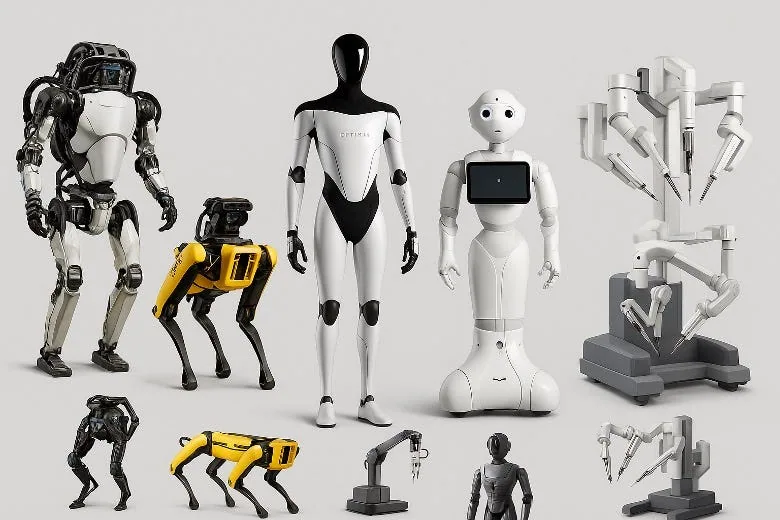
• Other Notable Players: Beyond those highlighted, there are many other significant contributors:
- Companies: Fanuc, Yaskawa, and KUKA (mentioned earlier) dominate industrial arms. DJI (China) is the unrivaled leader in drones, owning the majority of the consumer and professional drone market – effectively bringing flying robots to the masses. Intuitive Surgical (USA) leads medical robotics with the da Vinci system, and newer entrants like Medtronic and Johnson & Johnson are developing surgical robots, expanding the medical robotics industry. UPS and FedEx invest in delivery robots and drones. In the tech sphere, Alphabet/Google has various robotics projects (like the Everyday Robots project, recently consolidated, which aimed to make helper robots for offices; and subsidiary Intrinsic which works on robot software), and Apple uses extreme robotics in its manufacturing and recycling processes (including Daisy, the iPhone disassembly robot for recycling). NVIDIA plays a crucial role by providing AI computing platforms ( Jetson line) that many robots use as their AI brain. Amazon not only uses robots but also produces them after acquiring Kiva Systems; it continues to innovate in warehouse robots (like the new Proteus robot that can navigate freely among people). Universal Robots (Denmark) basically created the market for lightweight cobots and remains a leader for SMEs automating for the first time. UAV companies and autonomous vehicle startups have blurred into the robotics domain as well.
- Institutions: In academia, beyond MIT and ETH, Stanford University (with its Robotics Lab and AI Lab) has been a cradle of robotics (e.g., the Stanford arm in 1960s was one of the first robots, and Stanford’s autonomous car Stanley won the 2005 DARPA Grand Challenge). Carnegie Mellon University (CMU) is a powerhouse especially in field robotics and self- driving (hosting the National Robotics Engineering Center, NREC, which has developed robots for agriculture, mining, and defense). University of Tokyo and other Japanese universities (e.g., Osaka University’s Asimo project with Honda) have contributed to humanoid and android research. Korea Advanced Institute of Science and Technology (KAIST) won the DARPA Robotics Challenge in 2015 with its Hubo humanoid, highlighting Korea’s excellence. NASA’s JPL is an institution in its own right for space robotics (Mars rovers, robotic arms). And emerging research centers like OpenAI Robotics, Max Planck Institute for Intelligent Systems (Germany), and Oxford Robotics Institute (UK) are pushing AI-driven robotics further. Collaboration among these players is common – for example, companies frequently sponsor university research, and universities license tech to companies.
Together, these companies and institutions create a robust ecosystem: big firms provide resources and global reach, startups drive niche innovations and often get acquired to integrate their tech into larger platforms, and universities supply both new ideas and trained talent. The leading players also engage in setting benchmarks and competitions (e.g., DARPA challenges, the Mohamed Bin Zayed International Robotics Challenge, RoboCup) to spur progress. They also influence policy and public perception – for instance, when a company like Boston Dynamics demonstrates a very human-like robot, it sparks discussions on ethics and society readiness, to which institutions like MIT Media Lab contribute by studying human-robot interaction and policy frameworks.
In summary, the leadership in robotics is diverse and global. From corporate R&D labs building cutting- edge products to academic labs exploring far-future concepts, their combined efforts are rapidly advancing the field. The competition and collaboration among these players ensure that robotics technology continues to evolve at a rapid pace, benefitting from cross-pollination of ideas (for example, AI research from OpenAI finds its way into products by NVIDIA that then power a startup’s new robot). As we move forward, these established leaders will likely be joined by new entrants from regions like China (which now has many robotics startups and giants like Huawei and Xiaomi eyeing the market) and by companies from other domains (automakers becoming robotics makers, etc.), making the landscape even more vibrant.
Medical and Assistive Robotics
One of the most life-changing applications of robotics is in medicine and assistive care. From advanced surgical systems to rehabilitation devices and prosthetics,
• Surgical Robots: The flagship of medical robotics is robot-assisted surgery. The dominant system is the da Vinci Surgical System by Intuitive Surgical, which has been used in hospitals for over two decades. As of early 2025, there are more than 10,000 da Vinci robots installed worldwide 8 , and these systems have performed millions of procedures in specialties such as urology (prostatectomy), gynecology, cardiac, and general surgery. Surgical robots typically consist of robotic arms wielding surgical instruments, controlled by a surgeon at a console. They provide high precision, tremor filtering, and minimally invasive access via small incisions. This leads to benefits like less patient trauma, shorter hospital stays, and faster recovery. In 2023, sales of surgical robots continued to grow (~14% increase) despite their high costs 71 , and new competitors are entering the market – for example, Medtronic’s Hugo and Johnson & Johnson’s upcoming Ottava system (in development) aim to provide alternatives to da Vinci, potentially at lower cost. Surgical robotics is expanding beyond operating on hard tissues – there are robots for orthopedic surgery (like Stryker’s Mako for joint replacements), for neurosurgery (Stealth Autoguide, etc., for precise brain electrode placement), and for interventional cardiology (Catheter robots that navigate inside blood vessels). Limitations: Surgical robots are expensive (often $1-2 million each plus maintenance) and require significant training and setup time. They currently operate as extensions of the surgeon (the robot is not making decisions; the surgeon is in full control), so outcomes still depend on surgeon skill, just augmented by better tools. They also have limited haptic feedback (surgeons don’t directly feel forces, though visual and other feedback compensate somewhat). Current progress is toward making these robots smaller, more flexible, and more autonomous in certain steps (like automatically suturing a wound or positioning for optimal access). Research prototypes have shown autonomous suturing or endoscopy, but regulatory approval for fully autonomous tasks is still a ways off. Future direction: We can expect more AI integration – e.g., surgical robots that can highlight anatomy or tumors in the surgeon’s view using computer vision, or prevent errors by not allowing the tool to stray beyond a safe zone near critical arteries. Long term, as imaging and robotics converge, there might be “robotic surgeons” that can perform straightforward procedures start-to-finish under human supervision (this is being explored for remote battlefield or space surgeries). Another future frontier is microrobots for surgery – tiny robots that swim through blood vessels to target therapy (some early experiments exist for targeted cancer treatment). Overall, surgical robotics will continue to grow, with analysts forecasting double-digit growth and an expanding range of surgical specialties involved.
• Rehabilitation and Exoskeletons: Robotics is making a profound impact in physical rehabilitation and assistive mobility. Robotic exoskeletons – wearable robotic frameworks that strap onto a person’s legs (and sometimes torso) – are enabling some individuals with paralysis or muscle weakness to stand and walk. Companies like ReWalk Robotics and Ekso Bionics have FDA-approved exoskeletons that allow paraplegics (spinal cord injury patients) to walk with crutches for balance. These devices use motors at the joints and a backpack battery, and the user’s slight upper-body movements or a controller prompt the steps. While they don’t fully restore natural gait yet, they provide mobility and health benefits (standing and walking helps with circulation, bone density, etc.). In rehabilitation clinics, powered exoskeletons are used for gait training – therapists use them to help stroke patients re-learn walking by providing adjustable levels of support. Beyond legs, exoskeleton or robotic devices for upper limbs help patients regain arm movement; for example, there are robotic arm braces that guide a patient through exercises and assist them if they cannot complete the movement. The year 2023 saw a 128% increase in sales of rehabilitation and non-invasive therapy robots 71 , albeit from a small base, indicating fast growth in this area as the technology improves and becomes more affordable. Limitations: Exoskeletons can be heavy (20-30 kg), with limited battery life (a few hours per charge), and they are expensive (tens of thousands of dollars), which has limited personal ownership – most use is in institutional settings or via veteran’s programs. They also move somewhat slowly and require users to have some upper body strength and balance (hence often used with crutches). Current progress is focused on making these devices lighter, cheaper, and more user-friendly. Advances in materials (e.g., carbon fiber frames) and actuators (compact motors) are reducing weight. There are also soft exosuits – for example, Harvard’s Wyss Institute developed soft wearable robots using textile assistance instead of rigid frames, which help stroke patients walk by augmenting their remaining muscle function; these are lighter and more comfortable. Additionally, brain-computer interfaces are being tested to allow users to control exoskeletons with their thoughts (early demonstrations have spinal injury patients using an EEG cap or implanted sensor to trigger steps). Future direction: We anticipate exoskeletons becoming common for not just medical use but also occupational use – e.g., warehouse workers wearing exoskeletons to prevent back injuries when lifting, or soldiers using exoskeletons to carry heavy loads. As costs come down, personal exoskeletons for mobility could become more accessible, potentially allowing many wheelchair users to stand/walk for daily activities. Rehabilitation robots will likely integrate more intelligence – using AI to personalize therapy, like adjusting assistance level based on patient progress, and providing motivational feedback. Another future aspect is neurorehabilitation robots – devices that interact directly with neural signals (like FES bikes that stimulate muscles in coordination with a robotic movement). The ultimate vision is to blend exoskeletons with neural implants so seamlessly that a person with paralysis could walk almost naturally with robotic assistance reacting instantly to their intent.
• Robotic Prosthetics (Bionic Limbs): Prosthetic limbs have traditionally been passive or body- powered devices, but robotics is bringing us bionic limbs that move and feel more like the real thing. Advanced prosthetic arms, such as the LUKE Arm (developed under a DARPA program) or Hero Arm by Open Bionics, have motors at joints allowing the user to perform multiple grips, wrist rotation, and even some finger movements. Users control them through myoelectric signals – sensors pick up muscle contractions in the residual limb and translate that into hand movements (for example, flexing a certain muscle might trigger a grip). Recent breakthroughs are providing sensory feedback to prosthetic users: in clinical trials, implanted electrodes that connect prosthetic hand sensors to the user’s nerves have allowed amputees to feel rudimentary touch or pressure from the prosthetic 72 73 . In 2023, researchers demonstrated a system where a prosthetic leg under full neural control allowed users to walk with a more natural gait by providing sensory feedback from the prosthesis 70 – this is a first-of-its-kind result showing how integrating with the nervous system can drastically improve prosthetic function. Current progress: Modern prosthetic hands can do delicate tasks like picking up a credit card or typing on a keyboard, though mastering control takes practice. Some use AI pattern recognition on muscle signals to better intuit the user’s intended movement (for example, recognizing the muscle activation pattern for “pinch” vs “open hand”). Startups are also using lighter materials and 3D printing to make prosthetics more customized and affordable (Open Bionics’ Hero Arm is partially 3D printed and is relatively lower cost, aimed at young users who quickly outgrow sockets). Limitations: Prosthetic control is still not as fluid or fast as a natural limb – there can be a mental burden to operate a multi-articulating hand by thinking about individual muscle flexes. Sensory feedback is in early stages and usually requires surgery to implant interfaces, which is not widely available yet. Battery life for bionic limbs is limited (many arms need nightly charging). And cost is a big factor – advanced bionic arms can cost $50k-$100k, often beyond insurance coverage for many. Future direction: The field is moving towards more brain-driven control. Brain-computer interfaces (like implanted electrode arrays in the motor cortex) have enabled paralyzed individuals to control robotic arms with their thoughts alone in lab settings (notably, a team at University of Pittsburgh allowed a man to control a robotic arm and even feel sensations via a brain implant). By 2030, we may see commercial neuroprosthetics for some users, blending implants with prosthetic limbs for near-natural control. Also, osseointegration (directly attaching prosthetics to bone) combined with implanted signal connectors can improve comfort and bandwidth of control signals. There’s also work on prosthetic limbs with built-in AI autonomy – for example, a foot that can adjust stiffness or angle in real-time based on walking speed and terrain without user input, or a hand that can coordinate multiple joints for a smooth grasp once the user gives a general command. In terms of sensation, as research like the MIT study shows, providing a sense of proprioception (knowing limb position) and touch back to users is a key target to make prosthetics feel like part of the body. Robotics is essential here: tiny motors vibrate to give sensations, or electronic pulses stimulate nerves to convey touch/temperature. Ultimately, the goal is that a person with a robotic prosthetic hand could close their eyes and feel what they are holding, as well as move the hand just by thinking about it. We’re not there yet, but rapid progress in neural interfaces and robotics suggests a strong possibility in the coming decades.
• Assistive and Therapeutic Robots: Beyond replacing or augmenting limbs, robots are increasingly used to assist people with disabilities or special needs in daily life. For instance, assistive robot arms mounted on wheelchairs (like the JACO arm by Kinova) can help users who have limited arm function to pick up objects, open doors, and feed themselves. These arms are controlled via joysticks or even by sip-and-puff devices for quadriplegic users. They grant a level of independence in tasks of daily living. Another area is social companion robots for therapy – the cute robotic seal PARO has been used for years in dementia care to have a calming, engaging effect on patients, similar to pet therapy but without the unpredictability of a live animal. Likewise, humanoid robots like SoftBank’s Pepper or smaller robots like NAO have been used with children with autism to practice social cues and communication in a consistent, patient manner. These robots can do repetitive educational exercises or games tailored to the child’s needs. Therapeutic robots also include devices like Lokomat, a large machine that automates treadmill gait training for stroke or spinal injury rehab (supporting a patient in a harness and moving their legs – essentially a robot physiotherapist for walking practice). In mental health, experimental robotic pets or companions are being studied for reducing anxiety and loneliness. Limitations & Progress: Many assistive robots are still prototypes or not widely available due to cost and complexity. A robot butler that can cook and clean for a person with limited mobility is still beyond current tech (it involves general AI-level understanding and dexterity that we don’t yet have). Simpler tasks, however, are being handled: e.g., robotic feeders (like Obi) can help a person eat by automatically spooning food. The progress in voice assistants (Alexa, Google Assistant) has indirectly boosted assistive tech – now voice-controlled smart homes can serve many functions that a physical robot might have been envisioned for. However, physical tasks still need physical robots. Future direction: Assistive robots will likely become more common and affordable, focusing on specific needs – for example, small humanoid or arm robots that can fetch objects or manipulate household items on command for the elderly or disabled. Japan, facing an aging society, is heavily investing in “care robots” – devices that can help lift patients (robotic patient lifts), monitor them, or provide companionship. We may see semi-autonomous wheelchairs that can navigate to destinations on voice command, robotic guide dogs for the visually impaired (there was a prototype by an EU project where a robot with a cane acted as a guide). As AI improves, these robots will get better at understanding context – an assistive robot might proactively offer help if it sees a person struggling, or remind them to take medicine, etc. The hope is that such robots can help people live independently longer and reduce the load on caregivers. Ethical considerations do come into play (like ensuring dignity and privacy when using robots in intimate care), but overall the outlook is that medical and assistive robotics will greatly expand personal autonomy and healthcare capabilities.
In sum, medical and assistive robotics are advancing rapidly, transforming healthcare delivery and disability support. Surgical robots are making surgeries less invasive and more precise; rehabilitation robots are helping patients recover faster and better; exoskeletons and prosthetics are restoring mobility and ability in ways once thought impossible; and assistive robots are beginning to help people in daily tasks and emotional well-being. The technology, while impressive, is still in early adoption phases for many of these areas – hospitals and clinics in wealthier nations are using them more, but broad global access will require cost reductions. Nonetheless, the trajectory is clear: as robots become more capable and intelligent, their role in medicine will grow from tools to collaborators. We may even see in our lifetime things like a “robotic nurse assistant” that can perform basic procedures (drawing blood, changing dressings) or micro-robots that deliver drugs precisely where needed in the body. The ultimate vision combines these technologies – imagine a scenario in a few decades: a person with a spinal injury might have a neural implant and exoskeleton enabling them to walk, a personal care robot at home to assist with chores, and if they require surgery, an autonomous robotic surgeon could perform it with expert precision. While each piece is developing at its own pace, together they point to a future where disability is less limiting and healthcare is more effective and personalized, thanks to robotics.
Figure 9. Illustration of rehabilitation robotics including the Lokomat gait training device and robotic therapy arms, emphasizing robotics’ role in therapeutic recovery and patient mobility enhancement.
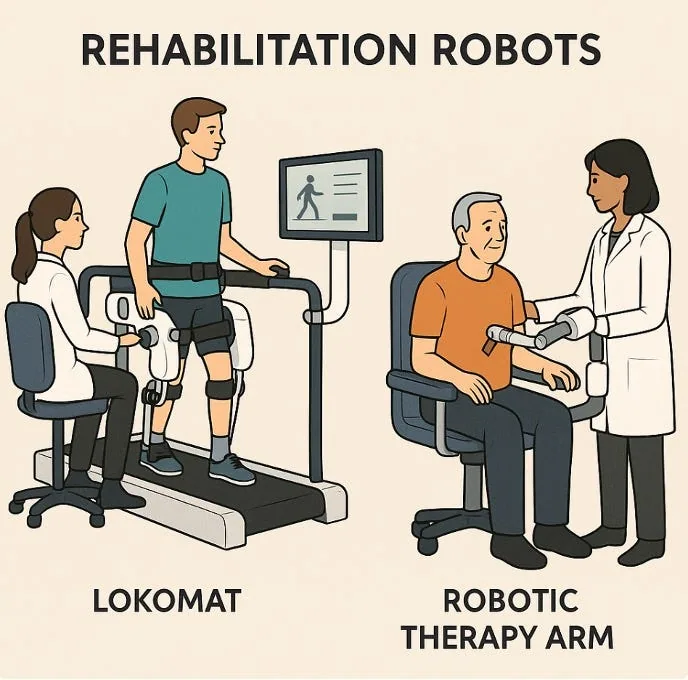
Visionary and Speculative Horizons
Looking further ahead, the convergence of robotics, AI, biotechnology, and neuroscience opens up
• Robotic Body Augmentation and Replacement: One radical vision is the replacement of the biological human body with a robotic chassis that is more capable and durable. In theory, if one could transfer or emulate all the functions of a human brain into a machine, a person’s mind could inhabit a robotic body, overcoming limitations of flesh and blood. This concept is a staple of futurism and transhumanism. Projects like the 2045 Initiative (founded by Dmitry Itskov) explicitly aim for “mind uploading to an artificial body” by the year 2045 74 . The idea would be to create avatars – initially perhaps controlled by brain-computer interfaces, and eventually containing a full copy of a person’s consciousness – that could live indefinitely. While today’s technology is nowhere near being able to replicate a human mind in software, incremental steps are being made. For instance, we’ve successfully simulated the entire neuron network of a tiny worm (C. elegans) and put that in a Lego robot, which then behaved like the worm (a simple proof of concept of transferring a brain’s “connectome” into a machine). On the human augmentation side, we already see partial merges: cochlear implants (electronic devices allowing deaf individuals to hear) and bionic eyes in trials provide senses; prosthetic limbs tied into the nervous system provide movement and touch; and brain implants like Neuralink are aiming to restore or enhance brain communication. Extrapolating these trends, future humans might incrementally replace failing biological organs with synthetic ones – a robotic heart here, a bionic eye there – until potentially much of the body is synthetic. A fully robotic body could be stronger (able to lift heavy loads), more resilient (no disease or aging in metal and silicone parts), and even adaptable (switching between different bodies for different tasks, for example). This raises profound questions about identity and humanity – when do you stop being “you”? Futurist Ray Kurzweil predicts that by 2045, mind uploading and digital immortality could become a reality 74 75 , essentially enabling consciousness in a non-biological form. Though many scientists are skeptical of the timeline, research in brain mapping, AI, and neuroprosthetics steadily advances the understanding needed to attempt such a thing.
• Digital Consciousness and Memory Upload: Achieving a digital form of consciousness – essentially mind uploading – is a speculative goal that would revolutionize robotics and human life. The concept involves scanning a person’s brain (down to every neuron connection and synapse strength) and reproducing that in a computer simulation, which could then potentially be run in a robotic body or a virtual environment. If the simulation preserves the person’s memories, personality, and thinking patterns, it would be akin to the person living on digitally. While this remains theoretical, incremental progress is being made in brain-machine interfacing and understanding the brain’s “code.” Experiments have shown that limited aspects of memory can be transferred or recorded (for example, researchers have used neural implants in rats to record and replay memory signals of a learned behavior, effectively transferring a memory). Tech pioneers argue that exponential advances in computing and AI might make full brain simulation feasible within a few decades. Once a mind is digital, it could potentially be copied, backed up, or edited (raising huge ethical issues). It could also interface directly with the vast knowledge of the internet, effectively achieving a kind of omniscience or at least instant access to information. Organizations and think tanks discussing digital consciousness emphasize philosophical questions: is the uploaded mind really you or just a copy? What rights would such digital people have? Despite hurdles, scientists and futurists foresee mind-uploading tech possibly by late 21st century, if at all 76 77 . Efforts like the Allen Institute’s high-resolution brain mapping, the EU’s Human Brain Project (which attempted to simulate components of the brain), and companies like Kernel and Neuralink working on high-bandwidth brain interfaces are paving enabling technologies. In the context of robotics, a conscious AI or uploaded human mind could be placed into a robotic body, effectively creating a “cyborg” or an android with a human mind. This ties back to countless science fiction tropes (from RoboCop to Ghost in the Shell), but we can see early pieces: people controlling robots remotely via brain signals (which has been demoed in labs for tasks like a paralyzed person moving a robot in another room by thought) or implanting chips that give people new senses (e.g., a chip that vibrates when facing north, giving a “north sense”). Memory prosthetics are also being researched – DARPA funded projects that successfully improved memory in patients by stimulating the hippocampus with patterns derived from their neural activity, hinting that we can write information into the brain to some extent. A full memory upload (downloading one’s memories to a computer for safekeeping or transfer) is far away, but conceptually, if brain simulation or scanning reaches a sufficient level, everything that makes up “you” could be preserved.
Figure 10. Visual representation of advanced robotics including Boston Dynamics’ Atlas and Spot, Tesla’s Optimus, and SoftBank’s Pepper, alongside a conceptual depiction of mind uploading, illustrating potential future integration of AI and robotics.

• DNA-based Personalization of Robotics: While at first DNA and robotics sound unrelated, there are intriguing intersections. One idea is using a person’s DNA (or overall biometric profile) to personalize robotic solutions for them. For example, a humanoid robot might be personalized using some of the user’s biological characteristics – perhaps integrating stem cells to grow biological skin around a robotic prosthetic that matches the person’s DNA for perfect biocompatibility (so the body doesn’t reject it). Or, imagine using one’s genetic info to tailor the interface between nerves and robotic implants, optimizing for their specific physiology. Another angle is DNA storage and computing for robots: DNA is an incredibly dense storage medium, and scientists have stored digital data (images, text) in synthesized DNA. A future advanced robot might use DNA molecules to store vast amounts of data (like a log of experiences or knowledge base) within a tiny volume in its “brain.” DNA-based computing could even help robots make decisions in a bio-inspired way (though this is very exploratory). There’s also a concept of using genetic algorithms and evolutionary approaches in simulation to “evolve” better robot designs – essentially mimicking DNA-driven evolution in a computer to spit out optimal robot morphologies and control systems. Over many generations of simulation, this could produce highly efficient or novel robot forms that a human engineer might not think of. When we say DNA-based personalization, another interpretation is customizing robots at the manufacturing level to individual needs – somewhat akin to how DNA makes each human unique. With advanced 3D printing and modular robotics, perhaps each household robot could be uniquely assembled to match the owner’s home layout, habits, and preferences (the analogy being each robot has its own “DNA” blueprint tailored to its environment). While not literally DNA, the idea is mass personalization, moving away from one-size-fits-all. In biotechnology, researchers are also interfacing robots with living cells – for instance, biohybrid robots that use muscle tissue (grown from cells) as actuators. One could foresee using a person’s own cells (via DNA) to grow muscular actuators or neural cultures that control a robot, which the immune system of that person would recognize as self if implanted. Essentially, your DNA could help create a robotic extension of yourself that your body accepts. All these ideas are speculative but show the convergence of bio and robo technologies. In a far future, the line between robotic and organic might blur – you might have robots partly made of organic components (living muscles, synthetic DNA computing elements) and humans augmented by synthetic components, meeting in a middle ground of biohybrids.
• Enhanced Senses and Capabilities: One clear advantage of robots is that they can be built to operate in regimes far beyond human senses and abilities. A visionary prospect for humans is to extend our sensory perception and cognitive capabilities by leveraging robotics. For example, robots routinely “see” in parts of the electromagnetic spectrum we cannot – infrared, ultraviolet, X- rays, etc. A future human outfitted with advanced robotic prosthetics or interfaces could access those spectra. Imagine having a robotic eye (or a drone feed linked to your brain) that gives you infrared vision at will – you could see in the dark or judge the temperature of objects. Or ultrasonic hearing beyond the normal range. Already, some sensory substitution devices allow blind people to “see” via vibrations or sound (the brain can re-map inputs). With direct neural links, one could feed multi-spectral camera data into the brain, effectively adding new senses. There are experiments where people wore belts with vibrators indicating compass north continuously; after weeks, they developed a “sense of direction” as an innate feeling. Similarly, a person might wear a robotic vest that provides a 360° ultrasonic sense (like bats have) – one would feel obstacles around them without looking, almost like a spatial sixth sense. Robotic extensions could also give humans new degrees of freedom – e.g., a person controlling a robotic third arm (there have been prototypes where a robotic arm attached to the torso can be controlled while the person’s natural arms do something else). Japanese researchers demonstrated a man using two extra robotic arms to help assemble furniture – effectively having four arms. Over time, the brain can adapt to using extra limbs (it’s plastic enough, as seen in tool use and such). So, future humans might don robotic exoskeletons or extra limbs when needed, to become super-capable (imagine repairing something holding a tool in each of four hands). Enhanced strength and endurance are straightforward with robotic augmentation – already exoskeletons can allow a worker to lift heavy tools for hours without strain. Cognitive enhancements via AI are another frontier: one concept is having a personal AI that works as a cognitive prosthetic, perhaps even integrated in a brain implant, that can recall information for you, perform calculations, or even monitor and regulate your emotional state. This is a less physical form of robotics (more software/AI), but paired with physical augmentation, it leads to the cyborg image of a person who is part human, part machine with vastly augmented capabilities. For instance, a future explorer could have a suite of built-in sensors (for atmosphere, radiation, etc.), an AI assistant feeding them analysis directly to their brain, and robotic limbs to traverse extreme terrain – an explorer beyond current human limits. This segues into the next point about intergalactic travel, because such enhancements would be valuable in space.
• Interplanetary and Intergalactic Exploration: Advanced robotics is expected to play a crucial role in humanity’s expansion beyond Earth. The harsh environments of space, other planets, and eventually other star systems are generally too dangerous or distant for unaugmented humans. Robots, however, are already paving the way: Mars rovers (Spirit, Opportunity, Curiosity, Perseverance) have been exploring Mars for years, acting as our telepresence avatars on another world. In the near future (the 2020s and 2030s), robots will help build outposts on the Moon and Mars before humans arrive. For example, NASA’s Artemis program plans to use robotic landers and rovers to scout lunar resources (like water ice) and perhaps begin excavation and construction tasks. Concepts exist for robotic 3D printers that could use lunar soil to build habitat walls or landing pads. By the time astronauts land to establish a base, robots would have ideally already created basic infrastructure and ensured the environment is safe. On Mars, the vision is similar: swarms of robots could be sent ahead to erect habitats, life-support systems, and even start growing food in sealed greenhouses, so that when humans get there, the essentials are in place. Looking further, if humanity ever attempts interstellar travel, sending human astronauts is extraordinarily challenging due to the long durations (even at a fraction of light speed, a trip could take decades or centuries). Instead, sending robotic probes with AI – essentially robotic explorers – is more feasible. These could be equipped with human-like decision-making to autonomously conduct science, and possibly even with uploaded human minds if that technology comes to fruition, meaning explorers could experience other star systems vicariously through robots. There’s a theory of sending “seed” robots that could land on a distant planet and then perhaps build more robots (self-replication) and prepare an environment for eventual colonists. This is far future, but shows how robotics would be the vanguard of interstellar exploration. Elon Musk and others have mused about “terraforming Mars” – a massive task that would likely involve armies of autonomous machines over generations modifying the environment. Another futuristic scenario is generation ships or hibernation pods: if humans travel in suspended animation, they’d rely on robotic caretakers to maintain the ship and the sleepers for potentially hundreds of years. Thus, robots may effectively crew future starships. Intergalactic travel (beyond our galaxy) is an even more remote idea, but any such venture would certainly be impossible without extremely advanced robotics to sustain itself over millennia.
Figure 11. Conceptual diagram of robotic missions to the Moon, Mars, and beyond, highlighting robots’ essential role in space exploration and the groundwork for future human missions to other celestial bodies.
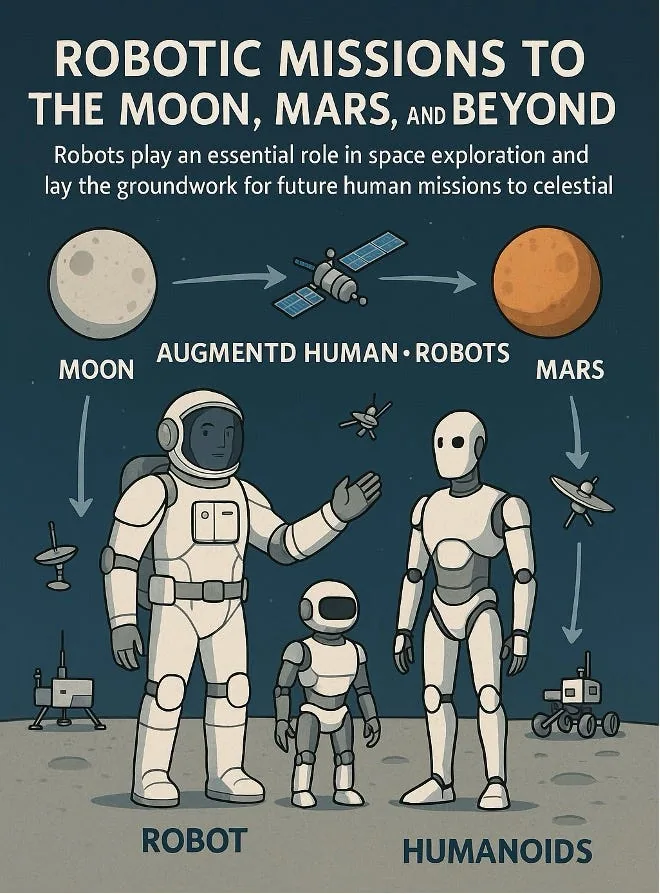
Furthermore, if at some point human consciousness can be digitized, one could beam or send that as data to a waiting robotic body at the destination (assuming the infrastructure exists) – bypassing the need to send fragile biological bodies. While this is speculative, it’s been discussed in theoretical terms as a way to overcome the light-speed travel limit for humans: send the info, not the meat. Even within the solar system, we see hints of this: astronauts on the ISS have remotely driven rovers on Earth or controlled robots like NASA’s robonaut. In the future, an astronaut orbiting Mars might remotely operate many robots on the surface in real-time (avoiding speed-of-light lag from Earth), acting as a “telepresence explorer.” This would combine human judgment with robotic endurance.
Lastly, advanced humanoid robots could themselves become the explorers of hazardous places: think of diving into the oceans of Europa (a Jovian moon) with a humanoid robot controlled by scientists – effectively sending a mechanical proxy where no person could survive. If that robot had a sophisticated AI, it could make on-the-spot discoveries and decisions.
All told, advanced robotics is our ticket to go to places and achieve feats that were purely in the realm of imagination. The synergy of human minds and robotic bodies – whether through remote control, AI assistance, or full mind transfer – might one day allow individuals to “travel” to extreme environments virtually or in robotic form. The visionary endgame is sometimes portrayed as a kind of convergence: humans evolving into a cybernetic species that lives in many forms – biological, robotic, virtual – choosing depending on the situation. You might have a biological body on Earth, but beam your consciousness to a robotic avatar on Mars for a day’s work, then later explore the cloud tops of Venus in another drone body, all in one lifetime.
While these ideas currently live in theoretical papers and sci-fi, each is backed by at least a kernel of active research: – Mind uploading is contemplated by neuroscientists and futurists (with Kurzweil predicting it by 2045 74 ). – Neural implants and BCIs are in human trials (Neuralink planning human tests, BrainGate already let people type via thoughts). – Longevity science combined with cyborg tech could extend life via synthetic organs. – Sensory extension experiments show the brain’s adaptability. – Space agencies explicitly plan for robotic precursors for human exploration.
Achieving these will require overcoming enormous technical and ethical challenges: scanning a brain without destroying it, ensuring continuity of identity, safeguarding digital minds from hacking, preventing runaway AI, and establishing rights for augmented humans or sentient machines, to name a few. There are also philosophical questions – would a life in a robotic body or virtual environment be fulfilling in the same way? How do we preserve what is fundamentally human in such transitions?
Regardless of how far these developments go, thinking about them helps guide present research. Even if full digital immortality isn’t attained, striving for it yields medical advances (better brain understanding, better prosthetics for the disabled in the interim). Space robotics done for exploration helps automation on Earth, and vice versa.
In conclusion, the future of robotics and humanity is intertwined in profound ways. The current trajectory suggests that robots will increasingly enhance human abilities (physically and cognitively), and humans will increasingly shape robots in our image – perhaps ultimately merging. As speculative as these scenarios are, they underscore an overarching trend: we are leveraging technology to transcend our natural limitations. Robotics, combined with AI and biotech, is the key enabling technology for that transcendence. If the boldest visions come true, the mid-to-late 21st century could see humans with optional mortality, living through robotic embodiments, and expanding life to the stars – effectively a new era of evolution where intelligent life deliberately directs its own development using its robotic creations.
By Erasmus Cromwll-Smith
May 23rd. 2025.
Simply the truth about current affairs
Sources:
1. International Federation of Robotics (IFR), World Robotics 2024 – global statistics on robot installations and densities 2 18 28.
2. IFR, Korea (1012/10k), Singapore (770/10k), China (470/10k), etc. 25 18.
4. IFR Press Release (Mar 2025), strategy and market share 21 13.
5. Boston Dynamics Press Release (Apr 2025) – Hyundai’s plan to buy tens of thousands of robots, integration of Atlas and Spot in manufacturing 27 52.
6. U.S. National Robotics Roadmap 2024 – notes on China buying 52% of robots sold in 2022, US ranking 10th in adoption 78 79.
7. All About Industries (Oct 2024), sold in 2023, especially logistics robots 80 6.
8. IFR Secretariat Blog ( Jan 2025), SoftBank’s pullback 60 61.
10. Medium (May 2025), uploading by 2045 and 2045 Initiative goals 74 75.
11. Brown University News (May 2025), motion as language 41 42.
12. ETH Zurich News (Mar 2024), obstacles autonomously 43.
13. MIT News ( July 2024), 1. Neural-controlled prosthesis restores natural gait – seven patients with new surgery walked more naturally with bionic legs 70.
14. PatentPC Blog (Apr 2025), Top Robotics Vendors – market share of industrial robot firms: Fanuc ~18%, ABB ~14%, Big 4 hold ~50%+ 68 67.
15. IFR Press Release (Feb 2025), Robotics R&D Programs 2025 – summary of government strategies in China, Japan, Korea, EU, US (e.g., Korea’s Basic Plan 2024–2028 with $128M funding, EU Horizon Europe robotics budget €174M) 26 37.
1 3 4 5 20 39 40 44 45 48 49 50 Top 5 Robot Trends 2024 – International Federation of Robotics https://ifr.org/ifr-press-releases/news/top-5-robot-trends-2024
2 12 PowerPoint-Presentation https://ifr.org/img/worldrobotics/Press_Conference_2024.pdf
6 71 80 Global Sales of Professional Service Robots Jump by 30%
https://www.all-about-industries.com/global-sales-of-professional-service-robots-jump-by-30- a-48fb5356d14077a18a550c2b64e0ad98/
7 Applications of Agricultural Robots in 2024 – Atlantic Project Cargo
https://atlanticprojectcargo.com/insights/full-guide-how-are-robots-used-in-agriculture-in-2024
8 [PDF] Intuitive Announces First Quarter Earnings
https://isrg.intuitive.com/node/21931/pdf
9 2.1 million domestic floor cleaning robots sold in 2023 – International Federation of Robotics
https://ifr.org/post/21-million-domestic-floor-cleaning-robots-sold-in-2023
10 iRobot Reports Fourth-Quarter and Full-Year 2023 Financial Results
11 iRobot Reports Fourth-Quarter and Full-Year 2023 Financial Results
Robotics China to Invest 1 Trillion Yuan in Robotics and High-Tech Industries – International Federation of
14 19 22 24 26 30 31 35 36 37 38
International Federation of Robotics Robotics Research: How Asia, Europe and America Invest –
15 16 78 79 ROADMAP Master https://hichristensen.com/pdf/roadmap-2024.pdf
18 23 25 28 32 33 34 Federation of Robotics Global Robot Density in Factories Doubled in Seven Years – International
https://ifr.org/ifr-press-releases/news/global-robot-density-in-factories-doubled-in-seven-years
27 52 53 Boston Dynamics & Hyundai Motor Group Expand Collaboration to Drive Mobility Manufacturing & Innovation | Boston Dynamics
https://bostondynamics.com/news/boston-dynamics-hyundai-motor-group-expand-collaboration-drive-mobility-manufacturing- innovation/
29 Robot Installed in US Auto Industry Up by Double Digits
https://ifr.org/ifr-press-releases/news/robot-installations-in-us-auto-industry-up-10.7
41 42 Researchers develop AI motion ‘translation’ model for controlling different kinds of robots | Brown University
https://www.brown.edu/news/2025-05-08/robot-motion
43 ANYmal can do parkour and walk across rubble | ETH Zurich
46 Google’s PaLM-E is a generalist robot brain that takes commands
https://arstechnica.com/information-technology/2023/03/embodied-ai-googles-palm-e-allows-robot-control-with-natural- commands/
47 Google’s PaLM-E embeds vision with ChatGPT-style AI model to …
51 74 75 76 Uploading Consciousness: The Road to Digital Immortality by 2045? | by Markus Kreth | May, 2025 | Medium
54 55 56 57 58 59 Optimus (robot) – Wikipedia https://en.wikipedia.org/wiki/Optimus_(robot)