Current Events
THE CASE FOR MARS
When Elon Musk talks about making humanity a “multiplanetary species” by settling Mars, he’s highlighting a critical truth: Humans must learn to survive beyond Earth if we are to endure in the long run. Establishing colonies on Mars is not just about exploring a new world – it’s training for an even greater journey. Our ultimate challenge is to prepare humanity for life beyond the Solar System, perhaps even in another galaxy. Current efforts by SpaceX and other organizations to build sustainable habitats on Mars are essential first steps. They are teaching us how to live on another planet, which in turn develops the technology and expertise required for eventual interstellar travel.
The themes explored in this article—digitized consciousness, brain-computer interfaces, and humanity’s evolutionary leap into a post-biological species—are intricately woven into my works of speculative fiction.
In Algorithm-323, I explore the philosophical and ethical ramifications of mind-mapping technologies, with CDA systems capable of intercepting real-time neural signals. The story functions as a cautionary tale set against the backdrop of our accelerating merger with machines.
Meanwhile, The Rebel Hackers of Point Breeze (written under the pen name Nelson Hamel) dives into AI powered by quantum computing that digitizes human brains and genomes, allowing human beings to upload, download, and transfer consciousness across devices and networks.
These narratives reflect the very real trajectory humanity is on—and mirror the transformative technologies that articles like this aim to unpack. In both fiction and fact, the question remains: what will we become, and how will we carry our humanity forward into the stars?
In this article, we’ll explore why hopping to Mars is only the beginning. To secure our survival, we’ll need to ride out the dying of the Sun, overcome our biological limits, and even reinvent ourselves as a new kind of species capable of journeying among the stars.
The Death of a Star: Our Sun’s Mortal Journey
Stars are not eternal – even our Sun will eventually die. Understanding the Sun’s life cycle helps explain why staying in the Solar System forever isn’t an option. Our Sun is currently a stable yellow dwarf in its middle age, peacefully fusing hydrogen in its core. But in about 5 billion years, it will exhaust the hydrogen fuel at its center and begin to die
. What happens next is nothing short of cosmic drama:

Chart: Timeline of the Sun’s life and death stages, from now through red giant and white dwarf phases.
As the Sun runs out of core fuel, gravity wins for a while – the core will contract and heat up, and the outer layers of the Sun will expand enormously, turning the Sun into a Red Giant star.
In this swollen red giant phase, our Sun’s radius will extend hundreds of times its current size, likely out past the Earth’s orbit.
In fact, by the time the Sun reaches its maximum size as a red giant (~7.5 billion years from now), it will be about 250 times larger in diameter and over 1,000 times more luminous than today.

Chart: Evolution of the Sun into a Red Giant
In the process, it will scorch and engulf the inner planets – Mercury and Venus will be swallowed, and Earth is expected to be either completely vaporized or charred to a barren cinder.
After this violent climax, the Sun will shed its outer layers. Picture a star coughing up its atmosphere into space, creating a glowing shell of gas called a planetary nebula. All that remains will be the Sun’s hot, dense core, now exposed – a White Dwarf about the size of Earth.
The Sun will spend the rest of time as this white dwarf ember, gradually cooling off. Eventually (trillions of years in the future) it will become a cold, dark Black Dwarf, though the universe isn’t old enough for any black dwarfs to exist yet.
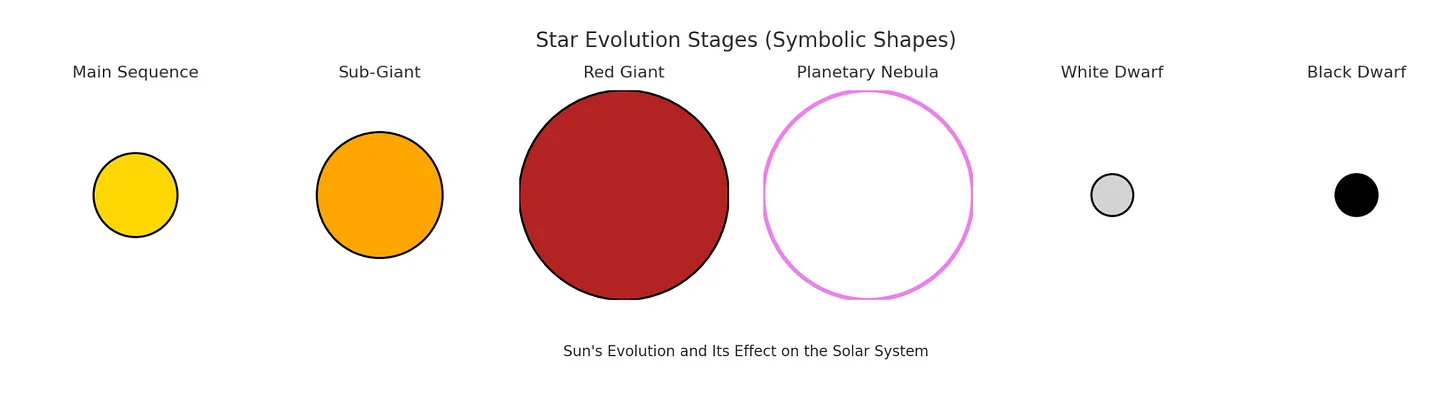
Chart: Star Evolution Stages (Symbolic Shapes)
To imagine this transformation, consider an analogy: the Sun as a giant campfire. For billions of years, it burns steady and bright (main sequence). When fuel runs low, it flares up wildly like a bonfire tossed with new fuel – huge flames (red giant phase) that briefly light up everything around but are unsustainable. Finally, the fire burns down to a small, hot coal (white dwarf) that glows faintly before fading away. In the Sun’s case, the “new fuel” in the analogy is helium: once core hydrogen is gone, the Sun will fuse helium in a last burst of energy, causing it to balloon in size and luminosity.
This helium fusion is like those sudden bursts of flame when you stoke a dying fire – spectacular but short-lived.
The timeline of these stages is immense on the human scale. The Sun’s stable life (main sequence) lasts about 10 billionyears in total, and we are roughly halfway through that.
The red giant phase will be relatively brief, on the order of a few hundred million years, and the white dwarf will then cool for trillions of years.
These numbers are hard to fathom – our own recorded history is mere thousands of years. By comparison, the Sun’s death throes and aftermath span epochs beyond imagination. Yet, as colossal and distant as these events are, they carry direct consequences for our tiny habitable world.
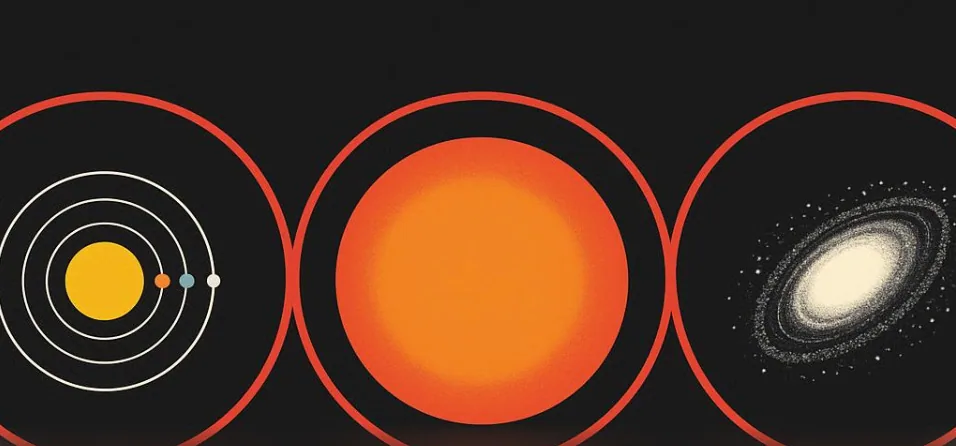
Chart: The Sun expands 250 times rendering the solar system inhabitable. After such destruction climax, the balloon deflates the Sun deflates becoming a White Dwarf until it totally cools down becoming a Black Dwarf forever more.
The Death of a Planet: Earth’s Fiery Fate
Earth has been our comfortable home for some 4.5 billion years, but it cannot stay safe forever. Long before the Sun engulfs it, Earth will likely be sterilized. In fact, life on Earth will be in peril well before the Sun’s red giant phase. As the Sun ages on the main sequence, it’s slowly getting brighter (about 10% increase per billion years). Climate models suggest that within 1–1.5 billion years from now, that increased solar output will overheat Earth enough to trigger runaway greenhouse effects, evaporating the oceans and wiping out complex life.
So even while the Sun still looks “normal,” Earth may become uninhabitable due to this intensifying solar radiation.
If by some chance life clings on until the red giant phase, the situation grows even more dire. During the red giant stage, Earth’s surface will be literally baked and then engulfed. The expanding Sun will boil away our oceans and strip Earth’s atmosphere long before actual contact. In those final millions of years, Earth would be a scorched, airless wasteland, its surface molten or at least searingly hot. Eventually, as the Sun’s bloated atmosphere reaches out, our planet (and any last traces of humanity on it) will be devoured by the Sun’s fiery plasma.
All the rocks, fossils, and monuments – every record of us – will be obliterated without a trace.
It’s sobering to realize that nothing on Earth is permanent on cosmic timescales. The planet itself will either be consumed or left as an uninhabitable cinder. To survive, life must leave Earth well before these final calamities. This is a key motivation for becoming an interplanetary (and ultimately interstellar) species. It’s not optional if we care about the distant future – it’s necessary for survival. Mars often comes up as the next haven, so what happens there when the Sun dies?
What Happens to Mars: A Temporary Refuge
Mars lies about 50% farther from the Sun than Earth, so it will fare slightly better during the Sun’s death spiral – but only slightly. Initially, as the Sun swells into a red giant, Mars might actually enjoy a brief period of warmth. The habitable zone (the band where temperatures allow liquid water) will move outward as the Sun’s luminosity increases.
For a short time, regions of the outer Solar System could thaw. In a poetic twist, the frozen deserts of Mars could become balmy; the Kuiper Belt’s icy worlds far beyond Neptune might turn into tropical oases (Alan Stern quipped that during the red giant phase, the Kuiper Belt would be like “Miami Beach”). So, Mars and the outer moons might briefly have conditions suitable for life while the inner planets are being roasted.
However, this pleasant phase for Mars would be fleeting. Mars may escape being physically engulfed by the Sun’s atmosphere – calculations suggest the Sun’s red giant radius will reach somewhere around Earth’s orbit, putting Mars near the edge of danger. But even if Mars isn’t swallowed whole, it will be anything but hospitable. The intense heat and solar wind from the red giant Sun will likely strip Mars of any remaining water and atmosphere. As one science article notes, Mars might “escape the Sun’s actual reach… but that water will likely all be gone by the time the red giant star takes over the inner solar system.”
In other words, Mars will become a bone-dry, airless rock – essentially a larger version of Mercury’s current state. Any atmosphere or surface ice Mars has during early red giant times would be blasted away by the escalating solar flux.
So while Mars might survive the Sun’s expansion in a physical sense, it won’t remain a sanctuary. At best, it’s a temporary refuge – a waystation that could buy our species a bit more time. Humanity’s long-term survival cannot be secured by Mars alone, because Mars too will ultimately succumb to the Sun’s demise. The Red Planet offers us a critical learning opportunity in the relatively near term (the next few centuries) to practice living off-Earth. But in the grand scheme, we will have to set our sights even farther out: beyond Mars, beyond the asteroid belt, perhaps to the moons of Jupiter and Saturn, and eventually out to the Kuiper Belt and Oort Cloud. And after that, to the stars.
Summary of Timescales
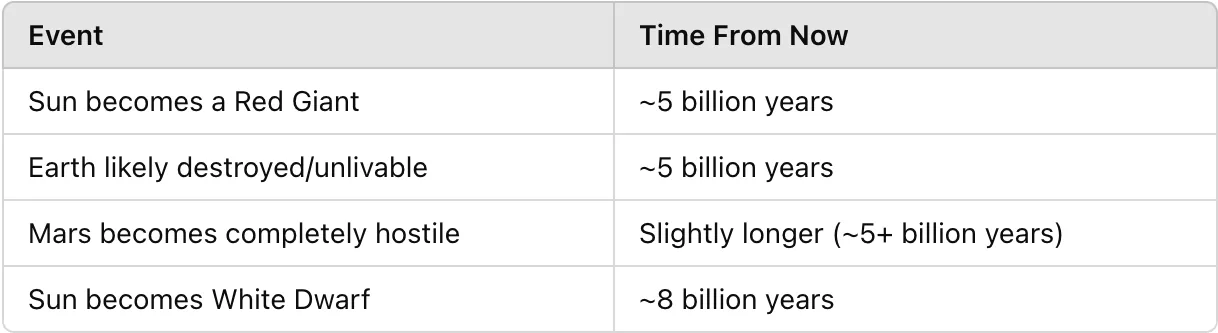
Conclusion:
- The Sun will eventually destroy Earth (and Mars) around 5 billion years from now when it becomes a red giant.
- It will then transition through various stages, becoming a planetary nebula and finally a white dwarf star.
- Moving humanity to Mars might add only a tiny fraction of additional survival time—measured in millions, not billions of years—so humanity would ultimately need to leave the inner Solar System entirely for long-term survival.
Thus, Mars is a short-term step, but not a long-term solution. Humanity’s long-term survival requires migration beyond our planetary neighborhood.
Beyond Mars: Venturing Outside the Solar System
Main Obstacles:
- Our Biological “Chasis.” Evolution pace not fast enough,
- Need to become Exponentially Smarter, Pronto,
- Propulsion Systems are inadequate,
- Human Energy Harnessing and Utilization is at a primitive stage.
Provided we conquer these formidable barriers, in the end, human survival hinges on leaving the Solar System entirely. Even if we establish thriving colonies on Mars or the moons of Jupiter, they all orbit the same doomed Sun. To survive the Sun’s red giant inferno and its aftermath, we would need to migrate outward as the habitable zone drifts to the cold fringe of the Solar System. For example, as the Sun brightens, humans might move from Mars to icy moons like Enceladus or Europa (which could melt and develop oceans), then further out to dwarf planets like Pluto when they warm up. But once the Sun enters its terminal phases, even those distant worlds will eventually freeze over or be fried in their own ways. Ultimately, no planet or moon in our Solar System offers permanent security – once the Sun becomes a white dwarf, all remaining planets will be cold and dead.
The logical conclusion is that we must become an interstellar species if we want our lineage to outlive the Sun. This means traveling to other star systems and finding (or engineering) new homes orbiting other stars. And not just one other star – over cosmic times, stars too have finite lifespans. In the very far future, even whole galaxies change. Thus, the journey of life may be one of constant migration, hopping from star to star, galaxy to galaxy, to wherever conditions are favorable.
How daunting is that? The nearest star to us, Alpha Centauri, is about 4.37 light-years away (over 40 trillion kilometers). With today’s technology, a spacecraft like Voyager 1 (traveling ~17 km/s) would take on the order of 70,000+ years to reach that star. Even a more optimistic propulsion could take centuries or millennia. The distances are mind-boggling. To illustrate the challenge, below is a chart of approximate travel times from Earth to various destinations, using current or near-future technology:
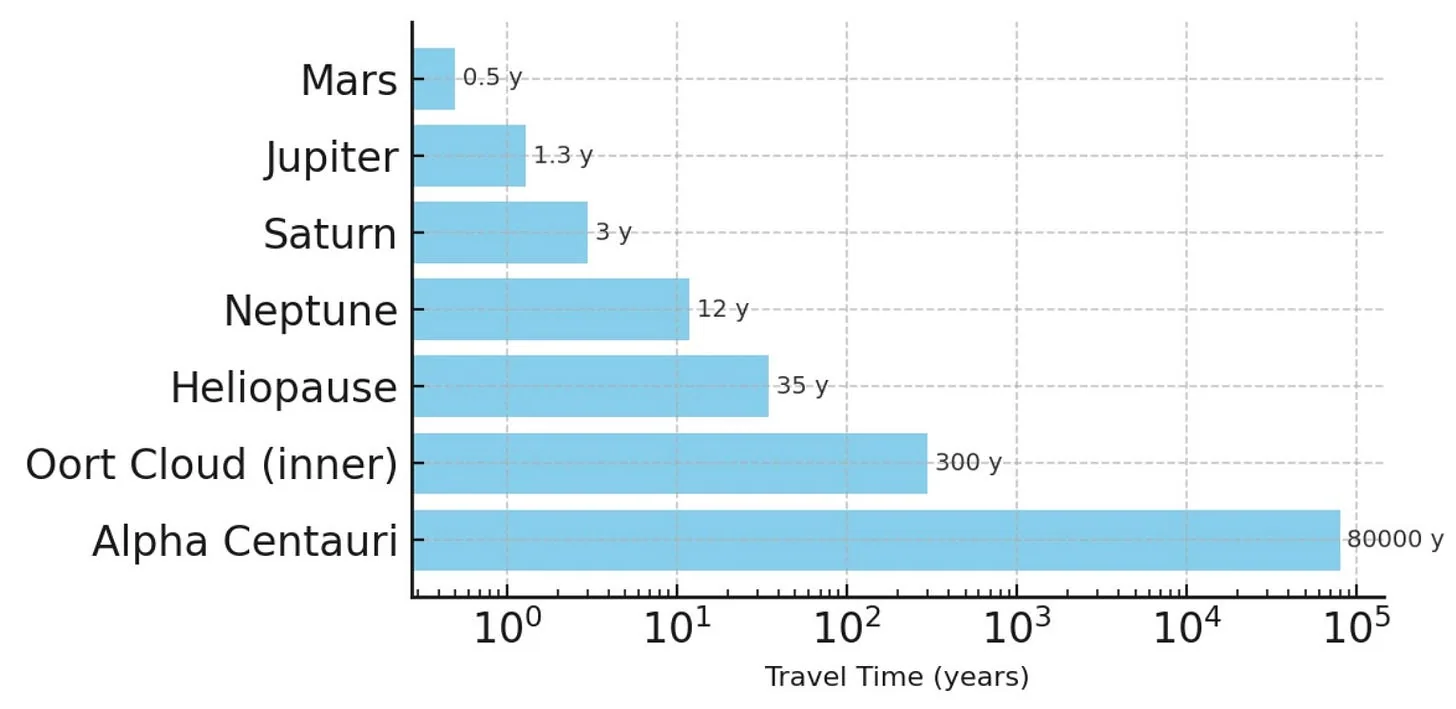
Chart: Logarithmic plot of travel times from Earth – from months (to Mars) up to tens of thousands of years (to the Oort Cloud and Alpha Centauri) at conventional spacecraft speeds.
As the chart shows, getting to Mars might take 6–9 months (launch window every ~ 26 months), Jupiter will take 1.3 years (launch window every ~ 13 months), Saturn will take 3 years (launch window every ~ 13 months), and reaching Neptune takes about 12 years with present-day probes【58†】. The Voyager 1 probe took 35 years just to cross the heliopause (the Solar System’s boundary where solar wind yields to interstellar space).
Projections suggest it would take ~300 years for Voyager to reach the inner edge of the Oort Cloud (the reservoir of comets about 1,000 AU out) and 30,000 years to traverse it.
At those speeds, a trip to Alpha Centauri would require tens of millennia – on the order of 80,000 years【58†】. Clearly, to become interstellar travelers, we need breakthroughs in propulsion (or fundamentally new methods of travel or suspended animation).
Factors Affecting Travel Times:
- Launch vehicle and spacecraft propulsion.
- Trajectory and planetary alignments (gravity assists).
- Orbital insertion strategy (flyby vs. orbit vs. landing).
Yet, while the engineering challenges are enormous, the imperative is clear: if we stay confined to one dying Solar System, we’re ticking off the time until extinction. Reaching new star systems is the only strategy to ensure that life (in some form) goes on. This raises a profound question: Are humans – with our frail bodies and limited lifespans – equipped for such a journey? To even attempt multi-generational space travel or colonization of distant worlds, we must confront our own biological and intellectual limitations.
Current Propulsion Technologies and Limitations:
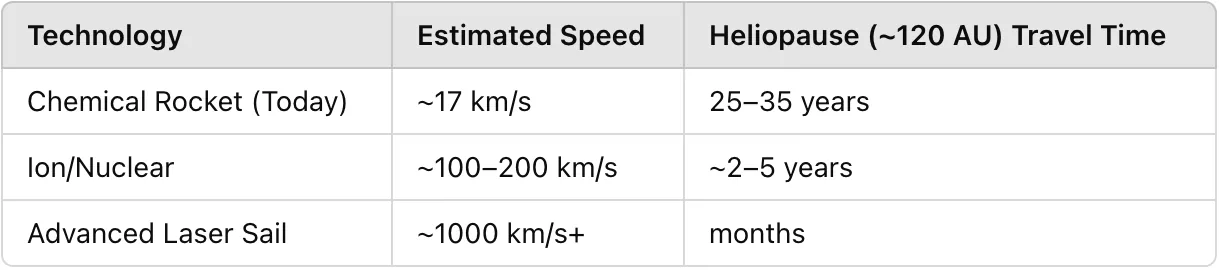
Current propulsion (chemical rockets + gravity assists):
- Maximum achieved speed: ~17–20 km/s.
- Not sustainable for long-term acceleration.
- Requires gravity-assist maneuvers for faster speed.
Future Propulsion Systems (Possible Improvements):
- Future propulsion could greatly reduce these travel times:
- Nuclear propulsion (fusion/fission): Could increase speeds to 50–200 km/s.
- Solar sails or laser propulsion: Potentially hundreds or thousands of km/s.
- Ion or electric propulsion: Slow acceleration but higher top speed potential.
- Antimatter propulsion (theoretical): Fraction of speed-of-light travel.
Conclusion:
- With current propulsion technology, reaching the Solar System’s boundary at the heliopause requires ~25–35 years.
- Reaching the theoretical Oort Cloud boundary would take tens of thousands of years, making it impractical with today’s technology.
- Significant propulsion breakthroughs are necessary to explore and travel beyond our Solar System efficiently within human timescales.
The Limits of Human Biology and Understanding
As remarkable as the human organism is, it evolved for a cozy life on Earth, not the depths of space. Biologically, we are ill-suited to be a spacefaring species without significant augmentation. Consider our basic sensory and cognitive framework, which is quite narrow:
- We see only a tiny slice of the electromagnetic spectrum. Our eyes detect wavelengths ~390–700 nm (visible light), which is but a minuscule fraction of all light. We’re blind to radio waves, microwaves, infrared, ultraviolet, X-rays, and gamma rays without the aid of instruments. The universe emits light across a vast spectrum, yet unaided we perceive almost none of it. In essence, we navigate the cosmic ocean with vision equivalent to a narrow keyhole.
- We hear only a narrow band of frequencies. The typical human hearing range is about 20 Hz to 20 kHz. We can’t hear infrasound below that (which elephants and whales use) nor ultrasound above it (which bats and dolphins use). Meanwhile, the universe is filled with vibrations and signals at frequencies far beyond our auditory reach.
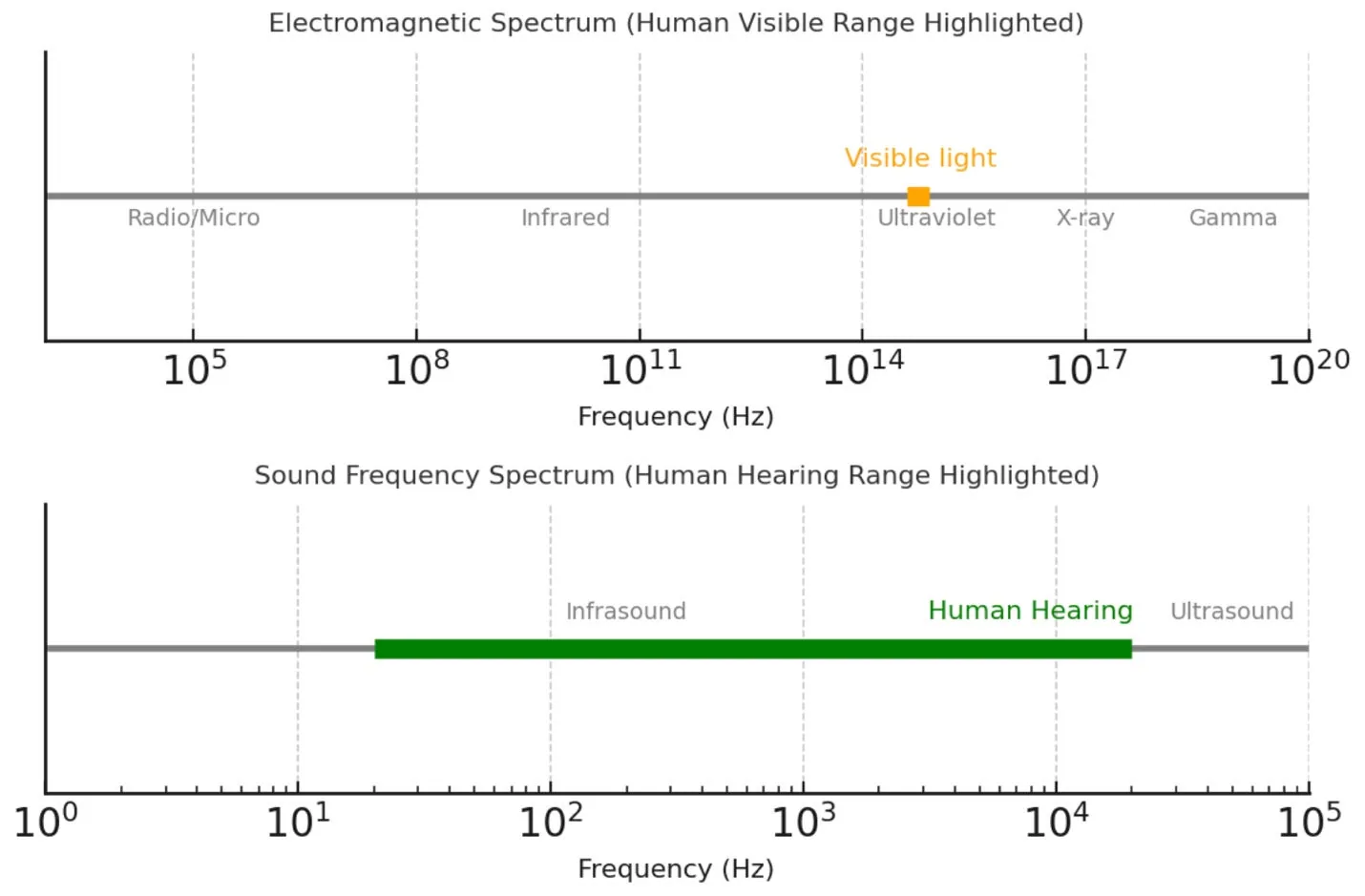
Graphic: Human sensory ranges vs full spectra – the visible light band highlighted on the vast electromagnetic spectrum (top), and the human auditory range highlighted within the broad spectrum of sound frequencies (bottom).
Our limited senses mean there’s a great deal of reality we simply don’t experience. We have built detectors and telescopes to extend our perception (radio antennas, X-ray telescopes, etc.), effectively giving us “machine senses” to observe what our biology cannot. Even so, our intuitive understanding of the world is shaped by those narrow bands we evolved to perceive. We easily misunderstand phenomena outside our native scale. Quantum mechanics is famously counterintuitive – particles behaving as waves, being in multiple states at once – because nothing in our everyday 3D macroscopic world prepared our brains for it. Likewise, concepts like 4-dimensional spacetime or invisible dark matter elude direct grasp.
And indeed, modern science tells us that most of the universe is composed of stuff we cannot directly see at all. Only ~5% of the universe is normal matter (the atoms making up stars, planets, and us); about 27% is dark matter and 68%is dark energy. These dark components don’t emit light; we infer dark matter’s existence from its gravity and dark energy from the accelerated expansion of the universe. In a very real sense, we are mostly blind – our eyes see a scant slice of light and our minds struggle to comprehend entities like dark matter which have no human-scale analogy.
There are also physiological constraints. Our bodies are vulnerable to radiation in space, our muscles and bones degenerate without gravity, and we require a narrow range of temperature, pressure, and chemistry to survive. We live on average <100 years, which is trivial next to cosmic times. Even our pace of thinking and reacting might be slow or inadequate for AI-level decision-making needed in complex space missions.
All these limitations suggest that the humans who venture to the stars may not be “human” in the exact way we define today. To truly become interstellar, we likely must modify ourselves – biologically, cybernetically, or digitally – to widen our senses, improve our robustness, and maybe even transcend the mortal lifespan of our flesh.
There is an urgent need for the human race to become exponentially smarter now. Biological evolution operates on geological timescales—hundreds of thousands to millions of years—and simply cannot keep pace with the accelerating demands of space exploration and the complexity of interstellar travel. If humanity intends to outlive our home planet and venture meaningfully into deep space, relying on natural evolution to enhance our cognitive abilities, senses, and resilience is not an option. Evolution, unaided, is far too slow and directionless to meet the pressing challenges of interplanetary survival, let alone interstellar colonization.
The rapid expansion of our cognitive frontiers through artificial intelligence, cybernetic augmentation, and genetic engineering thus becomes not merely desirable but essential. The cosmic clock is ticking, and the pace of technology has now outstripped biological evolution by several orders of magnitude. Waiting for natural evolutionary processes to shape us into beings fit for the cosmos would leave humanity stranded, unable to comprehend or respond effectively to complex extraterrestrial threats or environmental challenges encountered beyond Earth. The imperative for immediate intellectual and sensory augmentation emerges precisely because natural biology cannot evolve quickly enough to meet the critical deadlines set by cosmic-scale events, like our Sun’s transformation into a red giant or the existential risks we might face from celestial or technological disasters.
Thus, the drive to enhance human intelligence exponentially—through digital integration, brain-computer interfaces, or other advanced augmentation—is rooted not just in ambition or curiosity, but in sheer necessity. It represents our only viable pathway to adapt and thrive in the rapidly approaching era of deep space exploration and long-term species survival.
Evolve, Enhance, or Digitize: Becoming a New Species
The future of spacefaring humanity could involve directed evolution or transformation into a new form of life. This sounds like science fiction, but the seeds are already here: consider how technology is merging with biology. We have cochlear implants to restore hearing, retinal implants for vision, neural implants under development to interface brains with computers. These are early steps toward what many futurists call transhumanism – enhancing human capacities through science and tech. In the context of interstellar survival, such enhancements aren’t just fanciful; they may be essential.
One path is genetic engineering: We might alter our DNA to better handle radiation or low gravity, or to enter suspended animation for long voyages. Another path is cyborgization: integrating machines into our bodies (or our minds) for greater durability and capability. For instance, artificial intelligence paired with human consciousness could assist in making sense of complex data far faster than an unaided brain.
A more radical idea is mind uploading or digital consciousness. This involves transferring or copying human minds into robust, non-biological substrates – essentially, software running on advanced hardware. If consciousness (and identity) could exist as digital information, it might be freed from the limits of a carbon-based body. Imagine “people” who are really sophisticated AI hosting human minds, traveling through space as information patterns. They could endure conditions (and timescales) that no organic human could. Such digital beings might even dispense with vehicles: in principle, they could be transmitted as radio signals to distant stars (at light speed) and reconstituted in robotic bodies upon arrival. It sounds fantastical, but serious thinkers have proposed that the ultimate travelers might be post-biological intelligences – perhaps that’s even what advanced alien civilizations become.
This brings us to the concept of potentially becoming a new species. If we alter ourselves enough – be it through genetic evolution or cybernetic replacement – future spacefarers may no longer be Homo sapiens as we know it. They could be a new branch: Homo stellaris or even entirely synthetic life forms. Such a species could have senses that span wider spectra (seeing infrared or radio naturally), could think faster or in multiple threads (like parallel processors), and could live indefinitely by repairing or upgrading themselves.
There is an image (uploaded alongside this text) that metaphorically captures this idea of transformation. Picture a human silhouette merging into a starry cosmos, the figure’s body dissolving into digital pixels or cosmic dust. This kind of artwork symbolizes the evolution of humanity into something greater and more ethereal – part biological, part technological, and wholly adapted to life in space. The symbolism is powerful: a creature shedding its Earthly form to be reborn among the stars. It reflects key themes of transformation and spacefaring evolution. Humanity’s future might involve literally merging with our technology and with the cosmos – becoming hybrid beings who can spread intelligence across the galaxy. The “new species” that carries forth our legacy could be as different from us as we are from our primate ancestors.
Embracing this transformation is daunting. It raises profound philosophical and ethical questions: What does it mean to be human if our minds live in machines or our genomes are rewritten? Do we lose something essential, or do we carry our humanity with us in our values, memories, and culture? These are questions we must answer, but the trajectory of technological progress suggests that increasing human-machine integration is likely.
Reaching for Type II and III: Mastering Energy for the Stars
Transcending our limitations goes hand in hand with harnessing vastly more energy than our civilization currently uses. In 1964, astronomer Nikolai Kardashev proposed a scale of technological civilizations based on energy consumption. On the Kardashev Scale, a Type I civilization uses all the energy available on its home planet, Type II uses all energy of its star (e.g., via a Dyson sphere encompassing the Sun), and Type III harnesses the power of an entire galaxy. Humanity today is around Type 0.7 – we’re not even fully utilizing Earth’s potential yet, but we’re on the way. To become truly spacefaring, especially interstellar, we likely need to advance to Type II or beyond, tapping into enormous energy resources.
Why is energy so crucial? Because travel to other stars, terraforming planets, sustaining large populations off-world – all of it is incredibly energy-intensive. For example, building and propelling a starship to a significant fraction of light speed might require the output of a small star. Keeping a colony alive on a hostile planet or in a spaceship needs constant energy for life support, manufacturing, and protection. The more energy we can access and control, the more ambitious our space endeavors can be. Reaching Type II (harnessing our Sun’s full energy, roughly 10^26 watts) could enable mega-projects like Dyson spheres or swarms, which in turn could power interstellar arks or massive computing substrates for digital minds.
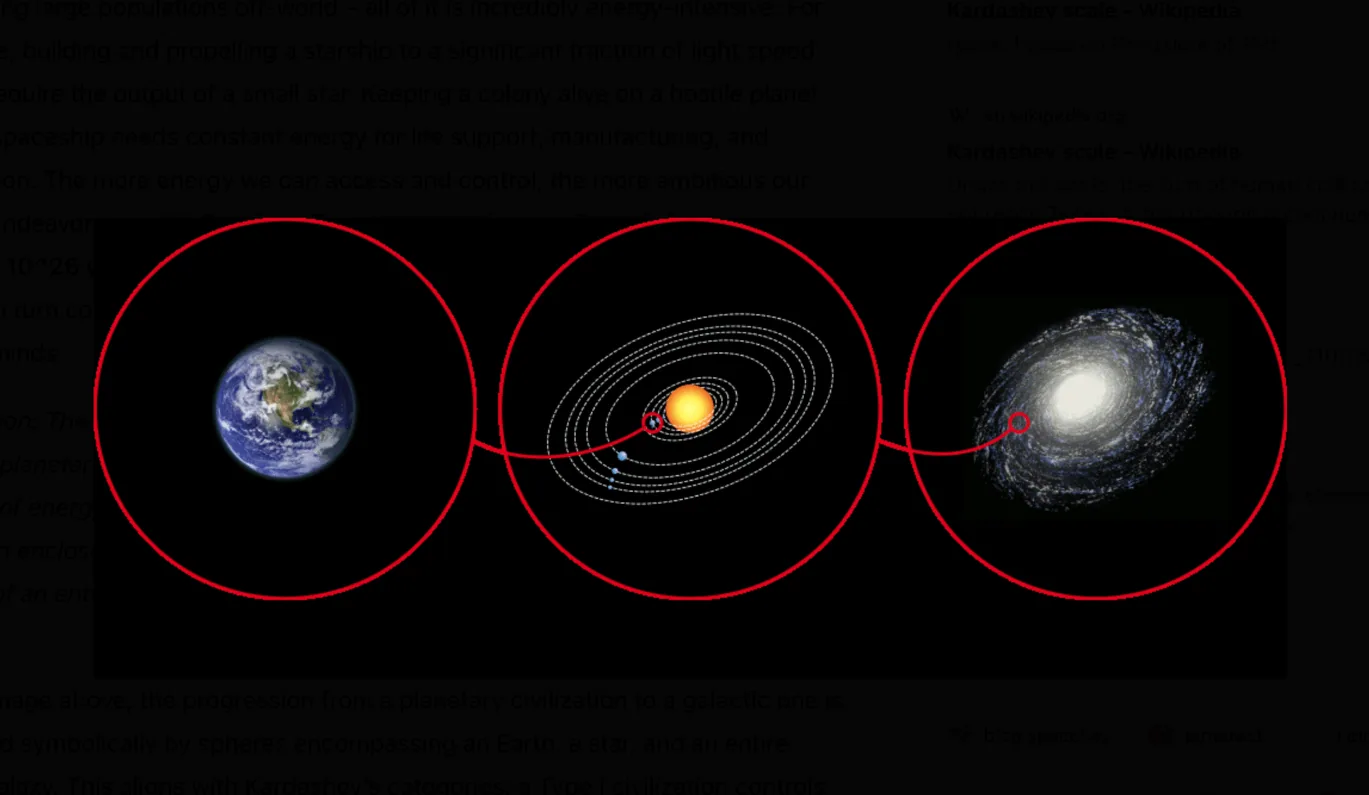
Illustration: The Kardashev Scale of civilizations. Type I (left) utilizes planetary energy (symbolized by Earth within a sphere of energy), Type II (center) harnesses stellar energy (our Sun enclosed by collectors), and Type III (right) taps the power of an entire galaxy).
In the image above, the progression from a planetary civilization to a galactic one is depicted symbolically by spheres encompassing an Earth, a star, and an entire spiral galaxy. This aligns with Kardashev’s categories: a Type I civilization controls energy on the scale of a planet, Type II on the scale of a star, and Type III on the scale of a galaxy. Humanity’s current global energy consumption (~$10^{13}$ watts) is many orders of magnitude below even Type I. However, our growth in energy use (and the potential of new sources like fusion or solar collectors in space) could push us towards Type I in the coming centuries. Reaching Type II would require monumental engineering – for instance, constructing a Dyson swarm of solar collectors orbiting the Sun to capture a significant fraction of its output. While that might be far in the future (perhaps thousands of years, if ever), it illustrates the kind of leap needed to truly secure our survival and mobility in the cosmos.
Interestingly, by the time a civilization is capable of interstellar travel, it likely has also solved its energy needs to at least Type II level – the two achievements go hand in hand. If we encounter extraterrestrial intelligences out among the stars, they might well be Type II or III civilizations who long ago overcame the bottlenecks of energy that we still struggle with. Such civilizations could create habitats around many stars or even roam freely, carrying miniature “suns” (fusion reactors) with them.
Mastering energy and mastering ourselves (via evolution or augmentation) are twin keys to unlocking the stars.Without vast energy, we can’t cross the gulfs of space; without transcending our human frailties, we can’t endure the journey. It is profound to realize that ensuring the survival of our species might require us to cease being our current species and become something new – much as a caterpillar must become a butterfly to escape its bounds.
A Cosmic Perspective on Time and Life
Before concluding, it’s worth reflecting on just how short our existence has been relative to cosmic time, and how much might lie ahead if we navigate wisely. Human life expectancy has grown from perhaps 30–40 years in ancient times to around 70–80 years globally today. Yet even a lifespan of 100 years is an eyeblink next to geological and astronomical cycles. Consider that 100 years is $10^2$ years, whereas the age of Earth is $4.5\times10^9$ years – a difference of about 10^7 (10 million times longer). The universe’s age is on the order of $10^{10}$ years. If we compress the universe’s history into one calendar year for analogy, a single human life is less than a second on that scale.
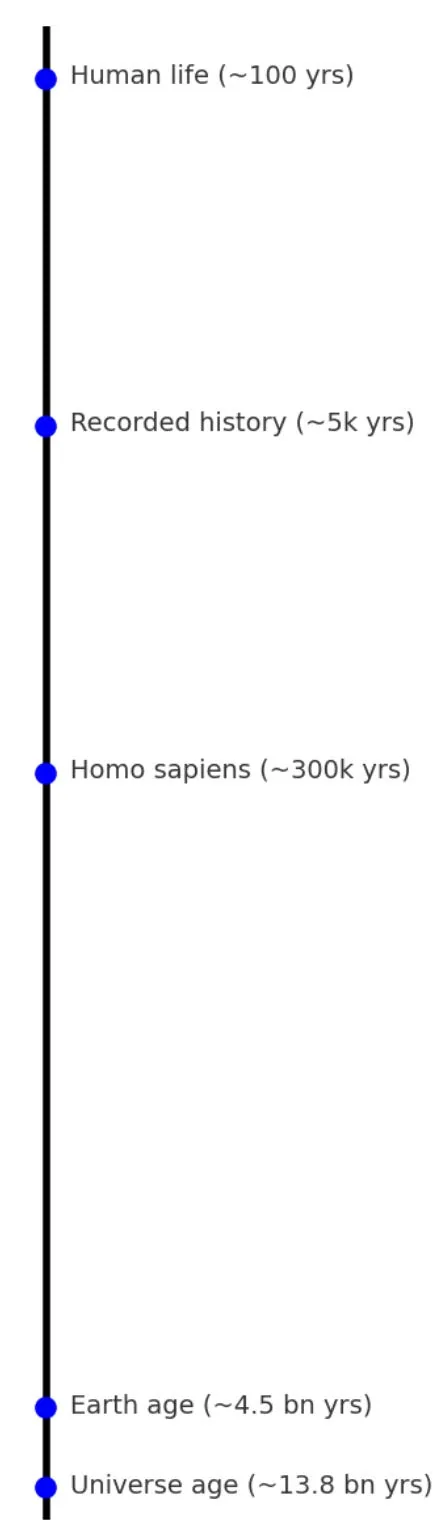
Timeline (logarithmic scale) comparing a human lifetime (~100 years) and other time spans: recorded human history (~5,000 years), the existence of Homo sapiens (~300,000 years), the age of Earth (~4.5 billion years), and the age of the universe (~13.8 billion years). Our individual lives and even entire civilizations occupy a mere blink of an eye in the cosmic timeline.
As the timeline graphic suggests, our recorded history (~5,000 years) is a tiny blip, and even the tenure of our species is negligible next to planetary and cosmic ages. This perspective can be humbling, but also inspiring: if we can survive and spread beyond Earth, the future stretch of time that life could continue far, far exceeds the past. There could be billions or even trillions of years of post-Sun existence for our descendants, whether they are biological or artificial, roaming the galaxy under the light of younger suns or perhaps drifting through intergalactic space. In that far future, the span of recorded human history so far would seem as microscopic to them as a single human life seems to us. We are, potentially, the ancestors of a truly ancient and long-lived lineage, if we play our cards right.
This vista of deep time also gives weight to our actions in the present. We stand at a juncture where space travel is just in its infancy – akin to a newborn taking its first breath. How we handle the next few centuries (managing our planet, developing space infrastructure, avoiding self-destruction) will determine whether we get to grow old as a species or die young.
Our Destiny Among the Stars: A Call to Action
The case for Mars is just the first chapter in the case for humanity’s cosmic journey. Mars, with all its challenges, is reachable and teaches us self-reliance off Earth. It forces us to solve problems of closed-loop life support, radiation shielding, and living in a harsh environment – all skills we will need multiplied by ten when we venture further out. But we must remember Mars is a training ground, not the final goal. The ultimate goal is to ensure that life and consciousness begun here on Earth can continue, evolve, and thrive even after Earth is gone.
Contemplating the death of our Sun and the immense distances to other stars can instill a sense of existential dread. But there is also a profound optimism and purpose in this perspective. We are the species (perhaps the only one in this Solar System, maybe the only one in this corner of the galaxy) capable of understanding these cosmic stakes. And thus we can choose to act. Our ancestors, huddled in caves, could never have imagined the concept of another star, let alone plan to go there. We can. We’ve cracked many of nature’s secrets; we know about DNA, electromagnetism, quantum physics, general relativity – knowledge that gives us god-like powers compared to even a few centuries ago. With that knowledge comes the responsibility to use it wisely for the long-term survival of life.
So what can we do, here and now? Support space exploration and development, for one. Every satellite we launch, every rover on Mars, every experiment on the space station is part of building the road to the stars. Encourage innovation in propulsion (like solar sails, fusion rockets, antimatter concepts), in habitat construction (3D-printing bases from local materials), and in life support (growing food in space, recycling air and water). These might seem like technical details, but they are the rudiments of making other worlds livable.
We should also embrace advancements in human augmentation carefully and thoughtfully. The idea of merging with AI or altering our biology can be unsettling, but if done with ethical foresight, it could greatly enhance our survival prospects. It’s not about losing our humanity; it’s about extending our capabilities while preserving the best of what makes us human – our curiosity, creativity, and capacity for love and meaning. A future where our minds can explore virtual worlds at the speed of light or where our bodies are resistant to all disease can be a wonderful one, if guided by wisdom.
Philosophically, we may need to redefine “us.” When we speak of ensuring humanity’s survival, perhaps we should focus less on the form (whether flesh or silicon) and more on the essence – the continuity of intelligence, experience, and values that trace back to Earth’s biosphere. If our descendants are a network of conscious machines or genetically enhanced post-humans who look nothing like us, it may not matter, so long as they remember where they came from and cherish life as we do. In that sense, sending life beyond the Earth is like sending our children to college or into the world – they may change, but a part of us goes with them and lives on.
In summary, becoming a spacefaring species is the grandest adventure we can undertake. It’s not just a technical endeavor, but a multi-generational voyage of growth. We will learn, fail, adapt, and in the process likely become something greater than we were. The challenges are immense – the dying Sun, the vast interstellar distances, the frailty of our bodies – but none are insurmountable given time and ingenuity. Remember that every step on this journey, from launching the first rocket to engineering a starship, is also a step in our evolution. We are, in real-time, witnessing the evolution of intelligent life from a single-planet species to a multi-planet and potentially interstellar species.
Let us imagine a far future scene: a group of explorers – perhaps partly biological, partly cybernetic – stand on a new Earth-like planet under the light of a young star in another galaxy. They discuss their distant ancestral home, the planet Earth, almost as myth or legend. Yet they carry forward our legacy, our culture, maybe even our DNA. Through them, humanity lives on, transformed but unbroken, among the stars. Our task, here and now, is to make sure that future comes to pass. Every one of us can contribute in some way to this legacy – through supporting science, educating others, fostering peace and cooperation (essential for large-scale projects), or simply keeping the flame of curiosity and hope alive.
The cosmos awaits. Mars is calling, and beyond Mars, the entire universe calls. In answering that call, we affirm not just a will to survive, but a willingness to grow. As Carl Sagan famously said, “The surface of the Earth is the shore of the cosmic ocean.” We are poised to wade into that ocean. Our survival, and so much more – our flourishing, our adventure, our destiny – lies in becoming children of the stars. Let’s take that leap, for all of humanity and for all that will come after us. The future will thank us, and in that distant tomorrow, our era might be remembered as the time when the seed of life on Earth first spread its wings and learned to fly among the heavens.
Erasmus Cromwell-Smith.
March 31st, 2025.
Sources: – Wikipedia.org – Space.com – Astronomy.com – Theplanets.org – Sciencesprings.wordpress.com – Hiddenhearing.co.uk – Science.nasa.govFootnotes: Potential faster ways to travel through Space: The “warp” or “time bubble” propulsion concept is typically known in theoretical physics and science fiction as an Alcubierre Warp Drive. 1. What is an Alcubierre Warp Drive? Proposed in 1994 by Mexican theoretical physicist Miguel Alcubierre, it’s a hypothetical faster-than-light propulsion concept based on Einstein’s General Relativity. It doesn’t move the spacecraft itself faster than light. Instead, it warps (or bends) space-time around the spacecraft, creating a “bubble” of normal space. Space is contracted in front of the craft and expanded behind it, effectively “surfing” through space-time at faster-than-light (FTL) apparent speeds without violating the cosmic speed limit within its local bubble. 2. How Would the Warp Bubble Work? Imagine placing a spacecraft inside a “bubble” of space-time: Front of the bubble: Space is compressed (shortening the distance ahead). Back of the bubble: Space expands (lengthening the distance behind). Inside the bubble: Space remains stable and normal; the spacecraft feels no acceleration or G-forces. This manipulation of space-time could theoretically allow travel between distant points faster than light appears to travel externally, without breaking physics laws within the bubble. Analogy:
Think of a surfboard riding a wave. The surfer (spacecraft) is not propelling faster than the wave itself; instead, the wave (space-time distortion) moves rapidly forward, carrying the surfer along effortlessly. 3. Does Warp Travel Affect Time? Inside the warp bubble, passengers would experience normal passage of time. Outside observers would perceive the spacecraft traveling faster than light, thus the spaceship could arrive at distant stars in days or weeks instead of thousands of years. Due to relativistic effects and space-time manipulation, time dilation would be minimal inside the bubble, avoiding significant aging differences for passengers. 4. Challenges and Requirements: While theoretically consistent with Einstein’s equations, significant issues exist: Negative Energy (Exotic Matter) Requirement: Alcubierre’s original warp drive requires negative energy density, or “exotic matter,” which hasn’t been proven to exist naturally. Negative energy density is theoretically possible through quantum vacuum effects (Casimir effect), but currently impossible in the large amounts needed for warp travel. Energy Demand: Initial calculations showed impossibly enormous energy demands (mass-energy equivalent to planets or even stars). Subsequent studies reduced these requirements significantly, yet still remain vastly beyond current human technological capabilities. Instability and Control: Theoretically, the warp bubble may be unstable, difficult to control, or produce dangerous radiation upon arrival. 5. Recent Developments (NASA and DARPA Research): NASA’s Eagleworks Lab has explored theoretical feasibility, creating experimental setups to detect tiny warp-like effects. Thus far, no conclusive proof has emerged. A 2021 DARPA-funded project claimed to have created an ultra-small-scale warp bubble structure accidentally in laboratory conditions. However, it’s still purely theoretical and inconclusive for practical application. 6. Potential Advantages of Warp Drive: Rapid interstellar travel: Journeys of centuries or millennia could become hours, days, or weeks. No relativistic aging: Astronauts age normally, avoiding the “twin paradox.” Real-time exploration: Enables practical human exploration and colonization of distant star systems. 7. Is Warp Drive Actually Possible? Currently: It remains a theoretical mathematical solution consistent with General Relativity but unproven physically. Modern physics cannot yet produce or confirm the existence of exotic negative energy. Serious scientific efforts are underway to explore more realistic, achievable conditions or alternatives. 8. Ethical and Philosophical Considerations: If warp drive became viable, it would raise significant issues: Could warp travel disrupt or destabilize distant space-time regions? Would humanity ethically manage rapid interstellar expansion? Could it accidentally create time paradoxes or causality issues? Conclusion: A “warp” or “time bubble” system—Alcubierre Warp Drive—is a promising but strictly theoretical concept. It offers fascinating potential for faster-than-light interstellar travel by manipulating space-time itself. While deeply intriguing, significant physics and engineering hurdles remain before it could ever become reality. However, continuing research suggests that warp drive isn’t outright impossible and might one day transition from theoretical possibility to practical reality.
What about Human life in Mars? Humans living on Mars for extended periods won’t turn into science-fiction mutants overnight, but long-term biological adaptations and changes are inevitable. Here’s what will realistically happen: 1. Key Factors Causing Changes on Mars: Living on Mars exposes humans to: Reduced gravity (about 38% of Earth’s gravity) Increased radiation (lack of magnetic field and thin atmosphere) Reduced sunlight Confined, artificial habitats Limited nutrition and resources These factors trigger significant physiological responses and adaptations over extended periods. 2. Likely Biological Changes (Adaptations vs. Mutations): Important distinction: Mutations: Sudden genetic changes due to environmental damage or radiation. Adaptations: Gradual physical or biological responses to prolonged environmental pressures. Most realistic changes would initially be adaptive: Physical Adaptations: Loss of muscle and bone density: Due to lower gravity. Weakening of cardiovascular system: Reduced heart and circulatory stress. Visual impairment: Altered intracranial pressure affecting eyesight. Potential height changes: Astronauts become slightly taller in low gravity, as spine decompresses. Radiation-induced Effects: Increased cancer risk: Radiation can damage DNA, raising cancer rates. Higher rate of genetic mutations over generations: If reproduction occurs on Mars, offspring might experience higher mutation rates, though changes would be gradual and subtle, not immediate drastic alterations. Psychological and Neurological Changes: Cognitive and emotional changes: Stress from isolation, confinement, altered sleep cycles. Neurological alterations: Possible cognitive impairment or mental health issues over long periods 3. Could We Actually Become “Mutants”? Not quickly or dramatically. Significant mutations as depicted in science fiction are unrealistic within just a few generations. But over long durations (multiple generations), subtle genetic changes might accumulate, potentially creating a Mars-adapted population distinct from Earth humans. Such changes would likely focus on radiation resistance, bone-density maintenance, or metabolic adaptations to reduced gravity and altered atmosphere. 4. Realistic Timeline for Noticeable Biological Changes: Immediate (months to years): Bone loss, muscle atrophy, cardiovascular and visual impairment. Medium-term (decades): Higher cancer risks, reproductive challenges, and minor genetic alterations. Long-term (centuries): Potential evolutionary divergence, creating distinct, Mars-adapted human physiology. 5. Could Genetic Engineering Accelerate Adaptation? Absolutely. Humans might intentionally use genetic engineering (gene-editing techniques like CRISPR) to: Enhance radiation resistance. Maintain bone and muscle density. Optimize metabolism for Mars’ environment. Such genetically enhanced humans would effectively be “engineered mutants”—intentionally adapted, rather than random mutations. Conclusion: Humans won’t become “mutants” in the sci-fi sense overnight. But long-term residence on Mars will inevitably cause meaningful biological changes due to adaptation and minor mutations. Over generations, a distinctively “Martian” variant of humans could emerge—particularly with genetic engineering speeding up this adaptation. Thus, Mars colonization could indeed lead humanity toward divergence into something subtly different from Earth-bound humans. Absolutely. Considering the immense magnitudes of cosmic time—billions or even trillions of years—our current biological chassis is insufficient. The human body evolved to live optimally about 70–100 years in Earth’s specific environment. In cosmic terms, our lifespan is essentially instantaneous, making meaningful interstellar exploration or colonization incredibly challenging. Limitations of Our Current Biological “Chassis”: 1. Limited Lifespan:
Our bodies naturally deteriorate due to genetic and cellular factors such as telomere shortening, DNA damage accumulation, and oxidative stress. 2. Fragility in Space:
Our biological systems degrade quickly under radiation, microgravity, and psychological isolation, making long-duration space travel difficult. 3. Resource Intensity:
Humans require significant amounts of oxygen, water, nutrients, and energy, making sustainability in space challenging.
Why a New Chassis Makes Sense: To explore and survive on cosmic timescales, humanity may need to move beyond its biological limitations and evolve technologically: 1. Biological Enhancement (Bioengineering) Genetic Engineering:
Gene editing (CRISPR or successors) could extend lifespans dramatically by repairing DNA, regenerating tissues, and slowing or halting aging processes. Synthetic Biology:
Building stronger cells, radiation resistance, enhanced cognition, and significantly reduced resource requirements. 2. Cybernetic Enhancement (Cyborgization) Integrating biological systems with advanced electronics, nanotech, and robotics could allow: Enhanced physical durability. Augmented senses. Direct neural interfaces (allowing mind-machine symbiosis). Greater longevity (replaceable or upgradeable biological parts). 3. Digital Consciousness (Mind Uploading) Transitioning human consciousness to digital substrates would free us entirely from biological constraints: Potential immortality (assuming stable hardware). Instantaneous travel across cosmic distances via transmitted information. Ability to survive hostile environments (digital entities in robotic bodies). 4. Artificial Bodies and Robotics Consciousness transferred to robotic bodies would offer: Virtually unlimited lifespan (replaceable and upgradable bodies). Enhanced durability and adaptability for interstellar and cosmic environments. Minimal resource dependence (no oxygen, minimal energy requirements). Ethical and Philosophical Considerations: What defines humanity if biological constraints vanish? How would consciousness be preserved during such transformations? Would personal identity remain intact through digital uploads? Are we prepared for the societal implications of vastly extended lifespans? Realistic Timeline of New Chassis Evolution: Next 50–100 years: Initial life-extension technologies, basic cybernetics, and genetic modifications to increase lifespan. Next 100–500 years: Advanced bioengineering and cybernetic enhancements commonplace. Next 500–1000+ years: Fully digital consciousness or hybrid forms become feasible, allowing near-unlimited lifespan. Conclusion: Yes, for humanity to meaningfully engage with the universe on cosmic scales, we’ll need to transcend our current biological chassis. Evolution toward bio-enhancement, cybernetics, or digital consciousness is inevitable if we aspire to explore and exist within the universe’s billions-of-years scale. Our future, therefore, likely lies not only among the stars but beyond biology itself.