Current Events
THE CASE FOR CANADA
1. Introduction
What if Canada formally joined the United States, yet remained a nation in every sense—retaining its flag, anthem, cultural traditions, judiciary, and distinct legal framework? This idea may seem far-fetched to Canadians who cherish their sovereignty, but rapid changes in technology, global markets, defense challenges, and shared environmental concerns invite us to explore this possibility. The United States leads in advanced industries like AI and biotechnology, while Canada’s economy, though robust, struggles with productivity gaps and relies on American military support for continental defense. This article examines how Canada might integrate with the U.S. while preserving its nationhood, offering mutual benefits in economics, security, and global influence, and addressing Canadian concerns about identity and autonomy.
2. Theoretical Foundations: Nation vs. State
The distinction between “nation” and “state” is central to this proposal. A nation is a cultural community bound by shared history, language, and symbols, as Benedict Anderson describes in Imagined Communities—a “socially-constructed community, imagined by the people who perceive themselves as part of a group.” A state, conversely, is a political entity with sovereignty, borders, and governing institutions. Canada could remain a nation within the U.S. state, much like Catalonia and the Basque Country exist as nations within Spain, with their own parliaments, languages, and cultural autonomy. Ernest Gellner’s Nations and Nationalism suggests that while nationalism often seeks political congruence, cultural nations can thrive within larger states if granted sufficient autonomy. For Canada, this would mean preserving its Parliament, judiciary, bilingualism, and symbols like the maple leaf flag, ensuring that Canadians continue to “feel Canadian” even under a new political arrangement.
3. Historical Context & Previous Integration Attempts
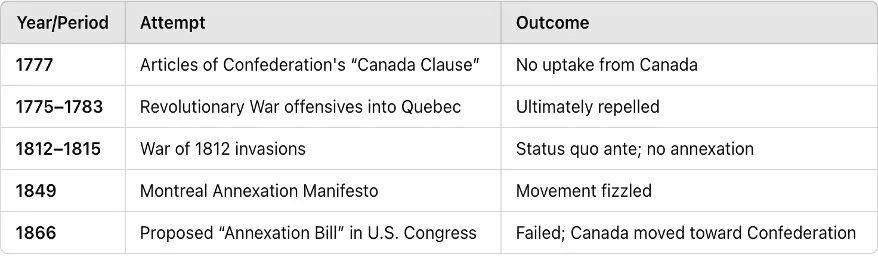
The idea of a U.S.-Canada union has historical roots. The Articles of Confederation (1777) invited “Canada” (then Quebec) to join the Union, and during the Revolutionary War and War of 1812, the U.S. launched military campaigns into British-controlled Canadian territory. In 1849, the Montreal Annexation Manifesto saw Canadian business elites advocate for union to secure economic benefits after Britain withdrew colonial trade preferences. These efforts failed due to Canadian resistance, British interests, and Canada’s Confederation in 1867, but they highlight a recurring “what if” in North American history. Today, shared challenges like climate change and Arctic security revive this question in a modern context.
4. Modern Shifts: Technology, Economic, and Environmental Imperatives
Global changes in technology, economics, and environmental challenges provide a compelling case for integration:
• Innovation and Technology: The U.S. ranks 3rd on the 2023 Global Innovation Index, investing 3.4% of GDP in R&D ($900 billion in 2022), while Canada ranks 15th, spending 1.5% of GDP. A union could integrate Canadian firms into U.S. innovation networks, potentially boosting Canada’s tech sector in cities like Toronto and Vancouver.
• Economic Comparisons and Disruptions: In 2024, the U.S. GDP was $28 trillion, compared to Canada’s $2.2 trillion. Canada’s GDP per capita ($54,000) lags behind most U.S. states, with Ontario on par with Alabama ($55,000) and Alberta ($71,000) ranking 14th among states.
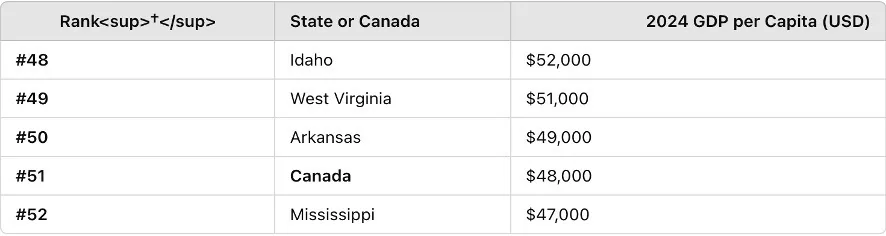
A union could close this gap, potentially increasing Canadian GDP per capita by 30–40% through improved productivity and access to U.S. markets.
However, short-term disruptions are likely:
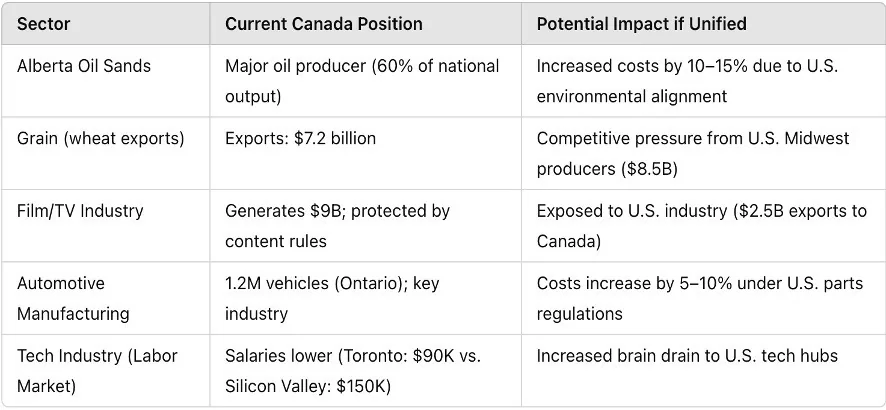
• The Tariff factor: Economic and Political Consequences: The ongoing tariff disputes between Canada and the United States add significant complexity to discussions of a potential union. Recent U.S. tariffs on Canadian softwood lumber, aluminum, and dairy products have not only caused direct economic harm—impacting industries valued at billions annually— these tariffs underscore Canada’s vulnerability due to its dependency on U.S. markets. Canadian proponents argue that a formal union could permanently eliminate such damaging trade barriers, stabilizing markets and protecting Canadian jobs. This contentious tariff issue vividly illustrates the paradox of Canada-U.S. economic relations—while current tensions fuel anti-union sentiment, they simultaneously expose Canada’s economic fragility outside a closer, institutionalized partnership.
• Resource and Industry Synergy: Canada’s natural resources (oil, minerals, timber) and educated workforce could complement U.S. industries, creating economies of scale. The U.S. would gain frictionless access to Canadian resources, while Canada could benefit from U.S. capital and markets.
• Environmental Collaboration: Shared ecosystems like the Great Lakes and the Arctic make climate change a joint concern. A union could build on existing efforts like the Great Lakes Restoration Initiative, which has invested $3.2 billion since 2010 to restore the shared ecosystem, reducing toxic algae blooms by 30% (EPA, 2024). In the Arctic, a unified stance on banning oil drilling in the Arctic National Wildlife Refuge—a contentious issue, with the U.S. approving drilling in 2021 despite Canada’s opposition—could strengthen conservation efforts, protecting 1.5 million acres of critical habitat (U.S. Fish and Wildlife Service, 2023).
5. Legal & Constitutional Feasibility
Integrating a sovereign nation like Canada into the U.S. requires navigating significant legal hurdles:
• U.S. Constitution: Article IV allows new states to join, but Canada’s demand for autonomy would necessitate constitutional amendments. Precedents like Louisiana’s civil law system and Puerto Rico’s autonomous governance show the U.S. can accommodate unique legal traditions. A treaty-based federacy model could define Canada’s special status, potentially via an amendment ensuring that “the Canadian Autonomous State retains jurisdiction over culture, education, and healthcare.” However, smaller U.S. states like Wyoming—population 580,000 compared to Canada’s 38 million (U.S. Census Bureau, Statistics Canada, 2023)—might oppose Canada’s admission, fearing diluted influence in Congress, where Canada could gain up to 50 House seats based on population, rivaling California’s 52. A polarized Congress could pose a further barrier; Republicans, who controlled the Senate with 53 seats in 2024, have historically opposed expanding federal power, potentially blocking amendments needed for Canada’s special status (U.S. Senate, 2024).
• Canadian Constitution: Amending Canada’s status requires unanimous consent from Parliament and all provincial legislatures—a high bar, especially given Quebec’s history of separatism and commitment to French-language rights. Alberta, where the oil sands contribute 60% of national oil production (Natural Resources Canada, 2023), might resist ceding control to a U.S. federal government, fearing stricter environmental regulations or reduced royalties, which generated $12 billion in 2022 (Alberta Energy Regulator, 2023). Partisan divides could also hinder consensus—Conservatives, who won 33% of the vote in the 2021 election and often emphasize sovereignty, might oppose a union, while Liberals (32% of the vote) might be more open (Elections Canada, 2021). The 1998 Reference re Secession of Quebec ruling suggests that a clear democratic vote for union would oblige negotiation, but these regional and political dynamics highlight the complexity of achieving consensus, compounded by historical mistrust from events like the War of 1812.
• Treaty Model: A union treaty could outline Canada’s retained powers (e.g., Parliament, Supreme Court, bilingualism) while ceding defense, foreign affairs, and currency to the U.S. federal government. Both countries would need constitutional amendments to entrench these arrangements, preventing future erosion by federal laws.
• Illustrative Examples: Draft Amendment & Interstate Compact
Constitutional Amendment:
“Notwithstanding any other provision, the Commonwealth of Canada is hereby admitted into the United States as an autonomous state. Canada shall retain jurisdiction over education, culture, language rights, healthcare, and other enumerated authorities. Federal laws shall apply only in areas expressly ceded by Canada—namely defense, foreign affairs, currency, and interstate commerce. This status may not be altered without the express consent of Canada’s Parliament and a supermajority vote of both Houses of the U.S. Congress.”
Interstate (Intergovernmental) Compact:
“The Government of the United States and the Government of Canada hereby form a perpetual union to coordinate on defense, external trade, and monetary policy. Canadian provinces shall maintain legislative powers equivalent to U.S. states, subject to the protection of bilingual and multicultural rights set forth in Canada’s Constitution. This compact is irrevocable except by mutual consent and must be executed as a constitutional treaty by both legislatures.”
6. Cultural Identity & Safeguards
Preserving Canada’s cultural identity is paramount, given its bilingualism, multiculturalism, and progressive social policies:
• Symbols and Institutions: Canada would retain its flag, anthem (“O Canada”), and holidays like Canada Day, ensuring that Canadians continue to imagine their community as distinct. The Supreme Court of Canada could remain the final arbiter of Canadian laws, with the U.S. Supreme Court intervening only in federal disputes.
• Language and Legal Systems: English and French would be recognized as official languages within Canada’s territory, mirroring Belgium’s bilingual framework. Quebec’s civil law system would be preserved, as would Canada’s judiciary, potentially as a semi-independent branch within the U.S. system.
• Social Policies: Canada’s progressive policies on gun control, immigration, and healthcare could be maintained through autonomy over these areas. For instance, a union treaty could exempt Canada from U.S. federal gun laws, preserving its stricter regulations.
• Indigenous Rights: Section 35 of Canada’s Constitution, which affirms Indigenous treaty rights, would need to be adopted by the U.S. federal government. This could strengthen Indigenous rights if enshrined in the U.S. Constitution, though the U.S.’s historical record with Native American treaties warrants careful enforcement mechanisms.
• Potential Tensions and Mitigation: U.S. resistance to bilingualism could spark significant tension. In states like Arizona, where English is the official language and “English-only” movements have strong support—31 states have such laws, per the U.S. English Foundation (2024)—there might be pushback against federal funding for bilingual services in Canada, potentially leading to lawsuits or legislative efforts to enforce English-only policies. Immigration policy differences could also create friction: Canada accepted 76,000 refugees in 2023, reflecting its open policies, while the U.S. admitted 60,000, often using restrictive measures like Title 42 expulsions (UNHCR, 2023). If the U.S. imposed stricter border controls, Canadian provinces might face pressure to align, risking public backlash. Catalonia’s experience in Spain, where the 2006 statute expanding autonomy was struck down by Spain’s Constitutional Court, illustrates how such tensions can escalate, fueling separatist sentiment if cultural autonomy is not rigorously protected. A veto mechanism, similar to Bosnia’s power-sharing model, could protect Canada from federal laws that threaten its cultural identity. To prevent these tensions from escalating, long-term strategies could foster mutual understanding. Educational initiatives, such as introducing bilingual French-English programs in U.S. border states like Maine or New York, could reduce resistance to Canada’s bilingualism—only 9% of Americans are fluent in a second language, compared to 20% of Canadians (U.S. Census Bureau, Statistics Canada, 2023). Cultural exchange programs, such as joint Canada-U.S. film festivals or art exhibitions, could highlight shared values while celebrating differences, building on existing initiatives like the Toronto International Film Festival, which attracted 15,000 U.S. visitors in 2023 (TIFF, 2023). Over time, a joint immigration framework could align policies, allowing Canada to maintain its refugee intake while the U.S. adopts a more open approach, potentially reducing border tensions.
7. Healthcare Protections
Canada’s universal healthcare system, a cornerstone of its identity, must be safeguarded. A 2023 Angus Reid poll found that 85% of Canadians view Medicare as a core part of their national identity. A union treaty could stipulate that Canada retains full control over its healthcare system, ensuring that U.S. federal policies—often more privatized—do not apply. This arrangement could mirror how Quebec manages its own social programs within Canada, preserving a key pillar of Canadian identity while allowing economic integration.
8. Defense & Security Considerations
Canada and the U.S. already share deep military ties through NORAD and NATO, but a union could formalize and enhance this partnership:
• Current Cooperation: NORAD, a binational command, oversees North American aerospace defense, with Canadian and U.S. officers working side by side. Canada relies on the U.S. defense umbrella, given its modest military spending (1.3% of GDP vs. the U.S.’s 3.4%).
• Arctic Security: The Arctic’s strategic importance is growing, with Russia conducting 12 bomber probes in 2024 and China expanding its polar presence. Canada’s limited Arctic capabilities—lacking year-round naval patrols—make it reliant on U.S. support. A union could ensure Canadian input in Arctic defense strategies while formalizing U.S. protection.
• Benefits and Trade-offs: A union would streamline defense coordination, pooling resources and eliminating command duplication. However, Canada would lose its independent military, a source of national pride tied to its peacekeeping heritage.
• Defense Spending Implications: Canada’s current defense spending, at 1.3% of GDP ($29 billion in 2023), ranks last among NATO allies on the 2% metric (NATO, 2024). Meeting this target would require an increase to $45 billion annually, straining Canada’s budget—potentially diverting funds from social programs like healthcare, which cost $330 billion in 2023, education, which received $50 billion in federal/provincial funding, or infrastructure, with $30 billion allocated for projects like high-speed rail (Canadian Institute for Health Information, Statistics Canada, 2023). The U.S. has long expressed frustration with Canada’s contributions, with former U.S. officials like Secretary of Defense Mark Esper in 2020 urging Canada to “step up” (Reuters, 2020). A union could shift this burden, integrating Canada into the U.S.’s $900 billion defense budget (3.4% of GDP), potentially reducing Canada’s independent spending needs but requiring a higher contribution to a unified North American defense framework—possibly 1.5% of GDP ($33 billion), still a significant increase. U.S. taxpayers might resist funding Canada’s defense, given the population disparity—Canada’s 38 million citizens represent just 10% of the combined population of 380 million (U.S. Census Bureau, Statistics Canada, 2023), potentially leading to perceptions of disproportionate burden-sharing.

9. Public Opinion & Political Reality
Public sentiment poses a significant hurdle to a union:
• Canadian Opposition: A 2025 YouGov poll found 77% of Canadians oppose joining the U.S., driven by fears of losing sovereignty and social programs like Medicare. Historical resistance to American influence (e.g., the War of 1812) and pride in distinct institutions fuel this sentiment. However, younger Canadians (20–30% open to a union) may be more receptive due to globalization and social media, suggesting potential generational shifts.
• American Views: The same poll showed 36% of Americans support a union, seeing it as a gain without threatening their identity. However, there’s no widespread push for integration in the U.S.
• Shifting Sentiment: Public opinion could shift under specific modern crises. For Canadians, a severe economic downturn, such as a recession hitting Canada’s resource sector—Alberta’s oil industry, which employs 140,000 workers, saw a 15% revenue drop in 2022 due to global price volatility (Canadian Energy Centre, 2023)—might make economic integration with the U.S. more appealing, echoing the 1849 Annexation Manifesto’s response to trade disruptions. An Arctic security incident, like a Russian military incursion in the Northwest Passage—where Russia has increased patrols by 30% since 2020 (NORAD, 2024)—could heighten Canadian fears of vulnerability, pushing support for a U.S. defense umbrella. A global trade war, such as escalating U.S.-China tariffs disrupting Canada’s $50 billion in annual exports to China (Statistics Canada, 2023), might also make Canadians reconsider the benefits of a unified North American market. American attitudes might also shift in response to crises. An Arctic security incident could increase U.S. support for a union to secure the northern frontier—U.S. military planners have identified the Arctic as a key vulnerability, with 40% of North American defense gaps linked to the region (U.S. Department of Defense, 2024). An economic downturn, such as a recession reducing U.S. oil production by 10% (as seen in 2020, per EIA, 2021), might make Americans more receptive to Canada’s resources, particularly Alberta’s oil sands, potentially pushing support for a union above the current 36% (YouGov, 2025). For now, the “No” side in a referendum would have a strong advantage in both countries.
10. Proposed Scenarios & Models of Integration
Several models outline potential paths for integration:
• Autonomous Commonwealth: Canada retains its Parliament, judiciary, flag, anthem, and healthcare system, joining the U.S. on defense, foreign policy, and currency. Canadians gain seats in Congress and voting rights in presidential elections, with constitutional guarantees of autonomy.
• Incremental Union: Deepen integration through trade, labor mobility, and R&D pacts, gradually formalizing a new constitutional status with partial federal representation.
• Full Admission as States: Canada’s provinces become U.S. states or a single “super-state,” requiring greater cultural and legal adjustments but simplifying constitutional integration.
11. A Canadian Perspective: Gains and Losses
For Canada, a union offers both opportunities and risks:
• Gains: Beyond economic and defense benefits, Canada could amplify its global influence through U.S. diplomatic networks, elevating priorities like climate change and multilateralism. Canadian firms would gain access to U.S. innovation ecosystems, fostering growth in tech hubs like Toronto.
• Losses: Canada risks losing its independent foreign policy voice, including its role in the Commonwealth and its peacekeeping legacy. Its progressive social policies might face pressure from U.S. federal laws, though autonomy arrangements could mitigate this.
• Partnership, Not Absorption: Framing the union as a partnership—where Canada retains its nationhood through symbols and institutions—could make the idea more palatable to Canadians, ensuring they still feel distinctly Canadian.
12. Conclusions & Next Steps
A Canada-U.S. union remains unlikely in the near term, given strong Canadian opposition, legal complexities, and political polarization. However, shared challenges in technology, security, and the environment make this a provocative thought experiment. If pursued, policymakers would need to:
• Draft constitutional amendments with robust cultural and legal safeguards, ensuring Canada’s autonomy over healthcare, language, and social policies, while addressing political divides.
• Conduct detailed economic modeling to quantify productivity gains, labor market impacts, and social program sustainability, while addressing disruptions across all sectors, including cultural and manufacturing industries.
• Hold democratic referendums in both countries, addressing Canadian and American concerns about identity, sovereignty, and burden-sharing through clear scenarios of how crises might shift public support.
Canada could remain a nation within the U.S. state if the right protections are in place, balancing the security and economic heft of the U.S. with the cultural soul of Canada. Whether this vision gains traction will depend on how Canadians and Americans navigate their shared future in a rapidly changing world.
Erasmus Cromwell-Smith
March 24th 2025.