Free novella
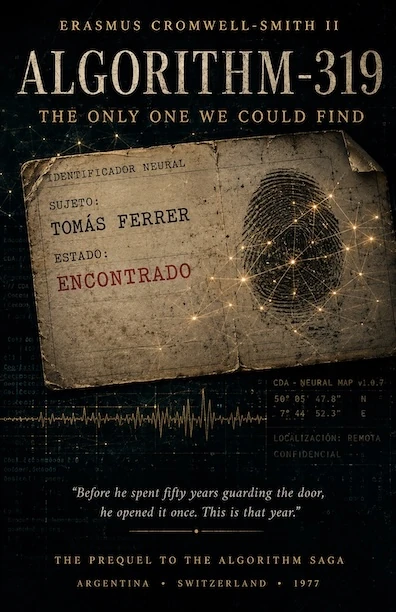
Algorithm-319: The Only One We Could Find
This novella is the prelude to The Algorithm Saga.
Algorithm-319: The Only One We Could Find is a haunting, deeply philosophical prequel novella that stands as the structural and moral foundation of the entire Algorithm Saga.
The setting
March to December 1977
San Carlos de Bariloche in Patagonia, Zermatt in Switzerland, and London. The narrative unfolds against the stark historical reality of Argentina’s military dictatorship and the Dirty War, during which thousands of civilians were systematically disappeared by the state.
The premise
Three minds in an eternal registry
Nineteen-year-old mathematical prodigy Nicolás Tosh works on the margins of Bariloche, inside a rented paint shed behind the Ferretería Wendt. There he has built a handheld device the size of a cigarette pack, with a single brass toggle. Pointed at a human being, it derives a unique eleven-decimal mathematical signature from the electrical weather of their thoughts — the baseline CDA-319 algorithm.
The processing itself happens eight thousand miles away, in rock-cut vaults beneath Zermatt housing a supercomputer array. Only three minds exist in that eternal registry: Tosh; his pragmatic nuclear-physicist partner Rainer Sábato; and Tosh’s only friend, Tomás Ferrer, who registered as a joke at a party.
The disappearance
A line that stops mid-stroke
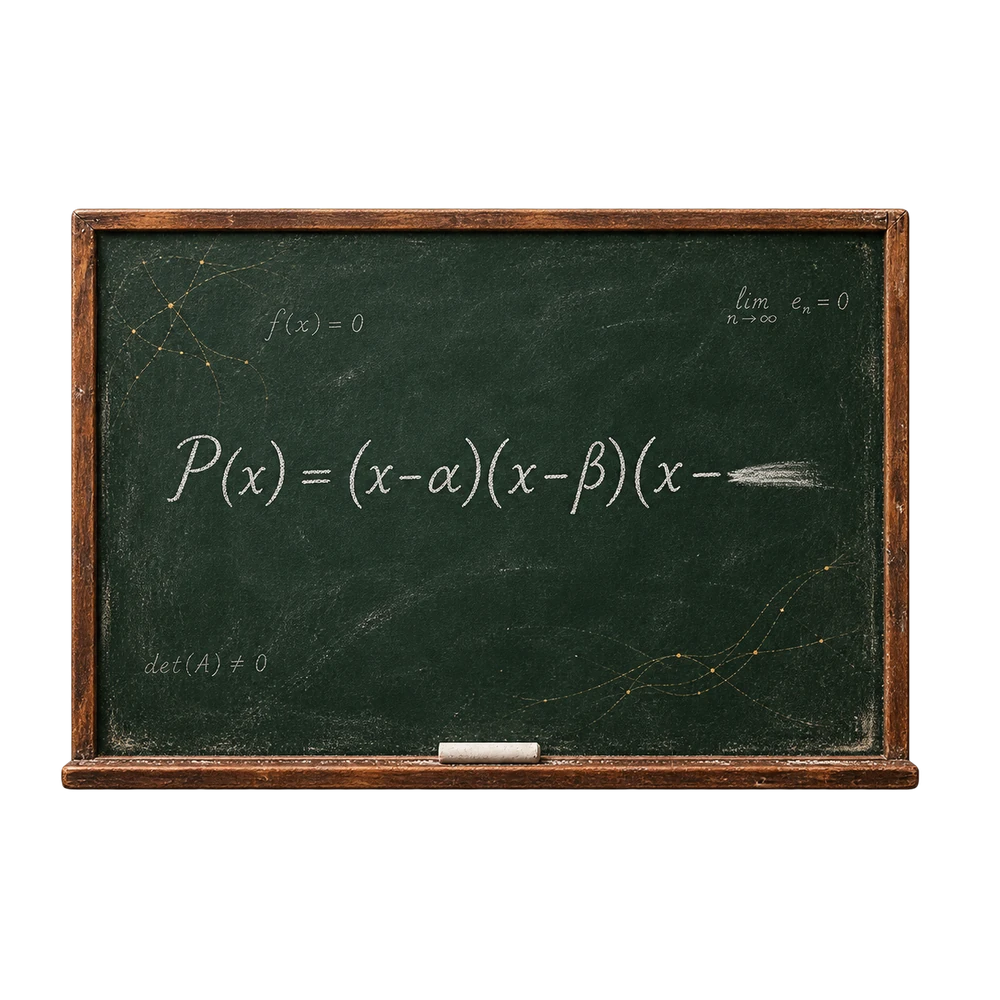
On a Thursday, Tomás fails to show up. When Tosh enters the paint shed he finds a line of white chalk on the blackboard that stops abruptly mid-stroke — not at the end of a factor, but where Tomás’s hand was simply forced to lift.
Soon after, Tomás’s mother arrives at the shed. Dolores Ferrer, a schoolteacher, has spent days systematically visiting police stations and ministry desks, documenting every deflection and silent lie in a school exercise book.
The moral slippage
One reasonable step at a time
CDA-319 — the register
Tosh queries the Zermatt system and confirms that Tomás’s signature is still active, with a confidence rating above four nines. The algorithm can confirm that a mind is still running. It cannot say where.
CDA-320 — the one-way voice
Sábato arrives and argues for logical escalation: a silent, one-way neural broadcast, transmitted into Tomás’s head daily at four in the afternoon. “Tomás. It is Nicolás. Count in primes. Two. Three. Five. Seven. Eleven. Keep going. I will be here.” Because the return channel requires the subject to speak aloud in a cell, Tomás cannot safely reply.
CDA-322 — the borrowed senses
When the mathematical density of the signature begins to slide, indicating physical or mental collapse, Sábato pushes for the ultimate trespass: an algorithm that forcibly intercepts and records the subject’s sight, sound and the surface of thought. Dolores begs to be the operator, claiming her maternal right as the boy’s first container. Tosh refuses. He decides he must be the one ruined by what they will see, shielding a mother from the visual reality of her son’s confinement.
Eleven clues, and a clerk
The parallel thread
The nineteen-minute scan of Tomás’s eyes yields eleven physical clues: a window with four vertical bars spaced eleven centimetres apart, a concrete water tower, a hill with a distinctive notch, the sound of freight trains, a civilian interviewer with a manila folder.
In a parallel narrative we meet Ismael Quintar, a meticulous civilian clerk for a military battalion, who has built a flawless cross-referenced index-card system of the detained. On the sixteenth of May, Quintar conducts the interview of the mathematics student, who answers the six written questions only by speaking prime numbers aloud. Quintar dismisses it as noise and closes the card.
The tragic irony
Two days late
Tosh’s contact locates the notch on a map. To keep the machine out of government hands, they launder the coordinates through a chain of lawyers, priests and journalists to a human rights commission. Bureaucratic delay does the rest: the commission reaches the site on the fourth of July, and finds it empty since the second.
Desperate, Tosh goes to Buenos Aires, waits at a bus stop, identifies Quintar, and uses CDA-323 to reconstruct the whole thirty-nine years of the man’s memory.
The revelation
Five inches by three
Tomás Ferrer was executed on the second of July. The liveness tracker had been confirming a body kept physically alive on a mechanical ventilator. Tosh had been speaking into an empty room for eleven weeks.
Worse waits inside Quintar’s mind. Tosh finds his own reflection there: the clerk’s pride in his index is precisely the same act as Tosh’s pride in his eternal register of minds. Both men set out to reduce a human soul to a findable, structured index. The only difference between them was five inches by three of card.
Whitehall, and the vow
December 1977
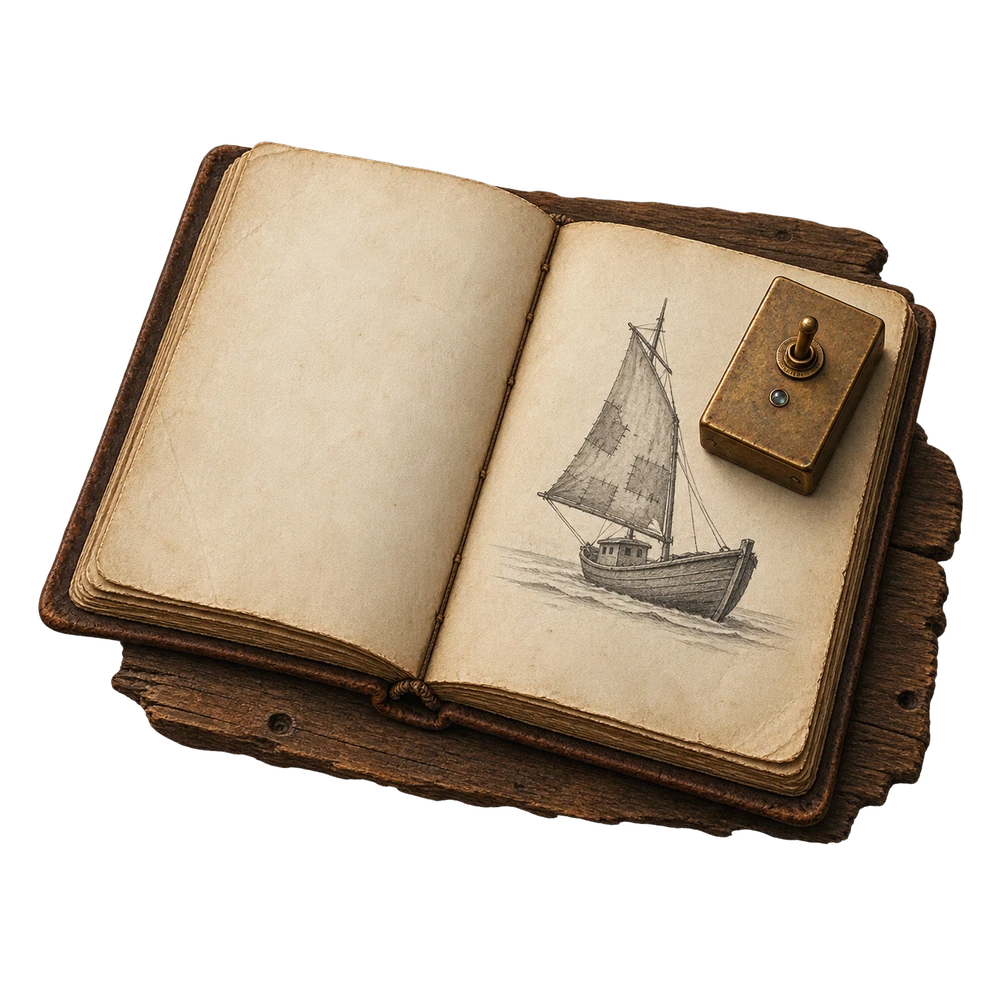
Devastated, Tosh travels to Whitehall in London to lock three of his own algorithms — 322, 323 and 324 — into a global schedule of banned weapons. Returning to Zermatt, beneath a recurring hand-drawn pencil sketch of a small fishing boat, he writes four lines in his logbook.
We will never forcibly rewrite the human mind.
Not to save time.
Not to save money.
Not, God forgive us if we are ever tempted to, to save lives.
Send me this novella
Leave your name and email and the novella arrives in your inbox.