Current Events
VENEZUELA POST-MADURO: Progress, Remaining Risks, and the 45-Day Test
Six weeks after the 3 January 2026 extraction, Venezuela is living through a paradox: controlled continuity at the top, partial liberalization at the edges, and an oil-linked bargain that can either finance an electoral conversion or freeze the transition in reversible limbo.
A transition that is both open and reversible
Day 43 is long enough for a country to discover what changed — and what did not. Maduro is gone; the state that served him is still standing. Roughly six weeks after Nicolás Maduro[1] was seized in a U.S. operation on 3 January 2026, Venezuela is experiencing an unusual combination of controlled political continuity at the top and partial liberalization at the edges. The continuity is anchored by a Supreme Court-driven interim arrangement that elevated Delcy Rodríguez[2] to acting head of state, alongside a still-intact inner circle and coercive apparatus. The liberalization is visible in street-level developments: public protests that are no longer automatically dispersed, incremental prisoner releases, and an active public debate over a new amnesty framework. Yet these openings remain legally and institutionally reversible.[3]
Economically, the dominant progress marker has been the reactivation of oil commercialization and prospective investment, enabled by rapid U.S. sanctions recalibration. New OFAC general licenses have authorized contingent contracting for new oil-and-gas investment and authorized operations for a named set of oil majors, while routing certain payments into U.S.-controlled deposit funds and barring participation by designated U.S. adversaries (including Cuba and China). The near-term consequence is a rebound toward roughly 1 million barrels per day of crude output and a gradual clearing of export/logistics bottlenecks, though banks and counterparties remain cautious amid compliance uncertainty, slowing transaction velocity.[4]
The main strategic problem is that the transition’s mechanism (external extraction plus coercive conditionality) differs sharply from the Eastern Europe/Spain analogies, which were driven by internal bargaining or elite-led liberalization under constitutional cover. This difference heightens the salience of legitimacy, sovereignty narratives, and security-actor incentives. The United Nations has publicly warned of a dangerous precedent and stressed that international law and the UN Charter were not respected, effects that can complicate recognition of new governing arrangements even when many states want political change in Venezuela.[6]
A balanced near-term outlook still points to three scenario bands. In the best case, the interim arrangement is converted into a time-bound, internationally monitored electoral roadmap with credible security-sector guarantees; reforms accelerate; and political competition re-enters the formal arena without major violence. In the baseline case, the governing shell persists while selective reforms continue as bargaining chips, yielding economic stabilization and controlled civic space but postponing decisive institutional change. In the worst case, hardline spoilers or fragmented security coalitions reverse liberalization, producing renewed repression, disorder, and a sanctions snapback that deepens humanitarian outflows.[7]
The pivot: the lens for reading the first six weeks
My article, ‘The Case for Venezuela’ frames the post-extraction moment as the culmination of a long erosion of fear-based governance, with historical emphasis on (i) Eastern Europe’s 1989 inflection, where economic exhaustion and the weakening of external patronage undermined coercion, and (ii) negotiated or elite-managed transitions (notably Poland and post-Franco Spain) that traded immediate retribution for stability through legalization, amnesty, and institutional re-foundation. It also flags Diosdado Cabello as a potential spoiler whose position inside the coercive apparatus could make any transition fragile and reversible unless neutralized politically or operationally.[8]
This Article treats the January 3rd. 2026 U.S. operation that captured Maduro and transferred him to U.S. custody, as the starting point of the Post-Maduro era.[9][10]
Day 45: what has actually changed
The post-extraction landscape can be described as continuity government under external conditionality: the visible head changed, but the core administrative and security machinery remains largely in place, producing real openings in some domains while preserving reversal capacity in others.
A six-week timeline of the key inflection points
The following sequence captures the governance, security, and economic moments that most plausibly structure the first six weeks:[11]

. Early 2026: the United States seized multiple tankers carrying Venezuelan oil
· 3 Jan 2026: U.S. operation captures former president; emergency diplomacy begins
· 4 Jan: Supreme Court orders vice president to assume interim presidency
· 8 Jan: Government announces initial releases; casualty narratives contested
. 14 Jan: The United States completed its first sale of seized Venezuelan oil, valued at approximately $500 million, with proceeds initially deposited into a Qatari bank account.
· 15 Jan: High-level security diplomacy ramps up; foreign stakeholder signaling intensifies
· 16 Jan: U.S. intelligence chief meets interim leadership in Caracas
· 21 Jan: Business federation points to new dollar inflows as an FX/price stabilizer
· 29 Jan: Expanded licensing opens pathways for Venezuelan-origin oil transactions
. 29 Jan: U.S. Transportation Secretary Sean Duffy rescinded the 2019 order prohibiting commercial airlines flights between the 2 countries
· 3 Feb: Additional licensing enables critical diluent and operational support flows
. 3 Feb: By this date the U.S. returned all $500 million from the initial sale to the Venezuelan government.
· 9 Feb: Civil society reporting provides updated political-prisoner counts
· 11 Feb: U.S. energy leadership visits; energy policy becomes transition centerpiece
· 13 Feb: New OFAC licenses widen operational/investment scope for named oil majors
· 15 Feb: Youth Day protests test tolerance and ‘new civic space’ claims
Legitimacy on two planes
The legal core of the interim arrangement is the Venezuelan Supreme Court’s order that Rodríguez assume the presidency ‘to guarantee administrative continuity,’ with subsequent debate to define the applicable framework in light of the president’s forced absence.[12] This framing, treating the vacancy as temporary, matters because it can delay or reshape constitutional triggers for rapid elections and gives incumbent officials a bridge to keep governing while negotiating with external stakeholders.
Internationally, legitimacy is contested on two planes at once: (1) the democratic legitimacy of pre-extraction Venezuela was widely questioned, yet (2) the extraction itself was condemned in the UN system as a sovereignty-violating use of force and a dangerous precedent.[13] The practical implication is that recognition becomes transactional: some states may engage the interim leadership for stability and humanitarian reasons while withholding endorsement of the method that created the interim.[15]
The streets reopen — then get tested
The clearest everyday-life change has been the reappearance of mass protest as a visible and partially tolerated practice. Student-led demonstrations around Youth Day (mid-February) in Caracas and other cities, previously likely to trigger immediate violent dispersal, have proceeded with less direct repression and have been covered more openly in media.[16]
At the same time, the new space is not secure. High-profile detentions and re-detentions, including the reported re-arrest of opposition figure Juan Pablo Guanipa[17], point to an enforcement apparatus still capable of selective coercion, one of the classic warning signs of a managed liberalization strategy rather than a consolidated democratic opening.[18]
Public perceptions also appear mixed. Recent polling has reported a surge in optimism about overall trajectory while also indicating that a majority of respondents felt security had deteriorated, consistent with a transition phase in which coercive control loosens unevenly and criminal violence or localized insecurity becomes more salient.[19]
Prisoners, amnesty, and the human baseline
The single best hard data point on repression is the political-prisoner count tracked by Foro Penal.[20] As of 9 February 2026, it reported 644 political prisoners, including 185 military detainees and 80 women, and noted that the whereabouts of 47 people were unknown.[21]
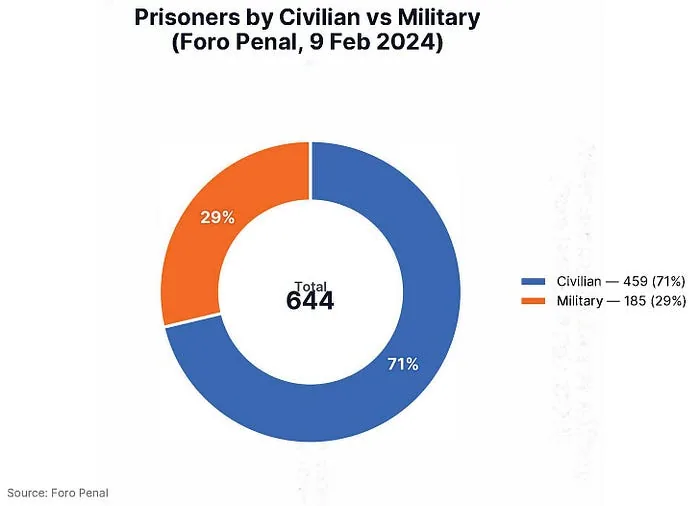
On releases, evidence is directionally positive but numerically inconsistent across sources, often reflecting definitional differences (full release vs conditional release vs house arrest) and political incentives to inflate or minimize progress. Reuters reported that Foro Penal had verified more than 430 releases since 8 January, while the same organization’s reporting shows a continuing high residual prisoner stock. Taken together, the plausible interpretation is that releases are real but partial, conditional, and politically managed.[22]
The amnesty bill now under debate is a second major human-rights pivot. Reporting indicates it is intended to cover politically linked offenses back to 1999 while excluding serious crimes such as human rights violations and other grave offenses; its final debate has been delayed amid internal disputes, suggesting unresolved bargaining over who qualifies, whether exiles are covered, and how political crime is defined.[23]
Humanitarian conditions remain structurally severe. Even without a new shock, Venezuela’s displacement crisis remains among the world’s largest: UNHCR reporting (updated May 2025) put the global total near 7.9 million refugees and migrants from Venezuela.[24] Inside the country, the World Food Programme reports 5.1 million people urgently requiring food assistance.[25]
A notable near-term positive signal is the arrival of a 6-metric-ton U.S. shipment of medicines and medical supplies, jointly received by U.S. and Venezuelan officials, an indicator that external stakeholders are now willing to operationalize limited humanitarian collaboration even amid unresolved legitimacy questions.[26]
The oil bargain
Oil is the transition’s macroeconomic fulcrum because it drives foreign exchange availability, fiscal capacity, and elite rent distribution. Recent reporting indicates Venezuela’s crude output has rebounded toward roughly 1 million b/d, with January exports returning to about 800,000 b/d in some accounts, as previously constrained flows reopened.[27] The International Energy Agency reported that crude production fell to about 780 kb/d in January but expected a rebound as Washington authorized pathways for exports and operations, consistent with the observed February recovery.[29]
This rebound is tightly coupled to OFAC’s evolving license regime. The most consequential recent instruments are General License 49 and General License 50. GL 49 authorizes negotiations and entry into contingent contracts for new oil-and-gas investment, contracts whose performance is expressly contingent on separate OFAC authorization, and it explicitly excludes transactions involving persons in certain countries, including Cuba and the People’s Republic of China.[30]
GL 50 authorizes oil-and-gas sector operations for a defined list of entities, BP plc[31], Chevron Corporation[32], Eni S.p.A.[33], Repsol, S.A.[34], and Shell plc[35], with key conditions: U.S. law governing contracts and U.S.-venue dispute resolution; routing certain payments into Foreign Government Deposit Funds; and prohibitions on debt swaps, gold payments, or payment in Venezuelan-issued digital tokens (including the petro), among other restrictions.[36]
Two constraints follow from this architecture. First, the payment-routing and reporting requirements create compliance friction and raise the bar for bank participation. Second, uncertainty about license boundaries can slow transaction normalization: reporting indicates PDVSA has limited sales to individually licensed firms in response to counterparty and banking caution, which can delay export acceleration and inventory clearance.[37]
On prices and currency, the evidence suggests persistent instability even with oil reopening. A key near-term mechanism is the supply of tradable dollars via oil-related flows; Venezuela’s main business federation has argued that fresh inflows could stabilize the exchange market and curb inflation pressures.[38] Yet reporting also points to a continuing spread between official and parallel exchange rates, reflecting both scarcity dynamics and credibility issues.[39]
For inflation, the best available officially anchored number is the IMF macro projection rather than current domestic CPI releases: IMF country data projects 2026 consumer price inflation at 682.1% and 2026 real GDP growth at -3.0%. These projections are not post-extraction outcome measures, but they are meaningful as a baseline risk envelope: even with improved oil monetization, macro stabilization will require policy credibility, fiscal discipline, and institutional trust that Venezuela does not yet have.[40]
Cuba: shrinking leverage, potent narratives, asymmetric options
Cuba’s most visible post-extraction footprint is the public confirmation that Cuban military and intelligence personnel were present and suffered significant casualties during the operation. Reuters reported Havana’s statement that 32 Cubans were killed; subsequent reporting described repatriation ceremonies and official commemoration.[41] This matters less for the precise number than for what it reveals: Cuban presence was operational, not merely advisory, making decubanization a real institutional challenge rather than a rhetorical goal.
Operationally, Cuba’s leverage appears pressured on two channels. First, U.S. policy has sought to cut Cuban access to Venezuelan oil and apply broader pressure through maritime enforcement, contributing to acute fuel stress and international attention to Cuba’s vulnerability.[42] Second, reporting indicates disruption in Cuba’s medical missions, an economic pillar for Havana and a service pillar inside Venezuela.[43]
Strategically, even reduced Cuban personnel presence does not automatically mean reduced Cuban influence. The more durable risk is legacy penetration of security institutions and the possibility of asymmetric obstruction: intelligence networks, hardline allies, and the informational framing of the transition as foreign occupation. That narrative is especially potent given the UN’s emphasis on sovereignty violations and dangerous precedent.[44]
Cabello: spoiler capacity and the managed-repression toolkit
Cabello’s centrality derives from control over internal security and the political machinery that can either permit gradual liberalization or shut it down. Reporting has emphasized that, even with Maduro removed, the inner circle remains intact and Cabello retains influence over intelligence and repressive structures.[45] This aligns with your essay’s Cabello factor framing: the key question is whether he becomes (a) a guarantor of controlled transition, (b) a veto player who trades limited reform for survival, or © an active spoiler.[8]
Recent reporting suggests two relevant patterns. First, Cabello has played a prominent public role in the immediate aftermath, including casualty claims and calls for public calm, signals of an actor positioning himself as a security-state spokesman.[46] Second, the prisoner-release process appears to be executed through a controlled, conditional model: enough to demonstrate responsiveness to pressure, but not enough to dissolve coercive leverage. Reuters has reported that Cabello, as interior minister, was overseeing the release effort, while civil society sources stress its slowness and conditionality.[47]
In practical terms, Cabello’s threat surface is less about conventional coups and more about selective coercion plus institutional sabotage: re-detentions, selective prosecution, informal militia mobilization, and bureaucratic choke points that can prevent electoral or judicial reform. The re-detention of figures like Guanipa functions as both deterrence and bargaining signal.[48]
Padrino López: the hinge for military cohesion and orderly de-escalation
Vladimir Padrino López[49] occupies a structurally different role: he is the principal public guarantor of armed-forces cohesion, and thus the most important actor for preventing fragmentation, localized mutinies, or militia competition. Immediately after the capture, Reuters reported Padrino’s denunciation of foreign military presence and claims of civilian-area strikes, indicative of a defensive posture under acute shock.[50]
Yet subsequent reporting shows the military quickly moved to endorse the Supreme Court-created interim framework, recognizing Rodríguez as acting leader and calling for resumption of daily activities, classic order maintenance messaging aimed at preventing panic and pre-empting a vacuum.[51] External observers have described Padrino as both a constraint on the interim leader and a potential moderating force, precisely because he can either enforce a minimal ruleset for transition or align with hardliners.[52]
The near-term tell is whether the defense ministry is used to (a) professionalize and depoliticize command structures and reduce militia influence, or (b) harden internal surveillance and preserve the existing coercion economy. Public signals of loyalty ceremonies and command reshuffles matter, but the decisive indicator will be whether military cohesion is paired with credible civilian control and an electoral timetable, conditions that are not yet established.[53]
What 1989 and Spain can still teach us — and what they can’t
Eastern Europe in 1989 illustrates how coercive systems can fail when external support weakens and ordinary officials decide not to enforce violence. The Hungarian-Austrian border opening became a catalyzing demonstration that a border regime could be breached when guards did not shoot, accelerating a broader cascade that culminated in the fall of the Berlin Wall.[54] In Venezuela, the analog is not a literal border gate but the visible re-entry of mass protest into public life: once citizens test the boundary and survive, fear can erode quickly.
Poland’s Round Table process similarly shows how a regime under economic and social stress can accept negotiated pluralization, legalizing opposition, opening elections, and sequencing reforms while avoiding immediate violent rupture. Official Polish historical timelines place the talks from 6 February to 5 April 1989, followed by June 1989 elections, rapid institutional movement once bargaining began in earnest.[55]
Spain’s post-Franco transition underscores a different lesson: stability can be purchased through broad amnesty and negotiated forgetting, an approach institutionalized through the 1977 Amnesty Law. It freed political prisoners and enabled returns from exile while also embedding long-term accountability controversies.[56] Venezuela’s current amnesty debate echoes the same trade-off logic, though in a different legal and international environment.
Differences that materially change risk and policy
The dominant difference is external coercive origin. Eastern European transitions occurred under a loosening imperial center and domestic mobilization; Spain’s was an elite-led internal reconfiguration; Poland’s was negotiated between domestic actors. Venezuela’s trigger, foreign seizure plus ongoing U.S. supervisory conditionality over the most valuable rent stream (oil), creates a legitimacy burden and gives spoilers a ready-made nationalist narrative. The UN Secretary-General’s emphasis on sovereignty and precedent can reinforce those narratives, regardless of Maduro’s prior illegitimacy.[6]
A second difference is the political economy of oil. Neither Poland nor East Germany nor Spain relied on a single commodity rent stream comparable to Venezuela’s; the oil sector is not just an engine but also a distributional system for elites and security actors. OFAC’s use of Foreign Government Deposit Funds and reporting requirements to manage payments is therefore not merely compliance plumbing, it shapes who can pay whom, and when.[57]
A third difference is the security ecosystem. Eastern Europe’s late-communist states had coercive organs, but Venezuela’s security landscape includes politicized intelligence services, armed civilian colectivos, and transnational illicit economies. These conditions make limited liberalization inherently more fragile unless security-sector reform is front-loaded. This is precisely why my warning about Cabello is structurally important: the actor controlling coercion has a more direct veto position than late-stage communist interior ministries did once the Soviet umbrella receded.[58]
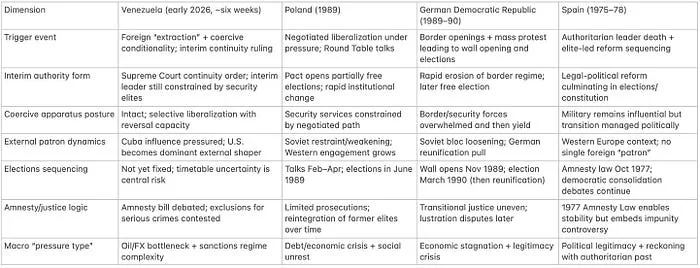
A quick comparative map
The table below summarizes the comparison across political, security, economic, and social dimensions, focusing on early-transition features rather than end states.[61]
From openings to outcomes: risks, scenarios, and the tests ahead
Progress to date
The most defensible progress claim is that Venezuela has moved from a personalized authoritarian apex to a multi-actor interim equilibrium in which at least some reform is being traded for survival, recognition, and economic reopening. This is visible in three domains: (1) a functioning interim chain of command validated by a Supreme Court framework; (2) measurable prisoner-count transparency and partial releases amid an active amnesty debate; and (3) rapid sanctions restructuring that has already lifted production/export capacity and created prospective pathways for investment.[62]
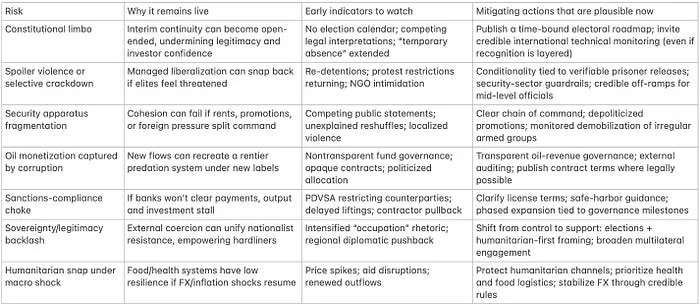
A risk register
The risk landscape is best captured as a transition risk register. Each item is both a hazard and a set of indicators you can track week-to-week in future updates.
Plausible near-term scenarios
Best case (sequenced democratic conversion). The interim coalition uses oil-based stabilization to buy time for institution-building rather than entrenchment: a credible election schedule is announced; political prisoners are released at scale with verifiable lists; and international engagement shifts from coercive supervision to technical support. In this case, OFAC’s contingent contract architecture (GL 49) becomes a lever for phased investment conditioned on measurable governance steps, not merely a funnel for rent reallocation.[70]
Baseline case (managed transition without decisive handover). Liberalization continues selectively, protests tolerated episodically, prisoner releases ongoing but conditional, amnesty narrowed, but core power (especially coercive capacity) remains inside the existing elite network. Oil output and exports improve, moderating FX pressures, yet political uncertainty remains high enough to deter deep capital formation. International stakeholders engage pragmatically, but legitimacy remains layered and contested.[71]
Worst case (spoiler reversal and destabilization). A spoiler dynamic, either hardline consolidation or intra-military fragmentation, reverses liberalization, produces renewed repression and disorder, and triggers a sanctions snapback or financial-channel breakdown. In this scenario, humanitarian conditions deteriorate quickly and outflows accelerate, stressing regional hosts already overextended by the existing displacement crisis.[72]
The tests that will decide whether this is real
In the next phase, the interim’s credibility will turn less on rhetoric than on whether it can produce verifiable movement on a short list of hinges:
· An election calendar: does the interim publish a time-bound electoral roadmap, or does continuity become open-ended? [63]
· Prisoners and coercion: do releases become scale and verifiable, or remain conditional bargaining chips paired with selective re-detentions? [64]
· Security cohesion: does command cohesion translate into professionalization and guardrails, or into tighter surveillance and militia leverage? [65]
· Oil governance: does oil monetization become transparent and auditable, or does it recreate rentier predation under new labels? [66]
· Sanctions normalization: do banks regain enough confidence for payments to clear at speed, or does compliance friction keep output and investment below potential? [67]
· Legitimacy and sovereignty: does the sovereignty backlash harden into a nationalist front that empowers hardliners, or can the transition be reframed as elections-first and humanitarian-first? [68]
Policy and strategic implications
For domestic actors, the central strategic choice is whether to treat oil reopening as a bridge to elections or as a substitute for elections. The interim leadership’s credibility will be judged less by rhetorical reform and more by (a) a published electoral timetable, (b) a transparent prisoner-release and accountability framework, and © early security-sector constraints on arbitrary detention and militia violence. The amnesty debate is a focal point: Spain’s experience shows how amnesty can stabilize democracy-building yet embed long-term legitimacy costs if perceived as blanket impunity; Venezuela’s draft exclusions for serious crimes are therefore not a technical detail but a legitimacy anchor.[73]
For international stakeholders, the key implication is that rule-of-law legitimacy and practical stabilization now conflict unless carefully sequenced. The UN’s position on sovereignty and precedent means many actors will not endorse the extraction method, but they may still support a Venezuelan-led democratic outcome if the transition becomes visibly electoral and rights-respecting. That suggests a diplomatic geometry in which humanitarian support, election assistance, and rights monitoring can be broadened without requiring full political endorsement of the trigger event.[74]
For the U.S. specifically, OFAC’s license design reveals a strategic logic: preserve leverage by controlling payment rails and constraining adversary participation, while offering private-sector pathways that are explicitly contingent and reportable. This can work as a transition scaffold, but it also creates a reputational risk: if Venezuelans experience the framework as extraction of resources or foreign domination, it strengthens hardliners’ nationalist framing and undermines the legitimacy needed for durable stabilization. The practical mitigation is to make the oil framework legible as temporary, auditable, and clearly tied to elections and rights benchmarks rather than open-ended control.[75]
Conclusion
The first six weeks after Maduro’s removal have produced neither a clean break nor a simple restoration. They have produced an interim equilibrium: continuity at the center, openings at the edges, and an external conditionality regime that is rapidly reshaping Venezuela’s economic lifeline.
That equilibrium can still be converted into a time-bound, internationally monitored electoral roadmap with credible security-sector guarantees, or it can harden into a managed transition that stabilizes the economy just enough to postpone decisive political change. The worst-case reversal remains live as long as coercive veto players can snap back liberalization at will.
The next phase will turn on whether the interim can translate oil reopening and partial civic opening into institutions that outlast the bargain: an election calendar, verifiable releases, and security-sector constraints that make reversibility harder. In transitions, the early question is always the same: is this an opening, or a pause? Venezuela’s answer is not yet written.
Erasmus Cromwell-Smith II
February 12th. 2026
Sources and further reading
[1] [11] [12] [32] [49] [51] [61] [62] [63] https://www.reuters.com/world/americas/venezuelas-supreme-court-orders-delcy-rodriguez-become-interim-president-2026-01-04/
[2] [8] [10] [58] “THE CASE FOR VENEZUELA” — by Erasmus Cromwell-Smith
[3] [9] [14] Trump says U.S. will run Venezuela after U.S. captures …
[4] [27] Venezuela’s Orinoco Belt loosening helps lift oil output to 1 million bpd, sources say
[5] [21] [28] [59] https://foropenal.com/balance-de-presos-politicos-en-venezuela-al-09-02-2026-por-foro-penal/
Balance de Presos Políticos en Venezuela al 09/02/2026 por Foro Penal
[6] [13] [31] [44] [68] [74] https://www.ungeneva.org/en/news-media/news/2026/01/114516/us-actions-venezuela-constitute-dangerous-precedent-guterres
[15] https://www.gov.uk/government/news/pm-statement-on-venezuela-3-january-2026
[16] https://www.ft.com/content/55d97298-22f0-4e10-8119-2ab30c759ac6
[17] [39] Venezuela’s Renewed Dollar Auctions Too Tepid to Fortify …
[18] [20] [48] [64] [72] Prominent Venezuelan opposition politician detained hours after release
[19] Venezuelans optimistic after US intervention, poll finds
[22] Venezuela frees 17 political prisoners, opposition …
[23] Venezuela’s lawmakers postpone final debate on amnesty bill to address sticking points
[24] https://www.unhcr.org/us/at/au/emergencies/venezuela-situation
[25] [69] https://www.wfp.org/countries/venezuela-bolivarian-republic
[26] https://apnews.com/article/d5f638acf13f26378c11faa75eeae5e5
[29] Oil Market Report — February 2026 — Analysis
[30] [70] https://ofac.treasury.gov/media/935011/download?inline=
[33] [47] US talks with hardline Venezuelan minister Cabello began …
[34] [46] Venezuela’s interior minister says 100 people died in U.S. …
[35] [41] Cuba says 32 of its citizens killed in Maduro extraction
[36] [57] [75] https://ofac.treasury.gov/media/935016/download?inline=
[37] [60] [67] https://www.reuters.com/business/energy/venezuelas-pdvsa-selling-oil-only-individually-licensed-companies-sources-say-2026-02-13/
[38] Venezuela private sector says fresh flow of dollars could stabilize exchange market, prices
[40] https://www.imf.org/en/countries/ven
[42] Moscow preparing to evacuate Russian tourists from Cuba amid US oil blockade
[43] Cuban doctors’ departure from Venezuela saps Havana of vital revenue
[50] Venezuela defense minister says will resist presence of …
[52] https://www.washingtonpost.com/world/2026/01/05/venezuela-acting-president-delcy-rodriguez/
[54] https://www.bundesregierung.de/breg-en/service/archive/-pan-european-picnic–1662402
[55] https://www.president.pl/archives/bronislaw-komorowski/freedom-day/1989
[56] https://www.boe.es/buscar/act.php?id=BOE-A-1977-24937
[65] https://www.reuters.com/world/americas/whos-actually-running-venezuela-2026-01-13/
[73] Venezuela AG hopes amnesty law will lead to ‘pacified country’, insists prisoners committed crimes